
CONTENTS
- 1. The Client Who Faced a Larceny Complaint

- - The Background of the Theft Case
- - Organizing the Issues in the Case
- 2. The Assistance Process for Responding to the Larceny Complaint
- - Defense Strategy for Larceny Punishment ① | Precise Demonstration of the Scene's Layout and the “Possibility of Mistake”
- - Defense Strategy for Larceny Punishment ② | Submission of Statements and a Written Opinion Demonstrating the Absence of Intent to Commit Theft
- - Defense Strategy for Larceny Punishment ③ | Securing the Victim's Wish Not to Punish
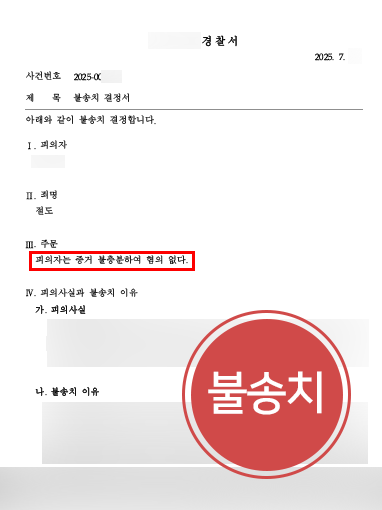
- 3. The Result of Responding to the Larceny Complaint: a “Non-Referral”
- - The Establishment and Level of Punishment of Larceny
- - If You Have Faced a Larceny Complaint
- - Larceny-Related FAQ

1. The Client Who Faced a Larceny Complaint
This is the account of a client who faced a criminal complaint for larceny.
 The Background of the Theft Case
The client visited an apartment complex recycling area to obtain a water container for farming, and found a large vacuum cleaner in a space where garbage bags and discarded home appliances were mixed together.
There were no sticker markings or management notices nearby, and because there was a customary practice at that location of leaving unused appliances or furniture for residents who needed them to take, it was an environment in which the item could reasonably be mistaken for a discarded object.
Accordingly, the client thought the vacuum cleaner was broken waste, loaded it onto a delivery truck, and took it home.
However, the next day the client learned from the local police box that the item was “something the owner had placed outside briefly in order to lend it,” and immediately went to the victim, apologized, and returned it.
Afterward, as the client came to be investigated on a charge of theft, the client requested the assistance of an attorney specializing in criminal law.

Organizing the Issues in the Case
After the legal consultation, the attorney specializing in criminal law analyzed the elements required to establish the offense of larceny and confirmed whether this case was subject to punishment.
The most important standard for determining larceny is whether the client had the intent of unlawful acquisition (the intent to make another person's property one's own) at the time of taking the item.
Accordingly, in this case, the attorney specializing in criminal law organized the following two issues.
② Were there circumstances in the process of taking the item, such as concealment, flight, or disposal, from which the “intent to commit theft” could be inferred?
After analyzing the case centered on these two points, the attorney specializing in criminal law established a strategy to make submissions to the police by combining the facts with the relevant legal principles.


2. The Assistance Process for Responding to the Larceny Complaint

The attorney specializing in criminal law, who took on the response to the larceny complaint, provided assistance by arguing as follows so that the client's grievance could be resolved.
Defense Strategy for Larceny Punishment ① | Precise Demonstration of the Scene's Layout and the “Possibility of Mistake”
The attorney specializing in criminal law first personally inspected the area of the apartment complex recycling site where the incident occurred, and photographed and organized the scene before submitting it to the police.
∙ A confirmation statement establishing that there was a customary practice in that complex of occasionally leaving home appliances and furniture out
∙ The structure in which the vacuum cleaner, left without a volume-rate disposal sticker, was highly likely to be mistaken for “waste”
In addition, citing the following precedent, the attorney emphasized that there were “objective circumstances under which the item could be perceived as a discarded object” and demonstrated the legitimacy of the client's mistaken belief.
Suwon District Court, Judgment of April 20, 2022, Case No. 2022Gojeong192
…
and other factors taken together, the evidence submitted by the prosecutor alone is insufficient to find that the defendant had the intent to commit theft.
Defense Strategy for Larceny Punishment ② | Submission of Statements and a Written Opinion Demonstrating the Absence of Intent to Commit Theft
The most essential among the requirements for establishing larceny is the “intent of unlawful acquisition,” and in order to negate it, the attorney specializing in criminal law organized the direction of the client's statements and prepared a written opinion centered on the following points.
∙ The fact that the purpose was to repair and use it or to utilize it as waste if necessary, and that there was no intent to acquire the vacuum cleaner as an “item of property value”
∙ The fact that the client voluntarily returned the item immediately after being contacted by the police box, which strongly supports the absence of an intent of acquisition
Noting in particular that the circumstances of the voluntary return were highly significant, the attorney specializing in criminal law systematically demonstrated that it was difficult to find that the client had the intent required for larceny.
Defense Strategy for Larceny Punishment ③ | Securing the Victim's Wish Not to Punish
The client had already confirmed that the owner of the vacuum cleaner did not wish for punishment, and the attorney specializing in criminal law formally compiled this and submitted it to the police.
In addition, the client had a prior record of a suspension of indictment for the same type of offense, which raised a concern that the police might regard this as “repeat offending.”
To prevent this, the attorney specializing in criminal law added the following supplementary reasoning.
∙ The fact that the present case arose from a structure in which the possibility of mistake was extremely high, and that there was no repetitive or malicious character whatsoever
Through this, the attorney emphasized that the client had not coveted the item with criminal intent, but that this was merely a misunderstanding arising in the course of ordinary, customary conduct.
3. The Result of Responding to the Larceny Complaint: a “Non-Referral”

As a result of the assistance provided by the attorney specializing in criminal law in responding to the larceny complaint, the police issued a “non-referral” decision regarding the client's larceny charge.
This was thanks to the clear demonstration that there was an objective environment in which the item could be mistaken for waste, and that there were no circumstances from which an intent to commit theft could be inferred.
In addition, the demonstration of the scene's layout and customary practices, the circumstances of the client's conduct, the voluntary return, and the submission of the written opinion operated together to lead to the determination that “it is difficult to find criminal intent.”
The Establishment and Level of Punishment of Larceny
Larceny is established when a person steals another person's property, and there must be an “intent to unlawfully acquire another person's property.”
In other words, if the item was taken with the intent to use it temporarily and return it, larceny is not established.
In the case of larceny, an attempt is also punishable, and in the case of a habitual offender, the punishment may be aggravated by up to one-half of the prescribed sentence.
Level of Punishment
Article 329 of the Criminal Act (Larceny) | Level of Punishment |
A person who steals another person's property | Imprisonment for not more than six years or a fine not exceeding 10 million won |
If You Have Faced a Larceny Complaint
Daeryun Law Firm has many attorneys specializing in criminal law who have handled a wide range of criminal cases, including larceny.
A consultation attorney quickly grasps the issues in the case and immediately assigns a dedicated attorney suited to the type of case, providing systematic assistance with the matter.
From guidance on the direction of statements and matters requiring caution, to accompaniment during the police investigation, the establishment of a strategy and the collection of evidence to prevent the inference of intent, and the preparation of a written opinion for submission to the investigative agency, the firm provides support from multiple angles.
If you are facing difficulties because of a criminal complaint, please feel free at any time to entrust your case to us through a 🔗legal consultation reservation.
Larceny-Related FAQ
A. Immediate return is strong evidence that there was no intent. Q. If I returned the item to the victim right away, can I avoid punishment from a larceny complaint?
However, this alone is not enough to clear the charge, so it is necessary to clearly organize the return process and the intent regarding possession and submit it to the police.
A. Even with a prior record for the same type of offense, if the circumstances and motive of the case are entirely different and the possibility of mistake was high, there are several cases in which a non-referral conclusion was reached without concern for recidivism.Q. I have a prior record, and I have faced a larceny complaint again. Is a non-referral still possible?
However, it must be clearly demonstrated that there was no intent to commit theft.
This content is based on actual case studies of Daeryun Law LLC with some adaptations, and the copyright belongs to our firm.
Unauthorized reproduction, duplication, or distribution and other copyright infringements may result in legal action under applicable laws.