
CONTENTS
- 1. The Client Facing the Risk of Punishment for Theft

- 2. Sentencing Levels for Theft
- - If Caught for Theft, Is There a Possibility of Detention?
- 3. The Criminal Law Attorney Who Took On the Response to Punishment for Theft
- - If a Settlement Is Reached, Will the Sentence Be Substantially Reduced?
- - How Is the Settlement Amount Usually Calculated?
- - Does Submitting a Letter of Apology or a Petition Actually Help?
- 4. Result of the Response to Punishment for Theft
- - After Receiving a Suspension of Indictment, Can One Be Indicted Again?
- - Should I Retain an Attorney Even for Simple Theft?

1. The Client Facing the Risk of Punishment for Theft
This is the account of a client who requested a consultation with this firm, stating that they faced the prospect of punishment for theft.
After doing the grocery shopping at a supermarket, the client used a self-checkout to pay for the items they had purchased.
While doing so, on a momentary impulse, they came to think that a few items might go unnoticed even if not paid for.
Accordingly, the client placed a few low-priced items in the basket without scanning their barcodes and left.
Afterward, as the client tried to leave the supermarket, an employee who had been watching them stopped the client and reported the matter as theft.
As a result, the client, facing the prospect of punishment for theft, visited this firm.

2. Sentencing Levels for Theft
🔗Theft refers to the act of taking another person's property, that is, taking it without permission or infringing on possession.
Article 329 of the Criminal Act provides that a person who steals another person's property shall be punished by imprisonment for not more than 6 years or a fine of not more than 10 million won.
Here, "property" includes everything of economic value, such as money and goods.
For example, secretly taking goods at a convenience store or using company property at work without authorization may also constitute theft.
For theft to be established, the following requirements must be satisfied: ▲the property belongs to another person, ▲there is an intent to unlawfully acquire the property, and ▲possession was actually infringed.
 If Caught for Theft, Is There a Possibility of Detention?
In general, it is rare for a person to be detained immediately in a theft case.
For a detention warrant to be requested, there must be a concern of flight, a possibility of destruction of evidence, or a seriousness such as habitual or special theft.
For example, where the amount of the theft is large or it has been repeated several times, or where it is judged that there is a high likelihood of reoffending due to numerous prior convictions, the possibility of detention increases.
Conversely, if the person is a first-time offender and their identity, such as address and workplace, is clear, the investigation is ordinarily conducted without detention.


3. The Criminal Law Attorney Who Took On the Response to Punishment for Theft
The criminal attorney responded as follows in order to defend against the client's punishment for theft.
2. Emphasizing that the client was a first-time offender and had committed the offense impulsively
3. Providing guidelines for the letter of reflection and petition, and reviewing and submitting the drafts
4. Emphasizing that the client was raising a young child alone, so that if an actual sentence were imposed, the child could be placed in serious danger
If a Settlement Is Reached, Will the Sentence Be Substantially Reduced?
Theft is a property crime, so recovery of the harm operates as a very important factor in sentencing.
If a settlement is reached, there arises a possibility that the prosecutor will issue a disposition of suspension of indictment, allowing the criminal record itself to be avoided, and even where an indictment is brought, there arises a possibility that the matter will conclude with a fine or a suspended sentence.
How Is the Settlement Amount Usually Calculated?
A settlement amount in a theft case takes into account not only the amount of harm (the price of the stolen item) but also the mental suffering experienced by the victim and the inconvenience arising from the incident (such as a stoppage of business).
For this reason, an amount far greater than the amount of harm is often demanded, but with the help of an attorney with extensive experience in handling settlements, there is a possibility of concluding the payment of a settlement amount at a reasonable level.
Does Submitting a Letter of Apology or a Petition Actually Help?
A letter of apology, a petition, and the like are in practice often taken into account as sentencing materials.
A letter of apology should not simply repeat that one did wrong, but should contain specific reflection and a plan to prevent reoffending.
In addition, a petition should preferably contain content regarding the client's efforts to prevent reoffending and the client's ordinary conduct in society.
However, since sincerity matters more than formality, it is advisable to submit such documents steadily at each stage of the investigation with sincere content.
With the help of an attorney, you may receive guidelines for a letter of apology and a petition.
4. Result of the Response to Punishment for Theft

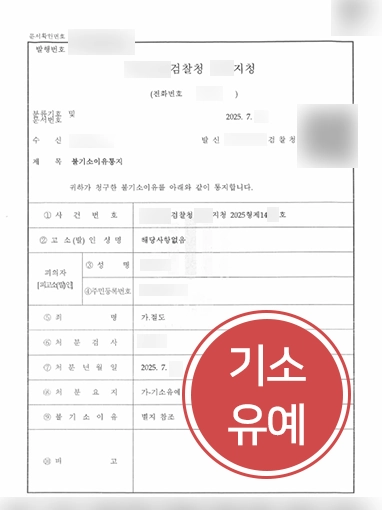
As a result of the response by the attorney specializing in criminal cases to defend the client against punishment for theft, the prosecutors' office issued a disposition of suspension of indictment in the client's case.
Suspension of indictment refers to a disposition in which the prosecutor recognizes the suspect's suspicion yet, in consideration of various circumstances, concludes the case without referring it to a criminal trial.
In other words, it is a system under which, although the crime is legally established and the evidence is also sufficient, leniency is granted without an indictment in consideration of the suspect's age, character, motive for the offense, whether the harm has been recovered, the presence of a prior record, and the like.
With the assistance of the attorney specializing in criminal cases, the client was able to avoid not only punishment for theft but also a criminal record.
After Receiving a Suspension of Indictment, Can One Be Indicted Again?
Once a suspension of indictment becomes final, the same case will not be prosecuted again.
However, if a crime of the same kind occurs, the record of the suspension of indictment may operate unfavorably.
In simple terms, a suspension of indictment carries a strong meaning of leniency limited to this occasion, and if the person commits a crime of the same kind again, the prosecution, taking into account that the person reoffended despite having received a suspension of indictment, may no longer grant leniency, and the likelihood of an actual sentence or a heavy sentence increases.
Should I Retain an Attorney Even for Simple Theft?
Even mere petty theft can leave a criminal record that may significantly affect employment and social life, and an actual custodial sentence may even be imposed.
In addition, because an incorrect statement during the police or prosecution investigation may work to your disadvantage, an early response is important.
Therefore, if you are facing the risk of punishment for theft, a consultation with an attorney can be regarded as, in practical terms, an indispensable safeguard.
During the settlement process, the victim may demand an excessive amount, but when an attorney is involved, negotiation can be conducted within a reasonable range.
Moreover, an incorrect statement during the police or prosecution investigation may remain as an unfavorable circumstance and affect the sentence, and an attorney strategically conducts an advance simulation of the statement to create the possibility of a reduced sentence.
In particular, because a criminal record may significantly affect one’s life as a whole (employment, changing jobs, and the like), even in a case of simple theft, receiving an attorney’s assistance can be far more advantageous.
If you are facing the risk of punishment for theft, please proceed right away with a Daeryun LLC 🔗legal consultation reservation and prepare a response strategy.
This content is based on actual case studies of Daeryun Law LLC with some adaptations, and the copyright belongs to our firm.
Unauthorized reproduction, duplication, or distribution and other copyright infringements may result in legal action under applicable laws.