
CONTENTS
- 1. The Client Implicated in a Fraud Charge

- - The Circumstances of Being Implicated in the Fraud Organization
- 2. The Assistance Provided to Defend Against the Establishment of the Fraud Charge
- - Defense Strategy ① | Reconstructing the Circumstances of the Contact and the Structure of Being Deceived
- - Defense Strategy ② | Analysis and Comparison of the Methods of the Loan Fraud Organization
- - Defense Strategy ③ | Designing the Direction of the Statement in Preparation for the Police Investigation
- 3. The Result of the Fraud Charge Assistance, Early Conclusion by ‘Non-Referral’
- - Level of Punishment for the Crime of Fraud
- - If You Have Been Unjustly Implicated in Fraud
- - FAQ Related to Fraud Charges

1. The Client Implicated in a Fraud Charge
The client, who had received a contact for investigation on a fraud charge, was, in a desperate state of trying to raise money for the client's mother's medical expenses, closer to a victim acting in good faith who had followed instructions believing only the words ‘we will give you a loan.’
 The Circumstances of Being Implicated in the Fraud Organization
The client had just completed individual rehabilitation and, due to a low credit score, was unable to obtain a loan.
As it was urgent for the client to raise medical expenses for the client's ailing mother, the client left an inquiry post on a lawful loan brokerage site.
At this time, the client reportedly received a contact from an unknown person saying, “If you help with the work, you can receive a loan.”
The client mistook this for a normal loan procedure and, as instructed, transferred the money deposited into the client's own bank account to designated accounts in installments, the client reportedly said.
Then the client came to notice the following circumstances.
• The client sensed something was wrong and inquired, but only received the repeated answer “There is no problem, just proceed”
• After that, the client received a contact from the police regarding a fraud charge
In effect, the client was deceived by a fraud organization that had approached using a loan as bait and was used for a ‘money-laundering transfer act.’



2. The Assistance Provided to Defend Against the Establishment of the Fraud Charge

For the client who was charged with fraud, Daeryun's criminal specialist attorney sought to prove that the client was “not an accomplice of the fraud organization but rather a victim who had been deceived,” and composed the following strategy.
Defense Strategy ① | Reconstructing the Circumstances of the Contact and the Structure of Being Deceived
In a fraud case, the key is whether intent (the intent to participate in the fraud) existed.
For this reason, the criminal specialist attorney structured the client's good faith and innocence in the following sequence.
• The urgent circumstance of raising the mother's medical expenses
• The contact that began with an inquiry through a lawful loan site
• The cooperation that took place without understanding the meaning of ‘sales work’
• The circumstance of receiving only the answer “there is no problem” despite repeated inquiries about lawfulness
• The fact that, after discovering the 1-won deposit warning messages, the client first confirmed an intention to stop
This structure strongly supported the point that “the client was a victim who had been deceived and had no intent to act as an accomplice at all.”
Defense Strategy ② | Analysis and Comparison of the Methods of the Loan Fraud Organization
Through the written opinion, the criminal specialist attorney clearly presented that ‘sales work’ is a typical money-laundering method of loan fraud organizations.
Category | Typical Method of the Fraud Organization | The Client's Actual Situation |
Method of Approach | Illegal loan text messages and calls | Contact came after an inquiry on a lawful loan site |
Content of Instructions | Use of technical terms such as ‘sales work’ | Did not know the meaning but mistook it for professional work |
Use of the Account | Multiple transfers after deposit of the victim's money | Same pattern of money deposit → installment transfers to n persons |
Point of Stopping | Continues until caught | Became suspicious after seeing the warning deposit message and inquired |
Through this, the attorney emphasized that the client presented an entirely different pattern from an intentional participant in fraud.
Defense Strategy ③ | Designing the Direction of the Statement in Preparation for the Police Investigation
Because, looking only at the flow of money, the investigative authorities could mistake the client for an ‘accomplice,’ the criminal specialist attorney prepared the following strategy at the investigation stage.
▷ Organizing objective materials, such as transfer records, KakaoTalk conversations, and call recordings, showing that no monetary benefit accrued to the client
▷ Correcting in advance any expression that could be interpreted as ‘there was intent,’ thereby clearly reinforcing the logic of the absence of intent and benefit
This design of the statement prevented the one-sided judgment that “money came into the account, so the person is an accomplice,” and ensured the point that the client was merely a victim simply drawn into the structure of the fraud crime was accurately recognized by the investigative authorities.
3. The Result of the Fraud Charge Assistance, Early Conclusion by ‘Non-Referral’

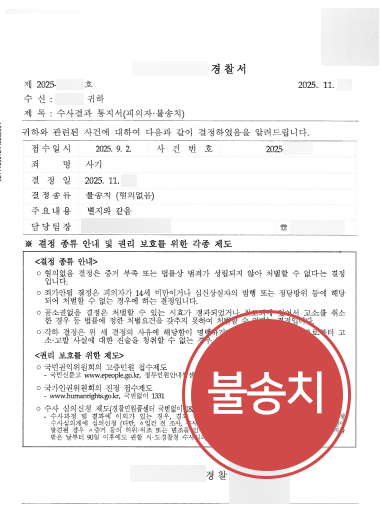
After reviewing the written opinion and materials on the fraud charge, the investigative authorities reached a conclusion of ‘non-referral (no suspicion of crime)’ on the client's case for the following reasons.
• The repeated confirmations of lawfulness and the content of the inquiries were consistent
• There was a high possibility that the suspect was a victim who had been deceived
• There were no circumstances of a link with members of the fraud organization or of obtaining benefit
In response, the client expressed great relief, saying, “I was afraid I would be branded as someone involved with a fraud organization when I only meant to look into a loan, and I am so relieved to receive this result.”
Level of Punishment for the Crime of Fraud
The crime of fraud is established when a person deceives another to obtain a pecuniary benefit, and the statutory penalty is as follows.
Legal Provision | Level of Punishment |
Article 347 of the Criminal Act (amended on December 23, 2025) | Imprisonment for not more than 20 years or a fine of not more than 50 million won |
If You Have Been Unjustly Implicated in Fraud
Drawing on its experience handling cases involving fraud, voice phishing, and implication in loan fraud, Daeryun LLC provides systematic defense assistance.
Through an initial consultation, a consultation attorney closely grasps the facts of the case, and afterward a dedicated case attorney suited to the case type is assigned to provide meticulous, step-by-step assistance.
In particular, for clients facing a police investigation, the firm systematically supports the entire process, from designing the direction of the statement and personally accompanying the investigation to submitting the written opinion.
If you have been unjustly implicated in a fraud organization, please feel free to entrust your case at any time through the 🔗legal consultation reservation.
FAQ Related to Fraud Charges
A. If it is proven that you are a victim who was deceived according to the methods commonly used by fraud organizations, you can avoid punishment.Q. I received a contact for investigation on a fraud charge. Will I be punished even if I was deceived by a fraud organization?
A. It can be proven through the ‘good faith and consistency’ of the conduct as a whole, such as the channel of contact, the content of the inquiries, whether lawfulness was confirmed, whether any benefit was obtained, and the conduct after confirming the warning messages.Q. In a fraud charge case, how is the ‘absence of intent’ proven?
See More
This content is based on actual case studies of Daeryun Law LLC with some adaptations, and the copyright belongs to our firm.
Unauthorized reproduction, duplication, or distribution and other copyright infringements may result in legal action under applicable laws.