
CONTENTS
- 1. Actual Sentence for Fraud | Details of the Matter

- 2. Actual Sentence for Fraud | The Concept of the Crime of Fraud
- - Requirements for the Establishment of the Crime of Fraud and the Level of an Actual Sentence
- 3. Actual Sentence for Fraud | Assistance From Daeryun's Attorney Specializing in Criminal Cases
- - Proof of the Absence of the Intent of Deception
- - Argument as to the Existence of the Ability to Repay and Performance in Good Faith
- - Proof of the Absence of Property Damage
- 4. Actual Sentence for Fraud | The Result of the Matter
- - Response Points for an Unjust Risk of an Actual Sentence for Fraud

1. Actual Sentence for Fraud | Details of the Matter

This is the account of clients who sought assistance from our firm's attorneys specializing in criminal cases, stating that they faced the risk of an actual sentence for fraud.
The clients, who were in a business partnership, borrowed money from a credit business operator in order to secure funds when the food business they were running fell into serious difficulty due to the economic downturn.
The clients had steadily repaid the principal and interest in accordance with the agreement, but the credit business operator, having already recovered the principal and substantial interest, demanded additional repayment.
When the clients did not comply, the credit business operator filed a fraud complaint on the basis that they “had obtained money by deception under the guise of a business,” and the clients came to face the risk of an actual sentence for fraud.
The clients asserted that they had in fact been running a business at the time they borrowed the money and had both the intention and the ability to repay, yet were being portrayed as though they had borrowed the money through deception, and they pleaded that this was unjust.
They therefore retained Daeryun's attorneys specializing in criminal cases and undertook a legal response to prove their innocence.
2. Actual Sentence for Fraud | The Concept of the Crime of Fraud
The crime of fraud is a crime of obtaining property or pecuniary benefit by deceiving another and is set out in the Criminal Act.
In other words, it is established where, through ‘deception,’ the other party is caused to fall into a mistake and, as a result, transfers property or provides economic benefit.
The key here is not simply the fact that money was borrowed or a transaction was not carried out, but whether “the other party was deceived through a falsehood” and whether “there was an intent to deceive (the intent of deception).”
Therefore, the mere circumstance of non-performance, that is, a failure to repay money, does not establish the crime of fraud.
The court interprets the elements of the crime of fraud very strictly, and criminal punishment is possible only where the intent of deception is clearly proven.
 Requirements for the Establishment of the Crime of Fraud and the Level of an Actual Sentence
For the crime of fraud to be established, the following requirements must be satisfied.
Category | Requirement | Explanation |
1. Deception | An act of deceiving the other party | Stating a false fact or concealing a fact |
2. Occurrence of a Mistake | The other party falls into a mistake as a result of the deception | Makes an economic decision based on a misapprehension of the facts |
3. Disposition of Property | The other party makes a disposition of property | Payment of money, conclusion of a contract, and similar acts |
4. Property Damage | Damage is incurred by the other party | A decrease in property or legal damage |
5. Causation | Causation among deception, mistake, disposition of property, and damage | The entire course of conduct must follow logically |
If the crime of fraud is recognized, it is punishable under the Criminal Act by imprisonment for up to 20 years or a fine of up to KRW 50 million.
In particular, where the amount is large or the offense is repeated or organized, the likelihood of an actual sentence is very high.
On the other hand, where there is no intent of deception and the matter amounts to no more than non-performance, it is treated not as a criminal punishment but as a civil non-performance of obligation.


3. Actual Sentence for Fraud | Assistance From Daeryun's Attorney Specializing in Criminal Cases
From the early stage of the matter, the attorney specializing in criminal cases broke down the strategy for proving innocence as follows.
Proof of the Absence of the Intent of Deception
In its Judgment of March 26, 1996, Case No. 95Do3034, the Supreme Court held that “if a person had the intention and the ability to repay at the time of borrowing, then even a subsequent failure to repay amounts to no more than a civil non-performance of obligation and does not establish the crime of fraud.”
On the basis of this precedent, the attorney specializing in criminal cases emphasized that, at the time they borrowed the money, the clients had a sufficient business plan and cash flow and had clearly expressed their intention to repay.
In fact, by submitting the business premises lease agreement, transaction records, and tax invoices, the attorney proved that there had been no intent of deception whatsoever.
Argument as to the Existence of the Ability to Repay and Performance in Good Faith
Despite high-interest terms that exceeded the maximum interest rate under the Interest Limitation Act, the clients had steadily repaid the principal and interest for several years.
Citing this point, the attorney specializing in criminal cases emphasized that the clients were not defaulters but faithful repayers.
Proof of the Absence of Property Damage
As a result of obtaining and analyzing the credit business operator's account transfer records, it was revealed that the amount the clients had repaid to the credit business operator actually exceeded the principal by several hundred million won or more.
Accordingly, since it was confirmed that the ‘amount of loss’ claimed by the credit business operator did not exist, and that the credit business operator had in fact obtained illegal interest income, the attorney emphasized that there was no property damage on the part of the credit business operator.
4. Actual Sentence for Fraud | The Result of the Matter

Through the thorough analysis of the materials and the legal arguments of the attorney specializing in criminal cases, the court determined that the ‘intent of deception’ required for the crime of fraud did not exist on the part of the clients.
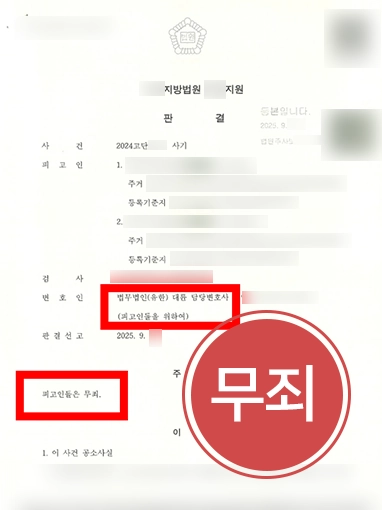
In the end, after a hard-fought legal contest spanning approximately three years, the clients received an acquittal and were able to be completely freed from the risk of an actual sentence for fraud.
Response Points for an Unjust Risk of an Actual Sentence for Fraud
Stage | Response Point | Explanation |
Stage 1 Analysis of the Contents of the Complaint | Review of the specificity of the ‘deception’ asserted by the other party | Confirmation of whether the claim is false or amounts to a civil dispute |
Stage 2 Securing Transaction Records | Securing account transfer records, contracts, and text messages | Submitted as evidence of the actual flow of funds |
Stage 3 Submission of Materials Proving the Intention to Repay | Securing evidence such as a repayment plan and a record of performance | The key to distinguishing non-performance from deception |
Stage 4 Legal Review and Application of Precedent | Argument as to the absence of the intent of deception on the basis of Supreme Court precedent | Logical rebuttal as to whether the requirements for the crime of fraud are satisfied |
Stage 5 Retaining an Attorney at an Early Stage | The contents of statements early in the investigation have a decisive effect | It is essential to establish a statement strategy with an attorney specializing in criminal cases |
The crime of fraud is not a crime that is established simply because money was not repaid.
The intent of deception and property damage must be clearly proven, and where these two elements are lacking, the matter amounts to no more than a civil non-performance of obligation.
As in this matter, there are also many cases in which a credit business operator or a transaction counterparty uses criminal proceedings to apply undue pressure.
In such cases, it is most important to prepare the initial response strategically together with an attorney specializing in criminal cases.
If you find yourself facing the risk of an actual sentence for fraud, you should respond with evidence and legal reasoning rather than with emotion.
An attorney specializing in criminal cases provides assistance to help you be freed from the risk of an actual sentence by clearly establishing the essence of the matter, focusing on the absence of an intent to defraud and the denial of intent.
If you believe you are facing the risk of an actual sentence for fraud, we invite you to proceed with the 🔗Criminal Attorney Legal Consultation Booking.
Daeryun, the ninth-largest law firm in Korea (based on 2025 National Tax Service value-added tax filings), provides legal services grounded in trust.
This content is based on actual case studies of Daeryun Law LLC with some adaptations, and the copyright belongs to our firm.
Unauthorized reproduction, duplication, or distribution and other copyright infringements may result in legal action under applicable laws.