
CONTENTS
- 1. The Client Subject to a Fraud Complaint

- 2. Establishing a Response Strategy for the Fraud Complaint
- - Strategy to Defend Against Punishment for Fraud | ① Demonstrating the Absence of 'Intent'
- - Strategy to Defend Against Punishment for Fraud | ② Rebutting the Assertion of False Statement of the Area
- - Strategy to Defend Against Punishment for Fraud | ③ Rebutting the Assertion of Deception by a Repair Promise
- - Strategy to Defend Against Punishment for Fraud | ④ Analyzing the Tenant's Structure of a 'Strategic Criminal Complaint'
- 3. Outcome of the Response to the Criminal Fraud Complaint, 'Non-Prosecution'
- - The Requirements for Fraud and the Level of Punishment
- - If You Are Subject to a Criminal Complaint
- - FAQ Related to Fraud

1. The Client Subject to a Fraud Complaint
The client who requested a consultation after being subject to a fraud complaint was the representative of a leasing business corporation and had leased a building the client owned to the other party.
However, the other party did not pay the monthly rent for a long period, on the ground that "the repair items among the special terms of the contract were not properly performed."
In response, the client had no choice but to file a lawsuit for delivery of the building and a claim for the return of unjust enrichment.
Then, the other party instead filed a fraud complaint against the client, claiming that at the time of the lease deposit contract the client had "stated that the leased building's area was larger than it actually was, and had deceived the other party by promising to make repairs."
The client, who was suddenly converted into the status of a suspect, expressed the following fears.
"The content of the complaint is so different from the facts that I do not know how to respond."
As the matter expanded into a criminal case, the client was worried that there would be a major blow to the operation of the company and to personal credit, and immediately requested a criminal fraud consultation.



2. Establishing a Response Strategy for the Fraud Complaint
After consulting with the client who had been subject to the fraud complaint, the criminal attorney who took charge of the case analyzed the structure of the complainant's assertions and systematically designed the defense strategy that the client needed.
In summary, the complainant's assertions were as follows.
▷ The client falsely described the area as larger than the actual area
▷ The client received the deposit on the pretext of a repair promise, without any intention of making repairs
However, these assertions had clear points that could be rebutted in both the facts and the legal principles.

 Strategy to Defend Against Punishment for Fraud | ① Demonstrating the Absence of 'Intent'
Although the client had already known that there was an illegal structure when purchasing the building, the client consistently explained that the building had been used for a long time without any problem, that the risk of demolition had not become immediately apparent, and that the client had planned to pay the enforcement fine if necessary so that there would be no hindrance to the tenant's use.
∙ It was not scheduled for demolition ⇒ It is difficult to find that the client "concealed a material fact restricting use"
∙ The enforcement fine could be paid ⇒ There was effectively no hindrance to the use of the leased property
∙ A key basis for negating the 'intent' element of fraud
In short, the defense actively demonstrated that there was no 'intent to deceive' to gain a benefit by concealing information unfavorable to the complainant.
Strategy to Defend Against Punishment for Fraud | ② Rebutting the Assertion of False Statement of the Area
As to the additional point the complainant raised, namely the assertion that "the client falsely inflated the area in describing it," the defense carefully rebutted it by emphasizing the following points.
▷ At the time of the contract, both parties had consulted based on the same drawings
▷ The complainant also conducted an on-site inspection
▷ The client had no motive to falsely inflate the area to gain a benefit
Through this, the defense emphasized that there was no intent to make a false statement in the first place.
Strategy to Defend Against Punishment for Fraud | ③ Rebutting the Assertion of Deception by a Repair Promise
The client had actually carried out repairs, and the defense organized, with supporting materials, the point that the level demanded by the tenant was close to "a full remodeling to the level of a new building."
: Completed repairs to a usable condition
∙ The complainant's demand
: Large-scale repairs to the level of a new building
∙ Essence of the dispute
: A difference of civil opinion regarding the 'scope of repairs'
Accordingly, the defense was able to clearly establish that the dispute concerned whether there had been a default under civil law, and that it was not a structure of criminal deception in which the client approached the matter intending to deceive, without any intention of making repairs.
See More
Strategy to Defend Against Punishment for Fraud | ④ Analyzing the Tenant's Structure of a 'Strategic Criminal Complaint'
The other party, while failing to pay the rent three or more times without a legitimate reason, nonetheless filed the criminal complaint, asserting as follows.
∙ Assertion of failure to disclose the illegal structure
∙ Assertion of a false statement of the area
Accordingly, the criminal law specialist attorney emphasized that the complainant's conduct was a typical method of pressuring a civil dispute through a criminal complaint.
In addition, the criminal law specialist attorney emphasized that the client's conduct could not constitute fraud.
∙ There was no 'intent to obtain a pecuniary benefit'
∙ Emphasized that this was within the domain of a 'civil dispute'
∙ Explained the structure in which the tenant responded with a criminal complaint after failing to pay the rent
3. Outcome of the Response to the Criminal Fraud Complaint, 'Non-Prosecution'

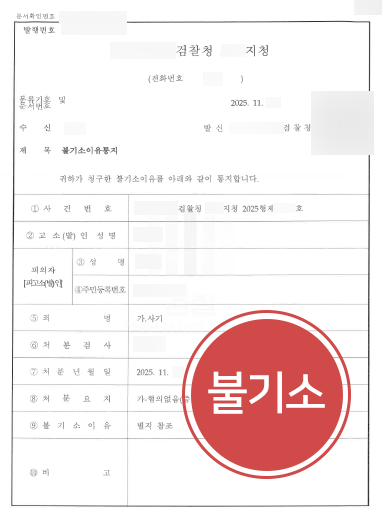
After comprehensively reviewing the written opinion, the materials, and the structured chronology submitted in response to the criminal fraud complaint, the investigative authority issued a 'non-prosecution disposition' for the following reasons.
∙ There was no intent regarding the false statement of the area and no motive to obtain a benefit
∙ The repair promise was not made for the purpose of deception but was within the domain of a civil dispute
∙ The failure to disclose the illegal structure was difficult to regard as 'fraudulent deception'
∙ The overall structure of the case corresponded to a civil dispute rather than a criminal one
Upon receiving notice of the non-prosecution disposition, the client expressed deep relief, saying, "I could not sleep at night out of fear that this case would shake the company and my entire livelihood."
The Requirements for Fraud and the Level of Punishment
Fraud is a crime of deceiving another person to obtain a pecuniary benefit.
For fraud to be established, the following constituent elements must be satisfied.
∙ A disposition by the victim resulting from the deception
∙ The occurrence of pecuniary harm
∙ Intent and an intention to obtain a benefit
The determination of fraud mainly varies depending on whether intent and a structure of deception are recognized.
Level of Punishment
Legal Provision | Level of Punishment |
Article 347 of the Criminal Act (amended on December 23, 2025) | Imprisonment for not more than 20 years or a fine not exceeding 50 million won |
If You Are Subject to a Criminal Complaint
In a criminal fraud complaint case, the initial response varies greatly depending on the intent of the party, whether there was deception, whether civil and criminal matters are proceeding, and the structuring of the materials.
Daeryun Law Firm, based on the facts identified through a thorough consultation with the client, designs the direction of statements and constructs the logic to negate intent.
Thereafter, through systematic assistance such as accompanying the client to police questioning and structuring written opinions and materials, the firm works to resolve the client's wrongful situation.
If you are experiencing difficulties due to a wrongful criminal fraud complaint, please feel free to entrust your case through a 🔗legal consultation reservation at any time.
FAQ Related to Fraud
A. Because fraud requires the 'intent to deceive' to be proven, it is difficult for criminal liability to be recognized merely on the basis of a difference in contract interpretation or a dispute over the scope of repairs.Q. I was subject to a criminal fraud complaint during a lease dispute. Is there really a possibility of criminal punishment?
A. If you are a suspect, advance preparation is essential. Q. I was subject to a criminal fraud complaint. What should I prepare before questioning?
By analyzing the complainant's assertions, rebutting them, and structuring the flow of the case through consistent statements and supporting evidence, you can respond effectively to unfavorable questions during questioning.
Related News
This content is based on actual case studies of Daeryun Law LLC with some adaptations, and the copyright belongs to our firm.
Unauthorized reproduction, duplication, or distribution and other copyright infringements may result in legal action under applicable laws.