
CONTENTS
- 1. Details of the Wastes Control Act Case

- - Assistance Provided by the Daeryun Corporate Attorney
- 2. Result of the Wastes Control Act Case
- 3. Explanation of the Wastes Control Act and Matters Companies Should Note
- - Administrative Sanctions for a Violation of the Wastes Control Act
- 4. Methods of Responding to Administrative Sanctions for a Violation of the Wastes Control Act
- - The Law Firm Daeryun's One-Stop Response Assistance

1. Details of the Wastes Control Act Case
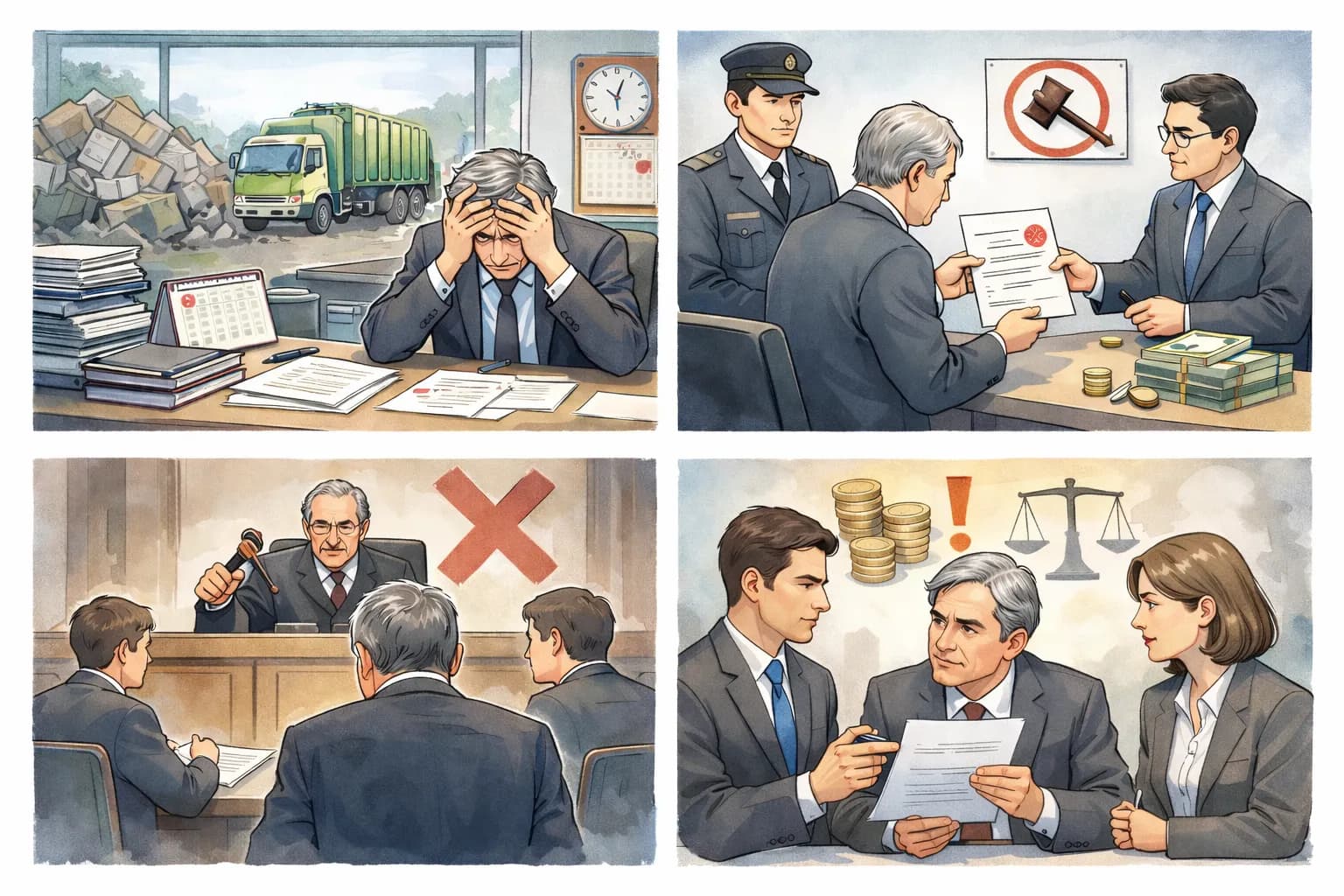
This is the story of a client who came to this firm's corporate attorney stating that he had received a penalty surcharge disposition for a violation of the Wastes Control Act.
The client was the representative of a company that, having obtained a permit for an intermediate waste-disposal business, operated an intermediate waste-disposal business centered on bulky waste.
Under the Wastes Control Act, a waste-treatment business operator must periodically report and obtain confirmation of suitability for its waste-management vehicles, but the client temporarily missed the reporting deadline in the course of handling numerous administrative tasks at the same time.
In response, the competent district office regarded the client's conduct as a violation of the Wastes Control Act and imposed a penalty surcharge in lieu of a three-month business suspension.
The client, judging the penalty surcharge disposition to be excessive, filed an administrative lawsuit but lost at the first instance and requested the assistance of a corporate attorney at the law firm Daeryun.
 Assistance Provided by the Daeryun Corporate Attorney
The corporate attorney collaborated with an administrative law attorney to assist the client in the case as follows.
1. Concentrated Assertion of the Illegality of Failing to Consider the Grounds for Mitigation under the Wastes Control Act
The Daeryun corporate attorney first established as the core issue the fact that the head of the district office had failed to consider at all the grounds for mitigation specified in the Wastes Control Act during the disposition process.
According to Article 83(2) of the Enforcement Rule of the Wastes Control Act, in the following cases, an administrative disposition may be mitigated within the scope of one-half of the business suspension period.
- Where the degree of the violation is minor, and
- Where there is no environmental pollution, or it is so slight that it has not affected human health
- Where the violation was due to an unavoidable cause rather than intent, and prompt follow-up measures were taken
In this matter, the client did not intentionally evade the reporting procedure under the Wastes Control Act but merely omitted it temporarily due to inexperience in administrative work, and no environmental pollution or harm to residents arose from the client's conduct.
In particular, by presenting a precedent ruling in which, in a separate case seeking revocation of another penalty surcharge imposition against the client's company, the administrative appeals commission had determined that "bulky waste has a low possibility of generating pollution in the course of collection and transport," the attorney asserted that this case was likewise a mere procedural violation with no substantial risk.
2. Active Dispute over the Violation of the Penalty Surcharge Calculation Standard under the Wastes Control Act
In addition, the Daeryun corporate attorney focused on disputing the fact that the revenue of the client's company had been overstated in the course of calculating the penalty surcharge.
According to Article 28(1) of the Wastes Control Act and Article 11(1) of the Enforcement Decree of the Wastes Control Act, a penalty surcharge in lieu of a business suspension must be calculated based solely on the average annual revenue arising from the "relevant waste-treatment business" subject to the business suspension.
However, even though the business subject to the suspension was the intermediate waste-disposal business, the district office applied an unlawful method of calculating the penalty surcharge based on the entire revenue of the client's company.
In response, Daeryun systematically organized the following points and asserted at the appellate level that this penalty surcharge disposition was unlawful in both its legal basis and its calculation structure.
- Identification of the business type subject to the business suspension
- Standard for separating revenue by business type
- Violation of the principles of proportionality and equality in calculating the penalty surcharge
2. Result of the Wastes Control Act Case
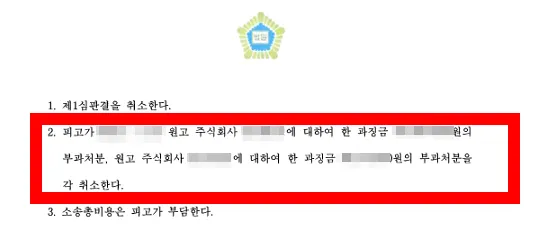
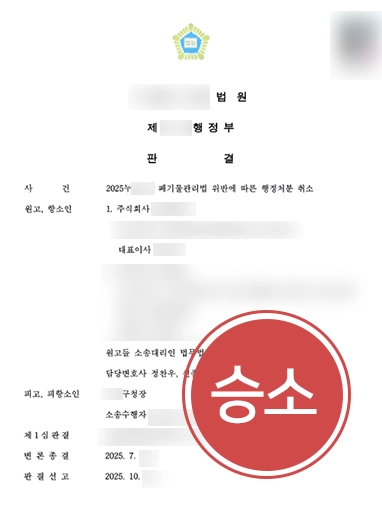
As a result, the appellate court revoked the first-instance judgment and rendered a judgment fully revoking the penalty surcharge disposition of approximately 700 million won imposed on the client's company for the violation of the Wastes Control Act.
This was the result of recognizing the substantial application of the mitigation provisions under the Wastes Control Act, a strict legal interpretation of the penalty surcharge calculation standard, and the illegality of an excessive sanction affecting corporate management, an outcome made possible by the strategic assistance of the law firm Daeryun's corporate attorney.


3. Explanation of the Wastes Control Act and Matters Companies Should Note
The Wastes Control Act is a law that strictly regulates the entire process of permitting, operating, and following up on a waste-treatment business, for the purpose of the proper treatment of waste and the protection of the environment.
In particular, even after obtaining a permit, an intermediate waste-disposal business operator bears ongoing management obligations such as compliance with waste-treatment standards, maintenance of facilities and equipment, vehicle reporting and confirmation of suitability, and periodic administrative reporting.
From a company's perspective, even without intent, a mere omission of an administrative procedure can result in a serious sanction such as a business suspension or a penalty surcharge, so even simple administrative work requires the establishment of a systematic management system and a legal review.
Administrative Sanctions for a Violation of the Wastes Control Act
The principal administrative sanctions that may be imposed for a violation of the Wastes Control Act are as follows.
- Business Suspension: A disposition prohibiting the operation of the waste-treatment business itself for a certain period, which can have a critical effect on corporate revenue and business relationships.
- Penalty Surcharge: A monetary sanction imposed in lieu of a business suspension, which must strictly follow the calculation standard set by statute, and an issue of illegality arises in the case of overcalculation. Under the Wastes Control Act, a penalty surcharge in lieu of a business suspension may be imposed within a range not exceeding the amount obtained by multiplying revenue by 5/100.
- Penalty Surcharge in Lieu of a Business Suspension: Although it is imposed selectively in consideration of the social and economic ripple effects of a business suspension, it has the same sanction character as a business suspension, so it becomes the subject of a legal dispute.
4. Methods of Responding to Administrative Sanctions for a Violation of the Wastes Control Act
Category | Response Strategy | Key Point |
Pre-Disposition Stage | Actively explain the grounds for mitigation | Prove minor nature, absence of fault, and absence of environmental pollution |
Penalty Surcharge Calculation | Review the revenue calculation standard | Assert limitation to the business type subject to suspension |
After the Disposition | Administrative appeal and administrative litigation | Assert violation of the principles of proportionality and equality |
Appellate-Level Response | Use precedents and prior rulings | Comparative argument of identical and similar matters |
The Law Firm Daeryun's One-Stop Response Assistance

The law firm Daeryun provides one-stop support for Wastes Control Act violation cases, from the initial response to the conclusion of the case, through the establishment of a response strategy to administrative dispositions by corporate attorneys and administrative law attorneys.
If you have received a business suspension or a penalty surcharge disposition for a violation of the Wastes Control Act, reviewing the possibility of legal mitigation or revocation is the first step in protecting your company.
Daeryun establishes a strategic response strategy that takes into account the company's business continuity and management stability.
If you are in a situation that requires legal assistance related to the Wastes Control Act, we encourage you to make a 🔗Legal Consultation Appointment with Daeryun, the ninth-ranked law firm in the Republic of Korea (based on 2025 National Tax Service value-added tax filings).
This content is based on actual case studies of Daeryun Law LLC with some adaptations, and the copyright belongs to our firm.
Unauthorized reproduction, duplication, or distribution and other copyright infringements may result in legal action under applicable laws.