
CONTENTS
- 1. Stalking Case | The Client Who Came to a Criminal Defense Attorney

- - Background of the Case
- - Was the Client's Conduct Also a Violation of the Stalking Act?
- 2. Stalking Case | The Criminal Defense Attorney's Response
- - Organizing the Facts Regarding the Client's Conduct
- - Emphasizing the Client's Remorseful Attitude
- - Conveying the Settlement with the Victim and Her Wish Not to Have the Offender Punished
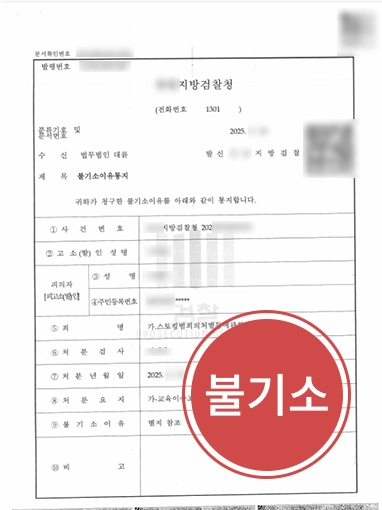
- - As a Result, a Non-Prosecution Decision
- 3. Stalking Case | If a Response Is Needed
- - Response Strategy
- - If Responding Alone Is Difficult

1. Stalking Case | The Client Who Came to a Criminal Defense Attorney
The account given by the client who requested a consultation regarding a stalking case is as follows.
 Background of the Case

The client had dated his former partner, Ms. A (hereinafter the victim), for approximately three years before they broke up.
Struggling emotionally after the breakup, the client began contacting the victim under the pretext of gifts and daily necessities he had given her.
At first, he sent text messages stating, “Return the gifts I gave you,” and thereafter he sent the victim hundreds of messages and calls containing statements such as “I miss you” and “Why will you not meet me?”
The victim asserted that she felt fearful because of the client's persistent contact, and she filed a complaint against the client as a suspect in a stalking case.
Having been accused of violating the Act on Punishment of Crime of Stalking, the client requested a consultation with a criminal defense attorney in order to respond.
Was the Client's Conduct Also a Violation of the Stalking Act?
A stalking case involves conduct that, against the other party's will, persistently and repeatedly follows the person and causes mental or physical harm.
Even where there is no intent to harass the other party, as with the client, the offense may be established if its elements are met.
▶Creation of anxiety or fear : Conduct that places psychological pressure on the other party
▶Disregard of an expressed refusal : Conduct that continues despite the other party's clear refusal
Where a violation of the Act on Punishment of Crime of Stalking, that is, the Stalking Act, is established, a person may be subject to imprisonment for not more than three years or a fine not exceeding 30 million won.
In addition, the treatment of a stalking case as a crime not punishable against the victim's will has been abolished, and accordingly prosecution may be brought regardless of the victim's wishes.


2. Stalking Case | The Criminal Defense Attorney's Response
The criminal defense attorney ascertained the facts and then promptly provided assistance.
The criminal defense attorney's assistance was as follows.
Organizing the Facts Regarding the Client's Conduct
Through a thorough consultation with the client, the criminal defense attorney organized the facts, including the point that the victim had moved away without even informing the client of her home address while they were still in a relationship, and the point that she subsequently blocked his contact information when he tried to reach her.
Through this, the attorney emphasized that the conduct was committed impulsively and without any intent by the client, whose judgment had been clouded out of concern for the victim, who had unilaterally ended the relationship without notice.
Emphasizing the Client's Remorseful Attitude
The criminal defense attorney emphasized the point that the client had not anticipated that his conduct would cause the victim to suffer and that he was now fully reflecting on and repenting of his conduct.
Accordingly, the attorney submitted the client's handwritten letter of apology and emphasized his remorseful attitude.
Conveying the Settlement with the Victim and Her Wish Not to Have the Offender Punished
The attorney emphasized the point that the client sincerely apologized to the victim and provided settlement money, that the victim accepted it, and that an amicable settlement was reached.
The criminal defense attorney submitted the victim's formal written statement of her wish not to have the offender punished and urged that it be taken into account in sentencing.
As a Result, a Non-Prosecution Decision
The investigative authorities recognized that the client's conduct had been committed impulsively and that he was sincerely reflecting on the offense after the fact.
In addition, taking into account the written statement of the wish not to have the offender punished submitted by the victim, they determined that there was little need for criminal punishment.
As a result, a non-prosecution decision was rendered in the stalking case, and the client was cleared of the charge of violating the Act on Punishment of Crime of Stalking and was able to return to his daily life.
3. Stalking Case | If a Response Is Needed
If you become implicated in a stalking case, the initial response is more important than anything else.
This is because a violation of the Stalking Act can lead to punishment if the repetitiveness of the conduct or the victim's fear is recognized, even where there was no intent.
In particular, because whether punishment follows can turn on the direction of the early statements and the submission of materials during the investigation, a thorough response is necessary.
Response Strategy
1) Ceasing Further Contact and Eliminating the Possibility of Reoffending
If you become implicated in a stalking case, the first step is to immediately cease all contact and approach.
Because the investigative authorities place importance on whether there is room for reoffending, a response that clearly establishes the absence of any prior record of punishment and the fact that the same conduct has not been repeated is necessary.
2) Organizing the Facts and Presenting an Account Centered on Sentencing Factors
Rather than simply asserting that one has been wronged, it is important to objectively organize the circumstances of the case and the degree of the conduct.
around factors favorable to sentencing, such as whether one is a first-time offender, the impulsive nature of the offense, and the absence of any possibility of reoffending.
3) Sincere Remorse and Apology, and Preparation for the Settlement Process
Because the treatment of a stalking case as a crime not punishable against the victim's will has been abolished, the possibility of punishment remains even where a settlement is reached with the victim.
However, a sincere apology and remorseful attitude, as well as the provision of settlement money or the use of the criminal deposit system, can serve as important factors for consideration at the investigation stage.
If Responding Alone Is Difficult
If preparing such a response on your own is difficult, entrusting the matter to a criminal defense attorney at Daeryun Law Firm is one option to consider.
A criminal defense attorney can review the stalking case as a whole, assess whether the charge is established, and provide a concrete plan for the direction of the statement and the response strategy so that you are not placed at a disadvantage during the investigation.
In addition, where necessary, the attorney can carry out the response across the entire procedure, including the submission of written opinions.
If you require a 🔗consultation reservation with a criminal defense attorney in connection with a stalking case, we encourage you to organize the situation and obtain a consultation at the early stage of the case.
Daeryun is a law firm that provides one-team legal services led by highly experienced attorneys.

This content is based on actual case studies of Daeryun Law LLC with some adaptations, and the copyright belongs to our firm.
Unauthorized reproduction, duplication, or distribution and other copyright infringements may result in legal action under applicable laws.