
CONTENTS
- 1. The Story of a Client at Risk of Punishment for a Violation of the Act on Aggravated Punishment of Specific Crimes

- 2. Assistance Strategy for Responding to the Case of a Violation of the Act on Aggravated Punishment of Specific Crimes
- - Analysis of the Situation at the Time the Vehicle Was Moving and Whether There Was a Hazard, Using Digital Forensics
- - Review of Objective Materials Regarding the Claim of Threatening Contacts
- - Response to the Police Investigation and Advance Organization of the Direction of the Statements
- 3. Result of the Assistance with the Violation of the Act on Aggravated Punishment of Specific Crimes, Obtaining Non-referral
- - A Case in Which a Violation of the Act on Aggravated Punishment of Specific Crimes and a Charge of Intimidation, among Others, Were at Issue Together
- 4. Method of Response When the Charge of Violating the Act on Aggravated Punishment of Specific Crimes Is Applied
- - Matters Reviewed as Important
- - The Direction of the Initial Response Is Important
- - Frequently Asked Questions concerning Violation of the Act on Aggravated Punishment of Specific Crimes

1. The Story of a Client at Risk of Punishment for a Violation of the Act on Aggravated Punishment of Specific Crimes

This is the story of a client who was at risk of punishment for a violation of the Act on Aggravated Punishment of Specific Crimes.
The client experienced continuous conflict over a financial matter in the course of ending a past romantic relationship.
During the relationship, the client had been helping the other party with various financial burdens, such as living expenses, on several occasions, but as the relationship grew distant, the conflict over the financial matter and demands for repayment gradually grew.
Afterward, the other party claimed that the client, while moving in a vehicle, demanded repayment of money and engaged in dangerous conduct that could cause harm to the other party's body, and continued to send threatening contacts and messages that created anxiety on a repeated basis.
In particular, the other party claimed that the client made coercive contact not only with the other party but also with the other party's family, and filed a criminal complaint for several criminal charges, including the charge of violating the Act on Aggravated Punishment of Specific Crimes.
During the investigation, the main issue was whether the conduct that occurred while the vehicle was moving was at the level of a mere dispute or constituted conduct that actually created a driving hazard, and accordingly, the application of the Act on Aggravated Punishment of Specific Crimes was anticipated.
The other party also requested that the client be investigated regarding the contacts made in the course of demanding the return of money.
The client, who suddenly came to be investigated by the police as a suspect in multiple criminal cases including the charge of violating the Act on Aggravated Punishment of Specific Crimes, came to Daeryun Law Firm in order to establish a direction of response.
2. Assistance Strategy for Responding to the Case of a Violation of the Act on Aggravated Punishment of Specific Crimes
In this case, in which the charge of violating the Act on Aggravated Punishment of Specific Crimes was at issue, the criminal attorney prepared a response strategy centered on whether the conduct that occurred while the vehicle was moving actually constituted conduct subject to aggravated punishment under the Act on Aggravated Punishment of Specific Crimes, and on the circumstances of the threatening contacts that the other party claimed.
In particular, because this case involved both the conduct during the operation of the vehicle and the content of the subsequent contacts, and the possibility of applying the Act on Aggravated Punishment of Specific Crimes was anticipated, the process of objectively organizing the situation at the time and the actual flow of the conversation was important.
Accordingly, the criminal attorney established a defense strategy for the client centered on digital evidence analysis, review of the legal principles related to the violation of the Act on Aggravated Punishment of Specific Crimes, and response to the police investigation.
 Analysis of the Situation at the Time the Vehicle Was Moving and Whether There Was a Hazard, Using Digital Forensics
In this case, the key issue was whether the dangerous conduct during the movement of the vehicle that the other party claimed actually constituted the charge of violating the Act on Aggravated Punishment of Specific Crimes.
The other party was claiming that the client, in the course of the movement of the vehicle, demanded repayment of money and engaged in conduct that could cause harm.
Accordingly, the attorney specializing in criminal law comprehensively reviewed the text messages, social media conversation records, and call records submitted by the client, and closely analyzed the situation at the time of the incident in collaboration with this law firm's Digital Forensics Center.
As a result, it could be confirmed that there were some differences between the dangerous situation that the other party claimed and the actual circumstances, and that there were portions in which it was difficult to definitively conclude that there had been an immediate risk of an accident or a direct intent to cause harm in the actual course of operating the vehicle.
In addition, by organizing the flow of the conversation and the background of the conduct at the time the vehicle was moving in chronological order, the attorney prepared a response strategy centered on the point that it was difficult to view the actual background of the case solely as a one-sided threatening situation, as the other party claimed.
Review of Objective Materials Regarding the Claim of Threatening Contacts
The other party was expanding the criminal proceedings against the client by claiming that not only the conduct during the movement of the vehicle but also the subsequent contacts were repeated threatening acts.
Furthermore, the other party claimed that the client continuously sent coercive contacts and messages that created anxiety to the other party and the other party's family.
Accordingly, the criminal attorney objectively analyzed the actual number of contacts, whether the calls were connected, and the content of the messages, based on the statements and materials submitted by the other party.
As a result, although there were circumstances showing that some of the contacts were made in connection with the financial repayment matter, a direct intent to cause harm or circumstances continuously inducing fear at the level the other party claimed were not clearly confirmed from the objective materials.
In addition, the attorney constructed the response logic centered on the point that the threatening messages directed at the family also differed from the actual materials, and provided assistance in the direction of contesting the credibility of the complaint as a whole.
Response to the Police Investigation and Advance Organization of the Direction of the Statements
In a criminal case, the direction and result of the investigation can vary depending on the content of the initial statement, so the response to the police investigation is very important.
In addition, because this case involved both the situation at the time the vehicle was moving and the background of the subsequent contacts, a process of organizing the entire flow of the case was needed so that some expressions or acts would not be interpreted in isolation.
The Daeryun criminal attorney held consultations with the client several times before the investigation, and organized the background of the financial matter, the situation at the time the vehicle was moving, and the actual content of the contacts in chronological order.
The attorney also closely reviewed the portions of the other party's claims that differed from the facts and the expressions that could give rise to misunderstanding, and systematically prepared the anticipated questions and the direction of the answers.
Based on this, the attorney attended the police investigation, corrected any improper pressure or the direction of the statements, and reviewed the suspect interrogation record.
The attorney assisted the client in maintaining a consistent statement centered on the facts rather than responding emotionally during the investigation, and led the investigative agency to be able to review the background of the case more comprehensively.
3. Result of the Assistance with the Violation of the Act on Aggravated Punishment of Specific Crimes, Obtaining Non-referral
Daeryun analyzed the situation at the time the vehicle was moving and the actual circumstances of the contacts, based on objective materials such as the client's statement, text message and call records, and social media conversation materials.
The attorney actively responded, centering on the points that the client's conduct could not be definitively concluded to be a dangerous act intended to actually cause harm, as the other party claimed, and that the subsequent contacts also had an aspect of having been made in the course of the financial repayment matter and the ending of the relationship.
The attorney also demonstrated that an assault on a driver is not established merely by a verbal dispute or an emotional act, but must be judged by comprehensively considering the possibility of an actual driving hazard arising and the degree of the conduct.
In addition, with respect to the repeated threatening contacts and the coercive contacts directed at the family that the other party claimed, the attorney actively argued that, as a result of reviewing them based on objective materials and the actual flow of the conversation, it was difficult to regard them as showing a direct intent to cause harm or circumstances continuously inducing fear.
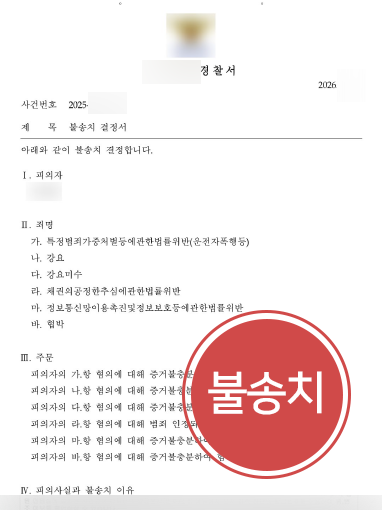
As a result, the investigative agency issued a decision of non-referral for all of the criminal facts that the other party claimed, including the violation of the Act on Aggravated Punishment of Specific Crimes and intimidation.
A Case in Which a Violation of the Act on Aggravated Punishment of Specific Crimes and a Charge of Intimidation, among Others, Were at Issue Together
This case is a matter in which a violation of the Act on Aggravated Punishment of Specific Crimes (assault on a driver) and a charge of intimidation, among others, were at issue together in the course of a financial conflict that arose after the end of a romantic relationship.
In particular, the other party filed a criminal complaint, claiming that the client engaged in dangerous conduct that could cause harm while the vehicle was moving, and that the client subsequently continued with repeated threatening contacts and coercive messages.
During the investigation, the main issue was confirmed to be whether the conduct that occurred while the vehicle was operating was at the level of a mere emotional clash or constituted conduct that could create a driving hazard.
The level of punishment for each related charge is as follows.
Act on Aggravated Punishment, etc. of Specific Crimes, Article 5-10 (Aggravated Punishment for Assault, etc. against a Driver of a Vehicle in Operation)
(2) A person who commits the offense under paragraph (1) and thereby causes injury to another person shall be punished by imprisonment for a definite term of not less than three years, and a person who causes death shall be punished by life imprisonment or by imprisonment for not less than five years.
Criminal Act, Article 283 (Intimidation)
In this case as well, the other party claimed that the client's contacts and conduct at the time the vehicle was moving constituted threatening acts. However, as a result of comprehensively reviewing the actual flow of the conversation, the situation at the time, and the objective materials, there was room for dispute as to whether the charges were established.
As such, even if conduct arises in the course of a financial matter or a relationship conflict, it can expand into several criminal cases depending on the situation, so it is important to systematically organize the facts and the objective materials from the early stage and to confirm the direction of the response.
4. Method of Response When the Charge of Violating the Act on Aggravated Punishment of Specific Crimes Is Applied
Among violations of the Act on Aggravated Punishment of Specific Crimes, the assault or intimidation of a driver of a vehicle that is in operation may be punished more heavily than an ordinary assault or intimidation case.
Conduct that occurs while a vehicle is moving may be investigated as a charge of violating the Act on Aggravated Punishment of Specific Crimes if the operational hazard is recognized, even if no actual accident occurred.
Because a charge is not immediately established merely by a minor verbal dispute or an impulsive act, it is necessary to objectively organize the situation at the time, the possibility of an actual hazard arising, and the background of the conduct in order to respond.
Matters Reviewed as Important
In cases involving a violation of the Act on Aggravated Punishment of Specific Crimes related to assault on a driver, whether there was a possibility of a hazard arising during the actual operation and the degree of the conduct are reviewed as key matters.
Even for the same conduct, the legal judgment may vary depending on the operating status of the vehicle, the situation at the time, and the background of the conduct.
The investigative agency generally determines whether a charge is established by comprehensively considering the factors below.
Factor Reviewed | Main Content Confirmed |
|---|---|
| Whether it was actually in operation |
| Interference with the driver's operation and the possibility of harm |
| Risk of an accident and the surrounding situation |
| Whether it was an impulsive situation or continuous conduct |
| Flow of the conversation and the situation at the scene |
| Whether evidence such as text messages, calls, and video exists |
| Whether the statements of the parties and third parties are consistent |
If only some scenes or expressions are interpreted separately, there is a possibility that the actual situation will be judged differently, so the process of specifically organizing the entire flow of the case is important.
The Direction of the Initial Response Is Important
A case of assault or intimidation against the driver of a moving vehicle may, if treated as a simple altercation and handled carelessly, lead to heavier criminal liability than anticipated.
When only certain scenes or statements regarding conduct that occurred while a vehicle was in motion are emphasized in how they are conveyed, there is also a possibility that the conduct will be interpreted as a dangerous act contrary to the actual intent.
For this reason, at the early investigation stage, the process of organizing in detail, based on objective materials, the circumstances at the time the vehicle was being operated, the flow of the conversation, and the course of the conduct is important.
Daeryun, the ninth-largest law firm in Korea (based on 2025 National Tax Service value-added tax filings), systematically analyzes matters such as the circumstances at the time the vehicle was moving and the differences between the other party's assertions and the objective materials from the initial consultation stage, and it provides legal services tailored to each case.
In addition, when necessary, it collaborates with the Digital Forensics Center to analyze deleted materials and the flow of conversations, and it provides systematic assistance extending to the direction of responding to the investigation so that no unfavorable statements or misunderstandings arise during the police investigation.
If you are facing a police investigation or criminal proceedings on a charge of violating the Act on Aggravated Punishment of Specific Crimes and require legal consultation, you may review the direction of your response through a 🔗legal consultation.
Frequently Asked Questions concerning Violation of the Act on Aggravated Punishment of Specific Crimes
Q. If there was an altercation while a vehicle was in motion, is it always punished as a violation of the Act on Aggravated Punishment of Specific Crimes?
A. No. The offense is not established merely because there was a verbal dispute or physical contact while a vehicle was in motion.
Whether the conduct amounts to assault or intimidation against the driver is determined by comprehensively reviewing factors such as the actual possibility of danger to the vehicle's operation, the degree of the conduct, and the circumstances at the time.
Q. For a charge of violating the Act on Aggravated Punishment of Specific Crimes, does the case end immediately if the victim does not want punishment?
A. No. Depending on the content of the applicable charge, there are cases in which the matter is not concluded by the victim's expression of a desire for no punishment alone.
In particular, for matters related to public safety, such as dangerous conduct while a vehicle is in motion, the investigation may continue after a comprehensive review of the circumstances at the time and the possibility of danger arising.
This content is based on actual case studies of Daeryun Law LLC with some adaptations, and the copyright belongs to our firm.
Unauthorized reproduction, duplication, or distribution and other copyright infringements may result in legal action under applicable laws.