
CONTENTS
- 1. The Circumstances of the First-Time Insult Offender Client's Case

- 2. First-Time Insult Offender: What Is Insult?
- - What Is the Difference Between Insult and Defamation?
- 3. Assistance Provided for the First-Time Insult Offender Client
- - Emphasizing That the Victim Had Refused the First-Time Insult Offender Client's Legitimate Instructions
- - Emphasizing That the Openness Was Low
- - Emphasizing That the Client Was a First-Time Offender
- 4. The First-Time Insult Offender Client, Case Result: "A Minor Fine"

1. The Circumstances of the First-Time Insult Offender Client's Case
This is the story of a client who was a first-time insult offender.
The client asked for a defense against punishment, saying that the client had committed insult, and the attorney listened in detail to the account of the client's case.

The client was working as the sales team leader at a company, and the complainant, A, who had accused the client on a charge of insult, was a member of the client's team.
The client gave A work-related instructions, but A repeatedly refused to comply and made rude remarks to the client, such as “Why do I have to do that?”
Unable to hold back, the client reportedly shouted profanity at A in a loud voice and yelled at A to follow the instructions.
A then accused the client of openly insulting A, and this led to the present case.
2. First-Time Insult Offender: What Is Insult?
This client came to an attorney after being accused of 🔗insult.
Insult refers to the offense of openly insulting a person, where to insult means to disparage and degrade a person.
For insult to be recognized, there must be openness, that is, the possibility of dissemination, and there must be intent in the act.
A person who commits insult may, under the Criminal Act, be punished by imprisonment with or without labor for up to one year or a fine of up to 2 million won.
 What Is the Difference Between Insult and Defamation?
You may be confused about the difference between insult and 🔗defamation.
Defamation refers to openly insulting a person by stating a fact, while insult refers to simply insulting a person without stating any fact.
Insult is usually established through profanity, criticism, curses, and the like, and in addition, the act of insulting a person through a gesture or movement can also be established as insult.
3. Assistance Provided for the First-Time Insult Offender Client
For the first-time insult offender client, the attorney provided assistance as follows.
Emphasizing That the Victim Had Refused the First-Time Insult Offender Client's Legitimate Instructions
As a ground for mitigation, the attorney cited the fact that, regarding the circumstances in which the client had directed profanity at the victim, the victim had refused the client's legitimate instructions.
The victim refused to follow the client's instructions, made rude remarks to the client, and also criticized the client within the office.
The client directed the profanity in this case in the course of trying to correct the victim's behavior.
Emphasizing That the Openness Was Low
As a ground for mitigation, the attorney cited the low degree of openness regarding the client's act of directing profanity at the victim.
The place where this incident occurred was an office, but only the client, the victim, and just two other employees were present.
One of the two employees was resting with their head down on the desk at the time the incident occurred and so did not hear the client's words and conduct, and the other party stated that, although they heard the words and conduct, they did not hear any of the content at all.
The attorney emphasized that it was difficult to find that the client's remarks had openness.
Emphasizing That the Client Was a First-Time Offender
As a ground for mitigation, the attorney cited the fact that the client was a first-time offender with no prior criminal punishment of any kind.
The client emphasized that the client had lived an upstanding life in society, with no criminal punishment and not even any history of police investigation.
4. The First-Time Insult Offender Client, Case Result: "A Minor Fine"

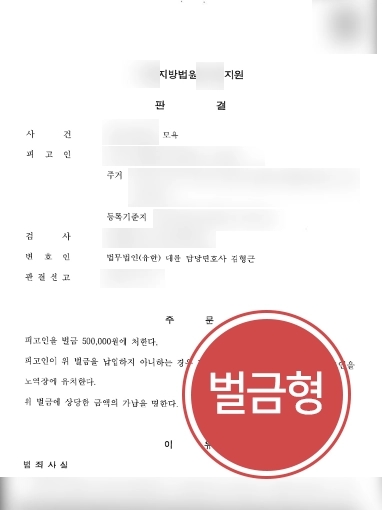
After hearing from the attorney who represented the client, the court imposed a fine of 500,000 won on the client.
The client had hurled profanity at the victim and degraded the victim within the office even though other employees could hear.
In such a case, insult is established and the client could have been heavily punished, yet through the attorney's assistance the client was able to receive a small fine of 500,000 won.
Even a first-time insult offender may, depending on the circumstances, receive a severe punishment of imprisonment.
If you are facing the risk of punishment for insult, as the client in this case was, seeking an attorney's assistance for a defense against punishment is recommended.
Daeryun Law Firm operates offices throughout the country and provides the same quality of service whichever office you visit.
If you need assistance, please visit a nearby Daeryun office and request a consultation.
This content is based on actual case studies of Daeryun Law LLC with some adaptations, and the copyright belongs to our firm.
Unauthorized reproduction, duplication, or distribution and other copyright infringements may result in legal action under applicable laws.