
CONTENTS
- 1. How the Client Came to the Gangnam Attorney Office

- - The Client Who Requested the Assistance of a Gangnam Attorney
- - Laws on the Crime of Destruction of Property, Explained by a Gangnam Attorney
- 2. The Gangnam Attorney Office's Assistance
- - Gangnam Attorney, Arguing That the Crime of Destruction of Property Is Not Committed
- - Gangnam Attorney, Arguing That the Client Removed the Flyer for a Public-Interest Purpose
- - Gangnam Attorney, Arguing That the Client's Act Carried No Criminal Liability
- 3. The Gangnam Attorney Office's Assistance, Result: Non-Prosecution
- - If You Are Looking for a Gangnam Attorney

1. How the Client Came to the Gangnam Attorney Office

The client was accused of the crime of destruction of property after removing an illegal flyer that had been posted on the mirror of an apartment elevator. The client requested the assistance of a Gangnam attorney. An attorney at the Gangnam branch office worked together with an attorney experienced in criminal cases to assist the client.
 The Client Who Requested the Assistance of a Gangnam Attorney
The client was charged with the crime of destruction of property.
While taking the elevator to go home, the client looked into the elevator mirror, wanting to fix their hair.
However, an illegal flyer had been posted on the elevator mirror.
The client removed the flyer and looked into the mirror.
Three months later, the client was accused of the crime of destruction of property for having removed the flyer posted in the elevator.
The client requested the assistance of an attorney at the Gangnam branch office to defend against punishment for the crime of destruction of property.
Laws on the Crime of Destruction of Property, Explained by a Gangnam Attorney
The Gangnam attorney explained the 🔗crime of destruction of property.
The crime of destruction of property
refers to the crime of impairing the utility of another person's property or document by destroying or concealing it or by any other method.
The flyer the client removed was an unauthorized posting.
An unauthorized posting is an advertisement or notice posted without permission in a public place or on a particular building.
※ Penalty for the Crime of Destruction of Property
Criminal Act
▶ Article 366 (Destruction of Property, etc.)
A person who destroys or conceals another person's property, document, or special media records such as electronic records, or impairs their utility by any other method, shall be punished by imprisonment for not more than 3 years or a fine not exceeding 7 million won.
Article 371 (Attempts) An attempt to commit the crimes under Articles 366, 367, and 369 shall be punished.
*Because the level of punishment may differ depending on individual circumstances, please apply for an 🔗attorney legal consultation for an accurate review.
A Gangnam attorney consultation may be conducted online, by telephone, or by an in-person visit.
2. The Gangnam Attorney Office's Assistance
After conducting a thorough consultation with the client at the Gangnam attorney office, the Gangnam attorney made the following arguments.
Gangnam Attorney, Arguing That the Crime of Destruction of Property Is Not Committed
The attorney at the Gangnam attorney office explained that, for the crime of destruction of a document to be committed, the document must have utility value.
The attorney argued that the flyer the client removed was a flyer containing false information that had not even been permitted by the management office, so the crime of destruction of property was not committed.
Gangnam Attorney, Arguing That the Client Removed the Flyer for a Public-Interest Purpose
The reason the client removed the illegal flyer was to relieve residents of the inconvenience in using the elevator mirror.
In other words, the client acted only because they believed that removing the illegal flyer was proper, so neither intent nor unlawfulness is established.
The Gangnam attorney argued that the client's act of removing the flyer from the mirror was a justifiable act and not unlawful, and that this did not constitute the crime of destruction of property and could not be regarded as a crime.
Gangnam Attorney, Arguing That the Client's Act Carried No Criminal Liability
The client was generally aware that removing an item owned by another person could be problematic.
However, the client believed that removing an illegal flyer was permitted under the law.
The attorney at the Gangnam attorney office argued that the client's act carried no possibility of social blame and therefore could not be punished under criminal law.
3. The Gangnam Attorney Office's Assistance, Result: Non-Prosecution
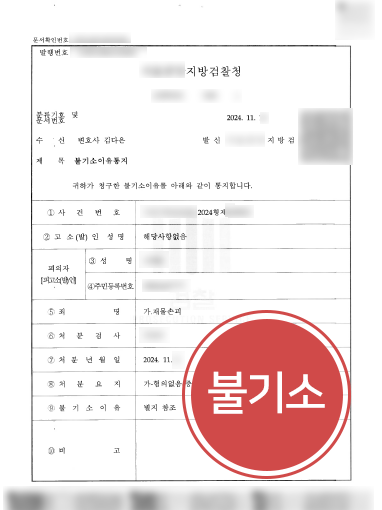
With the assistance of the Gangnam attorney office, the client was able to obtain a non-prosecution disposition. The client once again expressed gratitude to the Gangnam attorney.
If You Are Looking for a Gangnam Attorney
The client was accused of the crime of destruction of property for removing an illegal flyer posted on the mirror of an apartment elevator.
With the assistance of a Gangnam attorney, the client was able to obtain a non-prosecution decision.
After the police conducted supplementary investigation, the client received a non-referral decision from the police, and ultimately, by defending at the prosecution stage, obtained a non-prosecution disposition on the ground of no suspicion of crime.
Even when a person arbitrarily removes a flyer posted without permission, the crime of destruction of property may be committed.
This requires a comprehensive assessment of various circumstances, such as whether intent and unlawfulness are established and whether the act amounts to a justifiable act.
For this reason, it is recommended to promptly retain an attorney from the early stage of the investigation.
At Daeryun, attorneys assist clients in this area.
If you are involved in the crime of destruction of property, please request the assistance of the 🔗Gangnam attorney at the Gangnam attorney office, which offers consultation and prompt response.
This content is based on actual case studies of Daeryun Law LLC with some adaptations, and the copyright belongs to our firm.
Unauthorized reproduction, duplication, or distribution and other copyright infringements may result in legal action under applicable laws.