
CONTENTS
- 1. The Client Who Requested a Defense Against Punishment for Illegal Filming Using a Camera

- - Illegal Filming Using a Camera, What Punishment Does It Carry?
- 2. Defense Strategy for Illegal Filming Using a Camera
- - Defense for Illegal Filming Using a Camera 1. Arguing That There Was No Distribution
- - Defense for Illegal Filming Using a Camera 2. Arguing Efforts Toward Recovery of the Harm
- 3. The Client in the Illegal Filming Using a Camera Case Closes the Case With Suspension of Indictment

1. The Client Who Requested a Defense Against Punishment for Illegal Filming Using a Camera

This is the account of a client who requested a defense against punishment for illegal filming using a camera.
The client had been charged with using the camera on his own mobile phone to film himself having sexual intercourse with the victim, causing sexual desire or a sense of shame, and had been reported.
The attorney devised a defense strategy, emphasizing that the client admitted all of the charges of illegal filming using a camera and showed remorse.
 Illegal Filming Using a Camera, What Punishment Does It Carry?
🔗Illegal filming using a camera refers to the act of using a camera or a similar device with comparable functions to film a person's body that may cause sexual desire or a sense of shame, against the will of the person being filmed.
Whether the body part that was illegally filmed constitutes a ‘body that may cause sexual desire or a sense of shame’ is assessed objectively from the standpoint of ordinary, average people of the same gender and age group as the victim, considering whether it constitutes a body that may cause sexual desire or a sense of shame.
In addition, this is judged concretely, individually, and relatively by comprehensively considering the victim's attire and the degree of exposure, as well as the photographer's intent, the circumstances leading to the filming, the location, angle, and distance of the filming, the image on the original, and whether a particular body part was highlighted.
A person who violates this by illegally filming using a camera or the like is punishable by imprisonment for up to 7 years or a fine of up to 50 million won.
If the crime of illegal filming using a camera or the like is committed habitually, the sentence is aggravated by up to one half, and an attempt at illegal filming using a camera or the like is also punishable.
If a person begins an act closely connected to the offense of illegal filming using a camera or the like, such as pushing a mobile phone equipped with a camera function under the victim's skirt or inserting it into the gap beneath a restroom stall, the person may be regarded as having commenced the commission of illegal filming using a camera or the like.
The Supreme Court has also recognized the commencement of the offense of illegal filming using a camera or the like for acts such as holding a mobile phone equipped with a camera function in hand and crouching toward victims wearing skirts to point it at the inside of a victim's skirt.
According to the statistics on crime occurrence and arrests released by the National Police Agency, there were 5,490 cases of illegal filming using a camera that occurred in 2023, and as such crimes increase, even first-time offenders are finding it difficult to avoid heavy sentences.
In addition, because the act of contacting the victim itself may be interpreted as secondary harm given the nature of sexual offenses, receiving the help of an attorney to arrange a settlement with the victim can be helpful.
2. Defense Strategy for Illegal Filming Using a Camera
To defend against punishment for illegal filming using a camera, the attorney devised a defense strategy centered on the fact that the client admitted all of the alleged facts and showed remorse.
Defense for Illegal Filming Using a Camera 1. Arguing That There Was No Distribution
For the defense of illegal filming using a camera, the attorney argued that, although the client had filmed the victim, he had not distributed or disseminated it to others.
The attorney also emphasized that the client's commission of the offense in this case was not planned but impulsive, and requested that this be taken into account.
Defense for Illegal Filming Using a Camera 2. Arguing Efforts Toward Recovery of the Harm
The attorney argued that the client had begged the victim for forgiveness and had reached a settlement with the victim.
The attorney emphasized that, while it was true that the client had committed an offense matching the alleged facts in this case, the client was sincerely remorseful for his wrongdoing and was making efforts toward the recovery of the victim's harm.
3. The Client in the Illegal Filming Using a Camera Case Closes the Case With Suspension of Indictment
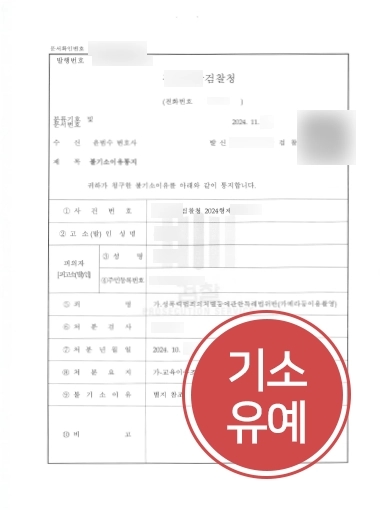
With the attorney's assistance, the client in the illegal filming using a camera case received a decision of suspension of indictment and successfully brought the case to a close.
The client explained, “I was very worried because severe punishment has recently been imposed for illegal filming using a camera. Thanks to the attorney, I believe I succeeded in defending against punishment.”
In the case of illegal filming using a camera, punishment becomes more severe where the offense is committed for profit, and if it was carried out habitually, the sentence may be aggravated by up to twofold.
In addition, because illegal filming using a camera is also a sexual offense, a person may be subject to various security measures upon a guilty verdict.
If you have been implicated in a charge of illegal filming using a camera, responding actively from the early stage of the case can be most helpful.
At Daeryun Law Firm, attorneys with extensive experience in sexual offense cases such as illegal filming using a camera assist from the consultation stage onward to support the early response to a case.
If you are looking for a 🔗attorney recommendation for illegal filming using a camera as described above, please turn to Daeryun Law Firm.
This content is based on actual case studies of Daeryun Law LLC with some adaptations, and the copyright belongs to our firm.
Unauthorized reproduction, duplication, or distribution and other copyright infringements may result in legal action under applicable laws.