
CONTENTS
- 1. The Client Who Reached Out to the Chuncheon Defamation Attorney

- - A Defamation Attorney's Case Notebook
- 2. Defamation Explained by a Chuncheon Defamation Attorney
- - Defamation Punishment Explained by a Defamation Attorney
- - Defamation Attorney Defamation Punishment FAQ
- 3. Defense of the Client Undertaken by a Chuncheon Defamation Attorney
- 4. The Disposition Led by a Chuncheon Defamation Attorney

1. The Client Who Reached Out to the Chuncheon Defamation Attorney
The client who reached out to the Chuncheon Defamation Attorney explained that the client had been criminally charged with defamation.
The client felt the charge was unjust, explaining that the client had merely spoken about the harm the client had suffered, and asked for help in defending against punishment.
The Chuncheon Defamation Attorney set out to ascertain the facts in order to defend the client against punishment, and the content was as follows.
 A Defamation Attorney's Case Notebook
The client reported having been subjected to workplace harassment to the company,
but received notice that the reported conduct did not amount to workplace harassment.
Feeling wronged and bewildered, the client posted large handwritten notices, stating that the client had been subjected to workplace harassment, both outside and inside the company.
The complainant, who saw the notices, confronted the client, asking why the client was doing this when it had been determined not to be workplace harassment,
and the client, in front of other employees, said things to the complainant such as, “You harassed me to the point that I feel like dying.”
The complainant then filed this complaint, claiming that the client had publicly alleged false facts and damaged the complainant's reputation.
2. Defamation Explained by a Chuncheon Defamation Attorney
The client was at risk of being punished for defamation.
Defamation is an offense committed when a person publicly alleges a false fact or a specific fact and damages the reputation of another.
The severity of the punishment varies depending on whether the publicly alleged fact is false or a specific fact.
Many people think that defamation and insult are the same, but each has different elements, so if you are curious, please click below to confirm.
Defamation Punishment Explained by a Defamation Attorney
If the 🔗defamation charge is applied to the client, the client may be punished at the following levels.
① A person who publicly alleges a fact and damages the reputation of another shall be punished by imprisonment with labor for not more than two years, imprisonment without labor, or a fine not exceeding five million won.
② A person who publicly alleges a false fact and damages the reputation of another shall be punished by imprisonment with labor for not more than five years, suspension of qualifications for not more than ten years, or a fine not exceeding ten million won.
If the fact publicly alleged by the client is a specific fact, the client may be punished by imprisonment with labor for not more than two years, imprisonment without labor, or a fine not exceeding five million won, and if it is a false fact, by imprisonment with labor for not more than five years, suspension of qualifications for not more than ten years, or a fine not exceeding ten million won.
Defamation Attorney Defamation Punishment FAQ
Among the punishments for defamation, what are imprisonment without labor and suspension of qualifications?
Unlike imprisonment with labor, imprisonment without labor is a penalty that does not compel hard labor. While hard labor is not compelled, confinement in a correctional facility and deprivation of physical liberty are the same. In addition, suspension of qualifications is one of the penalties affecting reputation, depriving an offender of reputation and qualifications permanently or for a fixed period.
If a person receives imprisonment without labor or suspension of qualifications for defamation, does it not remain on the criminal record?
All penalties of a fine or higher remain on the criminal record. In the Republic of Korea, penalties are ordered as confiscation, minor fine, misdemeanor imprisonment, fine, suspension of qualifications, imprisonment without labor, and imprisonment with labor. Both suspension of qualifications and imprisonment without labor are penalties of a fine or higher, so they remain on the criminal record, and you should take note of this.
3. Defense of the Client Undertaken by a Chuncheon Defamation Attorney
To defend against the client's criminal punishment, the attorney emphasized the following points in the defense.
The notices posted by the client did not identify the complainant.
The content of the notices posted by the client was merely an opinion, not a specific fact.
The client posted the notices not with intent to commit defamation, but to protest the determination of the company's disciplinary committee.
4. The Disposition Led by a Chuncheon Defamation Attorney

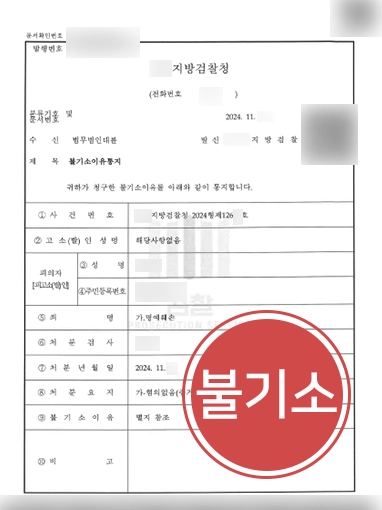
After reviewing the attorney's arguments, the prosecution issued a non-prosecution decision in the client's case, finding no charge.
The client had reported the complainant, who was harassing the client, to the company, but the complainant received no disciplinary action, and the client posted the notices in this case to protest that.
If defamation had been found to be committed by this conduct, the client was at risk of severe punishment, but with the attorney's assistance the client received a non-prosecution decision and was able to conclude the case.
If, like the client in this case, you have been charged with defamation and face the risk of punishment, please obtain a 🔗attorney recommendation from an attorney with extensive experience defending against defamation-related punishment and respond to your case.
This content is based on actual case studies of Daeryun Law LLC with some adaptations, and the copyright belongs to our firm.
Unauthorized reproduction, duplication, or distribution and other copyright infringements may result in legal action under applicable laws.