
CONTENTS
- 1. The Client Seeking to File a Lawsuit Against a Company That Violated the Franchise Business Act

- 2. What the Franchise Business Act Is
- 3. Attorney Who Filed Suit Against a Company in Violation of the Franchise Business Act
- - Franchisor That Violated the Franchise Business Act
- - Liability for Damages of the Franchisor and Interior Contractor Who Violated the Franchise Business Act
- 4. Result of Filing Suit Against a Company in Violation of the Franchise Business Act

1. The Client Seeking to File a Lawsuit Against a Company That Violated the Franchise Business Act
This is the account of a client who requested the assistance of an attorney, stating that a company's violation of the Fair Transactions in Franchise Business Act had caused significant losses.
The client was operating a clothing retail store using the business mark of the defendant company in this case.
In short, the defendant was the representative of a franchise company, and the client was a person who had entered into a franchise contract with that company to operate a store.
When the client went to consult about the franchise, the defendant provided a disclosure document and demanded immediate payment of the franchise fee and training fee, and after the payment was made, stated that an interior contractor would be introduced.
The interior contractor introduced by the defendant did not even draw up a proper contract and merely pressed the client to pay the construction cost without any basis.
The client, fearing that the construction might be disrupted, had no choice but to comply with the contractor's demand.
The contractor said the construction was complete when it was in a state that could hardly be regarded as complete.
When the client pressed the matter and happened to ask whether the contractor had obtained an 'interior construction business license,' the contractor blocked the client's contact.
In addition, the defendant, as the franchise headquarters, was supposed to supply goods to the client, but when the client requested the supply of goods, supplied clothing that had been produced several years earlier.
The client accordingly stated that the defendant bore responsibility to compensate for the losses and that the client would file a lawsuit.
2. What the Franchise Business Act Is
We reviewed the facts of the case for a client who intended to claim damages from a defendant who had violated the Fair Transactions in Franchise Business Act.
Under the Fair Transactions in Franchise Business Act, a franchise business refers to an arrangement in which a franchisee uses the trademark, trade name, and other business marks of a franchisor to sell goods in accordance with set quality standards and business methods.
The franchisor provides support, training, and oversight for the franchisee's management and business operations, and the franchisee pays a franchise fee to the franchisor in return for the use of the business marks and for the support and training related to management and business operations.
The Fair Transactions in Franchise Business Act is the law governing fair transactions in franchise business, and its purpose is to establish a fair trading order in franchise business and to promote the balanced and mutually complementary development of franchisors and franchisees.
3. Attorney Who Filed Suit Against a Company in Violation of the Franchise Business Act
For a client seeking to file suit against a company that violated the Fair Transactions in Franchise Business Act, the attorney provided assistance as follows.
 Franchisor That Violated the Franchise Business Act
(3) If a franchisor has not provided the registered disclosure document and the document on the status of nearby franchises by the method under paragraph (1), or where 14 days have not passed from the date on which the disclosure document, etc. was provided, the franchisor shall not engage in any of the following acts:
1. Receiving a franchise fee from a prospective franchisee
Under the Fair Transactions in Franchise Business Act, a franchisor may not receive a franchise fee where 14 days have not passed from the date on which the disclosure document, etc. was provided.
The defendant in this case, however, demanded that the franchise fee be paid immediately on the day the disclosure document was received, violating the Fair Transactions in Franchise Business Act.
The Fair Transactions in Franchise Business Act provides that if a franchisee requests a refund of the franchise fee within four months from the date of conclusion of the franchise agreement, the franchisor must refund it.
Accordingly, the attorney argued that the defendant had to refund the franchise fee of 16 million won to the client.
Liability for Damages of the Franchisor and Interior Contractor Who Violated the Franchise Business Act
The interior contractor introduced by the franchisor who violated the Fair Transactions in Franchise Business Act was the defendant's husband.
Knowing that her husband did not hold an interior construction business license, the defendant nevertheless introduced him to the client, which made it difficult to operate the store in this case.
The attorney argued that, because the defendant had introduced the interior contractor on her own responsibility, the defendant and the interior contractor were jointly liable to compensate the client for construction costs of 41 million won.
4. Result of Filing Suit Against a Company in Violation of the Franchise Business Act

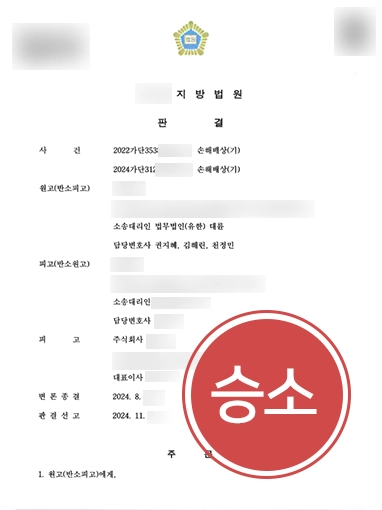
As a result of filing suit against the company that violated the Fair Transactions in Franchise Business Act, the court ruled in the client's favor.
The court issued a judgment ordering the defendant to compensate the client 16 million won in franchise fees and the interior contractor to compensate the client 41 million won in construction costs.
The client had been suffering severe financial and emotional stress because of the unreasonable franchise agreement that violated the Fair Transactions in Franchise Business Act and the poorly performed interior construction.
With the attorney's assistance, the client was able to obtain the desired result in the suit against the defendant who violated the Fair Transactions in Franchise Business Act.
As in this case, resolving a dispute arising from a franchise agreement on one's own can present considerable difficulty.
If needed, consulting an attorney can be helpful in working toward a favorable outcome. 🔗Find an attorney
This content is based on actual case studies of Daeryun Law LLC with some adaptations, and the copyright belongs to our firm.
Unauthorized reproduction, duplication, or distribution and other copyright infringements may result in legal action under applicable laws.