CONTENTS
- 1. The Client's Situation

- 2. Cheongju Law Office: Assistance for the Decision to Pay Service Fees
- - Cheongju Law Office: Arguing That the Service Was Completed
- - Cheongju Law Office: Arguing the Defendant's Default
- 3. Result of the Cheongju Law Office's Assistance: Success in Obtaining a Decision for Full Payment of the Unpaid Service Fees

1. The Client's Situation

This is the account of a client who requested assistance from the Cheongju Law Office.
The client had not received service fees, the compensation for his labor, for several years.
The client eventually decided to obtain payment through litigation and requested assistance from the Cheongju Law Office.
 What Are Service Fees?
Service fees refer to the cost of providing the labor needed for production and consumption at a company.
Service fees are the cost paid in exchange for providing a specific service or work.
Service fees and wages are classified according to the contractual relationship and its nature.
∙Contractual relationship
-Service fees: These have a strong character of transactions between businesses, and the service provider often holds a business registration certificate. Freelancers, subcontractors, and the like fall into this category.
-Wages: These arise from a relationship between an employer and an employee, in which the employee belongs to the employer and provides labor in a continuous and subordinate relationship.
∙Legal protection
-Service fees: Because this is a civil contractual relationship, it is protected according to the conditions stated in the contract. If service fees are not paid, the matter must be resolved through a civil lawsuit or a payment order.
-Wages: These are protected under the Labor Standards Act. In the event of unpaid wages, you can 🔗report the unpaid wages to the labor office or recover them through legal action.
Legal Disputes That Frequently Arise Regarding Service Fees
Legal disputes related to service fees mainly arise in connection with contract terms, payment, work performance, and similar matters.
One representative dispute is the nonpayment of service fees.
This occurs when the client who placed the order does not pay even though the service provider has completed the work.
To resolve this, an application for a payment order or a civil lawsuit must be filed.
Other representative types of legal disputes include ▲disputes over contract terms ▲disputes over the quality and performance of the service ▲payment deadlines and delay interest ▲disputes arising from contract termination ▲subcontracting disputes ▲tax and deduction issues.
2. Cheongju Law Office: Assistance for the Decision to Pay Service Fees
The Cheongju Law Office set out to assist with the decision to pay the client's service fees.
Cheongju Law Office: Arguing That the Service Was Completed
The client had entered into an oral contract with the defendant for the research service at issue in this case.
The client agreed to provide research services in the relevant field to the defendant, and the defendant agreed to pay 20 million won in service fees.
Because the plaintiff and the defendant were acquaintances, they contracted only orally and did not prepare a separate written contract.
To prove that a contract had been concluded between the two, the Cheongju Law Office submitted as evidence the emails, text messages, and similar communications that the two had exchanged regarding the research contract.
Cheongju Law Office: Arguing the Defendant's Default
The Cheongju Law Office argued the defendant's liability for default.
Even now, three years after the contract, the client had demanded the service fees from the defendant on several occasions, but the defendant intentionally failed to pay and caused a default.
The attorney in charge emphasized that the defendant had an obligation to pay the unpaid service fees to the client.


3. Result of the Cheongju Law Office's Assistance: Success in Obtaining a Decision for Full Payment of the Unpaid Service Fees
As a result of the Cheongju Law Office's assistance, the court ruled that the defendant must pay the entire amount of the unpaid service fees.
If you are not being paid your service fees, it is recommended to visit a law office and have a consultation as soon as possible.
This is because service fees are subject to an extinctive prescription, and once that prescription period passes, the right to claim is extinguished.
The extinctive prescription for service fees is divided into five years and three years depending on the nature of the service fees.
Outstanding commercial claims for receivables such as accounts receivable, construction payments, and service fees are subject to a five-year extinctive prescription under the Commercial Act, while receivables such as 🔗price of goods, construction payments, and service fees without an enforcement title are subject to three years.
For this reason, if you are not being paid your service fees, please do not hesitate to request assistance from a law office.
Daeryun Law Firm draws on data from extensive litigation experience to predict the course of a client's case and derive a swift response method.
If you are looking for 🔗an attorney recommendation in the Cheongju area for a situation like the above, please contact the Daeryun Law Firm 🔗Cheongju Attorney office.
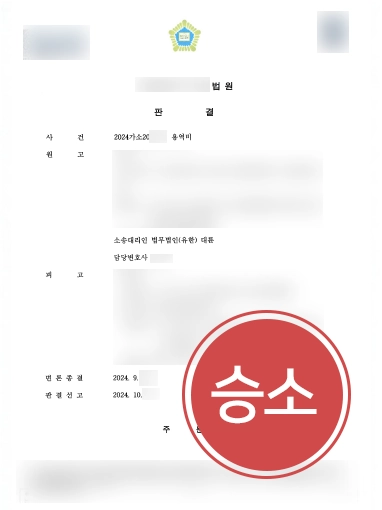
This content is based on actual case studies of Daeryun Law LLC with some adaptations, and the copyright belongs to our firm.
Unauthorized reproduction, duplication, or distribution and other copyright infringements may result in legal action under applicable laws.