
CONTENTS
- 1. What Was the Mutual Assault Client's Case About?

- 2. What Was the Mutual Assault Client's Potential Punishment?
- - What Was the Defense Strategy Against Punishment?
- 3. How Was the Mutual Assault Client Assisted in the Case?
- - Emphasizing That There Was No Intent to Commit Assault
- - Emphasizing That a Judgment Dismissing the Prosecution Should Be Issued
- 4. What Was the Result of the Assistance in the Mutual Assault Client's Case?

1. What Was the Mutual Assault Client's Case About?
This is the account of a client who sought assistance, stating that he faced the risk of criminal punishment for mutual assault.
The client explained that the case arose after he was accused over an assault involving his father, and he explained that he lived with his parents in order to care for his mother, who was in poor health.
He explained that his father had habitually subjected his mother to verbal abuse and assault, and that on the day of the incident his father was likewise using violence against his mother, so the client tried to pull his father away from her.
In this process, when his father resisted forcefully, the client had no choice but to grab his father's body and strike his face, committing assault.
His father also committed assault by picking up a dangerous object and throwing it at the client, after which his father reported the client on a charge of assault against a lineal ascendant, leaving the client facing the risk of punishment for mutual assault.
2. What Was the Mutual Assault Client's Potential Punishment?

The charge against the client, who requested assistance in defending against punishment on the basis of mutual assault, was assault against a lineal ascendant.
The Criminal Act prescribes a higher level of punishment for assault against a lineal ascendant.
Here, a lineal ascendant refers to those in one's ascending line, such as parents, grandparents, and great-grandparents.
(2) When a person commits the offense under paragraph (1) against his or her own or his or her spouse's lineal ascendant, the person shall be punished by imprisonment for not more than 5 years or a fine not exceeding 7 million won.
(3) The offenses under paragraphs (1) and (2) may not be prosecuted against the clearly expressed will of the victim.
In the case of simple assault, the punishment is imprisonment for not more than 2 years, a fine not exceeding 5 million won, detention, or a minor fine. In the case of assault against one's own or one's spouse's lineal ascendant, the punishment is imprisonment for not more than 5 years or a fine not exceeding 7 million won.
 What Was the Defense Strategy Against Punishment?
The client explained that he was unable to obtain a statement of no desire for punishment because his father was ignoring all of his attempts to make contact. In the case of an assault charge, the offense is one that may not be prosecuted against the clearly expressed will of the victim.
Therefore, if one wishes to defend against punishment for an assault charge, reaching a settlement with the victim is the most important strategy.
Accordingly, the attorney decided to assist by handling the settlement on behalf of the client with the client's father, who was the victim in this case.


3. How Was the Mutual Assault Client Assisted in the Case?
The attorney assisted in the case as follows in order to defend the client against punishment.
Emphasizing That There Was No Intent to Commit Assault
The attorney emphasized that the client had no intent to assault his father.
The client's father had always taken a patriarchal attitude and habitually subjected the mother to assault and verbal abuse.
On the day of the incident, the client could not bear to watch his mother being assaulted by his father.
He merely wanted to pull his father away from his mother and had no intent whatsoever to commit assault.
Emphasizing That a Judgment Dismissing the Prosecution Should Be Issued
The attorney emphasized that, because a settlement had been reached with the client's father on the client's behalf, a judgment dismissing the prosecution should be issued.
Under Article 260, paragraph (3) of the Criminal Act, the offense of assault may not be prosecuted against the clearly expressed will of the victim.
Because the client's father had expressed his wish not to have the client punished, a judgment dismissing the prosecution should be issued with respect to the client.
4. What Was the Result of the Assistance in the Mutual Assault Client's Case?
Having heard the attorney's arguments, the court issued a judgment dismissing the prosecution against the client.
The client was in an unfavorable position because the charge was assault against a lineal ascendant and his father was elderly.
However, because of the assistance of an attorney experienced not only in defending against criminal punishment but also in handling settlements with victims, a judgment dismissing the prosecution could be obtained.
As seen above, in cases involving charges such as simple assault and assault against a lineal ascendant, reaching a settlement with the victim is highly significant.
However, victims of assault often refuse to settle, so caution is required. If you seek a referral to an attorney at this firm, we assist by accompanying clients to police questioning, gathering evidence, and handling settlements, achieving favorable results for clients.
If you are facing the risk of punishment on a charge such as assault against a lineal ascendant, like the client in this case, please reach out to our firm for a consultation.
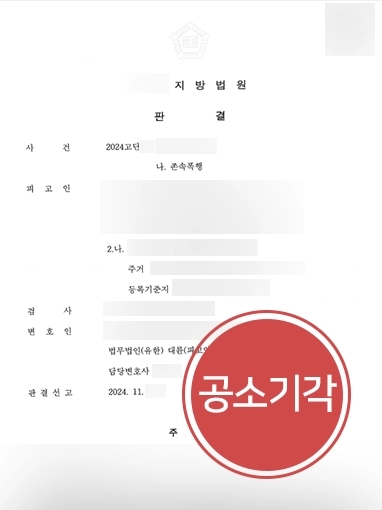
This content is based on actual case studies of Daeryun Law LLC with some adaptations, and the copyright belongs to our firm.
Unauthorized reproduction, duplication, or distribution and other copyright infringements may result in legal action under applicable laws.