
CONTENTS
- 1. The Client Who Reached Out to a Busan Attorney Office

- - The Account of the Client Booked for Defamation
- 2. Defamation Explained by a Busan Attorney Office
- - What Are the Requirements for the Establishment of Defamation?
- - What Is the Sentencing for Defamation?
- 3. The Three Arguments of a Busan Attorney Office
- - Argument ① There Was No Intent to Defame
- - Argument ② There Was No Intent to Disparage
- - Argument ③ Remorse and Follow-Up Measures
- 4. The Prosecution's Decision on the Busan Attorney Office's Arguments
- - If You Are Involved in a Defamation Charge

1. The Client Who Reached Out to a Busan Attorney Office

The client became involved in a defamation case unintentionally, and reached out to a Busan attorney to seek counsel and to defend against punishment.
 The Account of the Client Booked for Defamation
The account of the client, who held a detailed consultation with a Busan attorney, is as follows.
The client, who had entered into an international marriage, had been spending happy days with his wife.
However, after the two had a serious argument over their lifestyles, the relationship between the couple gradually grew distant.
Unable to bear this, the wife left home before long.
To find his wife, the client posted her photograph, name, and other identifying information on social media.
At the same time, he posted a message to the effect that, "My wife betrayed me and left home. This is a premeditated crime."
A few days later, the client was placed in a very bewildering situation upon receiving notice from the investigative authorities that an investigation was beginning on a charge of 🔗defamation / dissemination of false information.
He reached out to a Busan attorney, seeking to defend against punishment with the assistance of an attorney experienced in handling criminal cases over many years.
2. Defamation Explained by a Busan Attorney Office
The client was booked on a charge of defamation, and reached out to a Busan attorney for assistance in defending against punishment.
Defamation is an offense committed when a person publicly alleges a fact or a false fact that damages another person's reputation.
Let us take a detailed look at the requirements for the establishment of defamation, the applicable sentencing, and other matters.
What Are the Requirements for the Establishment of Defamation?
The requirements for the establishment of defamation can be broadly divided into three: publicity, specificity, and intent.
| Publicity | It must be perceivable by an unspecified or large number of people |
| Specificity | The victim must be specifically identifiable |
| Intent | A specific fact must be alleged |
Related Precedent
Even where a person conversed one-on-one in a private chat room of a personal blog after being told by the other party that the secret would be kept, that circumstance alone does not mean that the conversation partner has no possibility of disseminating the contents of the conversation to an unspecified or large number of people. Therefore, there is room to recognize publicity, which is a requirement of defamation (Judgment 2007Do8155).
What Is the Sentencing for Defamation?
Defamation can be broadly divided into defamation by alleging a fact and defamation by alleging a false fact.
A person who publicly alleges a fact and damages another person's reputation may be punished by imprisonment with or without labor for not more than two years or a fine of not more than five million won.
In addition, a person who publicly alleges a false fact and damages another person's reputation may be punished by imprisonment for not more than five years, suspension of qualifications for not more than ten years, or a fine of not more than ten million won.


3. The Three Arguments of a Busan Attorney Office
The Busan attorney analyzed case studies and precedents from many years and established a thorough response strategy.
To obtain a non-prosecution decision from the prosecution, the attorney made the following arguments.
Argument ① There Was No Intent to Defame
The client was in an emotionally unstable state amid conflict with his wife, and was greatly shocked by his wife leaving home.
Posting the message on social media was not done with malicious intent but as an attempt to find his wife.
Accordingly, the attorney emphasized that the client's conduct lacked the intent required for the establishment of defamation.
Argument ② There Was No Intent to Disparage
Disparagement means the act of publicly denigrating a specific person with malicious intent.
The message the client posted did nothing more than describe his personal situation, rather than aiming to criticize his wife.
The attorney emphasized that the message posted on social media was not a specific criticism and that there was no intent to disparage whatsoever.
Argument ③ Remorse and Follow-Up Measures
The client is deeply remorseful for having posted a message of a defamatory nature due to a momentary lapse in judgment.
After posting the message on social media, he recognized that the situation could develop seriously and deleted it immediately.
The attorney emphasized that the client had taken follow-up measures and made efforts to prevent the spread of harm.
4. The Prosecution's Decision on the Busan Attorney Office's Arguments
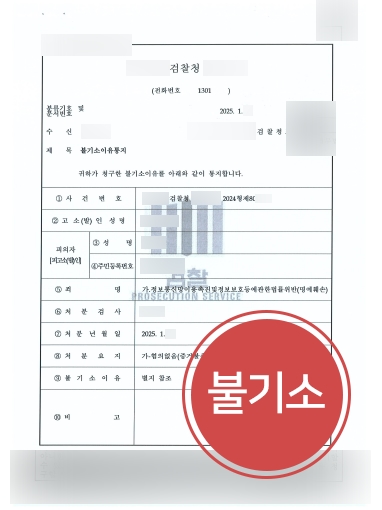
The prosecution accepted the arguments of the Busan attorney office and ultimately issued a non-prosecution decision.
Having brought the case to a swift conclusion through non-prosecution, the client expressed deep gratitude to the Busan attorney.
If You Are Involved in a Defamation Charge
The case above was one in which a client booked on a charge of defamation obtained a non-prosecution decision from the prosecution.
In criminal cases, where securing the critical early window at the outset is very important, consulting an attorney for a more systematic response can be helpful.
At Daeryun Law Firm, 🔗criminal attorneys actively assist clients on the basis of extensive practical experience and expertise.
If you are facing difficulties in a situation similar to the case above, please entrust your case to us through a 🔗legal consultation appointment.
See More
This content is based on actual case studies of Daeryun Law LLC with some adaptations, and the copyright belongs to our firm.
Unauthorized reproduction, duplication, or distribution and other copyright infringements may result in legal action under applicable laws.