
CONTENTS
- 1. The Full Account of the Stalking Client's Case

- 2. What Is the Crime of Stalking?
- 3. What Was the Strategy to Obtain No Suspicion of Crime for the Stalking Client?
- - The Client's Conduct Does Not Constitute the Crime of Stalking
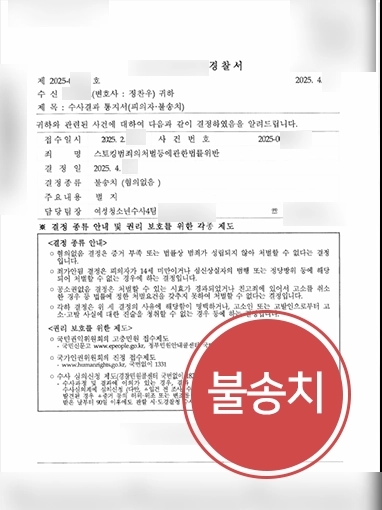
- 4. Result of the Assistance: Non-Referral for Stalking

1. The Full Account of the Stalking Client's Case

The client, who one day was suddenly subjected to a police investigation on a stalking charge.
Bewildered and startled, the client looked closely into what the charge was and found that it was the victim, who had been the client's former romantic partner as well as a senior or junior colleague at work, who had filed a complaint against the client for stalking.
The two had known each other for quite a long time, and having happened to join the same company, they had looked out for one another and over the course of several months developed a close relationship.
However, as both had partners, the two ended their relationship, agreeing to remain good senior and junior colleagues.
Afterward, the client, concerned about the victim who had transferred to another department after their breakup, sent several messages to check on the victim, but this was the source of the trouble.
The victim, having seen the client getting along well with a spouse even after the breakup, harbored resentment toward the client and reported the client's several check-in messages to the police as constituting the crime of stalking.
2. What Is the Crime of Stalking?

To assist the client charged with the crime of stalking, the attorney reviewed matters such as the applicable level of punishment.
The crime of stalking is as follows.
| Act on Punishment of Crime of Stalking, Article 2 "Stalking act" means doing any of the acts under the following items, against the will of and without justifiable reason, toward the other party or that party's cohabitant or family, thereby causing the other party anxiety or fear. |
The acts that constitute the crime of stalking are specified as follows.
| Approaching, following, or blocking the path of the other party or that party's cohabitant or family |
| Waiting for or watching the other party and others at or near their residence, workplace, school, or other places where they ordinarily live |
| Causing objects, writings, words, or the like to reach the other party and others by mail, telephone, fax, or an information and communications network, or causing writings, words, or the like to appear to the other party and others through a program or telephone function that uses an information and communications network |
| Causing objects or the like to reach the other party and others, directly or through a third party, or placing objects or the like at or near their residence |
| Damaging objects or the like placed at or near the residence of the other party and others |
| Using information on the name, title, photograph, image, or identity of the other party and others through an information and communications network to impersonate the other party and others |
In addition, where a person is punished for the crime of stalking, the level of punishment is as follows.
| ① A person who commits the crime of stalking shall be punished by imprisonment for not more than 3 years or a fine not exceeding 30 million won. |
| ② A person who commits the crime of stalking while carrying or using a deadly weapon or other dangerous object shall be punished by imprisonment for not more than 5 years or a fine not exceeding 50 million won. |


3. What Was the Strategy to Obtain No Suspicion of Crime for the Stalking Client?
The attorney established a strategy aimed at non-referral of the stalking case.
 The Client's Conduct Does Not Constitute the Crime of Stalking

The firm's specialist attorney argued that the conduct did not amount to the crime of stalking, since, although the client acknowledged the fact that he had called several times, the content of the two parties' conversations and calls, when examined, did not support such a finding.
The attorney argued that the client and the victim had previously been in a romantic relationship for several months, and that even after breaking up the victim continued to address the client with terms such as "oppa," arguing that the two had remained on close terms.
The attorney argued that, for the victim who was transferring to another department, the client could not bring himself to ignore someone with whom he had previously been close and intimate, and that he had contacted her merely to ask how she was doing.
Finally, the attorney requested that consideration be given to the fact that, when the victim firmly told him never to contact her again, the client, upon hearing this, did not make a single contact with the victim for more than several months and also deleted the victim's contact information.
The attorney argued that, although it was true that the client had contacted her, when the content of the two parties' conversations and calls was reviewed, it was difficult to recognize criminal intent, as there was no recognition that the client himself created any fear or anxiety in the victim or that he had an intent to commit the crime of stalking.
The attorney also requested leniency by asking that consideration be given to the fact that the client was a first-time offender given the slight intent behind the conduct, and that he submitted a letter of reflection expressing genuine remorse.
4. Result of the Assistance: Non-Referral for Stalking
The police, accepting the arguments of the attorney who had conducted a thorough defense to assist the stalking-case client, issued a stalking non-referral (no suspicion of crime) decision regarding the client.
The reasons for the non-referral decision included a finding that, upon reviewing the content of the conversations and calls between the client and the complainant, the client's conduct did not constitute a stalking offense.
🔗Stalking ConductIf you have been unfairly implicated in a stalking offense, it is most important to argue that your conduct does not constitute stalking and to respond by finding evidence to substantiate that point.
In particular, if you are facing a police investigation, we hope you may obtain the assistance of a 🔗criminal law attorney experienced in stalking cases, establish a sentencing strategy suited to your case, develop a statement strategy that may work in your favor, and promptly clear yourself of the suspicion.
This content is based on actual case studies of Daeryun Law LLC with some adaptations, and the copyright belongs to our firm.
Unauthorized reproduction, duplication, or distribution and other copyright infringements may result in legal action under applicable laws.