
CONTENTS
- 1. The Account of the Client Subject to a Complaint for Online Defamation

- 2. What Is Online Defamation?
- 3. The Strategy for Defending Against Punishment for the Online Defamation Client
- - Assistance 1 The Client Did Not Know That the Promise Was False
- - Assistance 2 The Client Holds a Sincere Apology
- - Assistance 3 The Client Intends to Settle With the Victim
- 4. Online Defamation Client, Suspension of Indictment Disposition Through Daeryun's Assistance

1. The Account of the Client Subject to a Complaint for Online Defamation

The story of the client accused of online defamation via the ICT network is as follows.
The client had long been a fan of a well-known influencer.
That influencer was fairly famous, with hundreds of thousands of subscribers on social media.
When the influencer failed to keep a pledge made to celebrate reaching a subscriber milestone, the client was greatly disappointed and posted comments slandering the influencer several times on an online community.
The victim, who saw these comments, accused the client of online defamation via the ICT network, and the client, who was very surprised, became very afraid of being punished.
To prevent punishment for online defamation via the ICT network, the client sought out this firm, and a defense strategy against punishment was established.
2. What Is Online Defamation?

Online defamation refers to content set out in the Act on Promotion of Information and Communications Network Utilization and Information Protection.
| Article 70 of the Act on Promotion of Information and Communications Network Utilization and Information Protection |
| Paragraph 1) A person who, with the purpose of defaming another, damages another person's reputation by publicly disclosing a fact through an information and communications network shall be punished by imprisonment with labor for not more than 3 years or a fine of not more than 30 million won. |
Paragraph 2) A person who, with the purpose of defaming another, damages another person's reputation by publicly disclosing a false fact through an information and communications network shall be punished by imprisonment with labor for not more than 7 years, suspension of qualifications for not more than 10 years, or a fine of not more than 50 million won. |
According to Paragraph 2, for defamation under the Network Act to be established, the fact that the defendant publicly disclosed must be false, and the defendant must recognize that the fact is false.
In addition, there must be a purpose of defaming another person.
Whether there is a purpose of defamation does not depend on whether the fact asserted by the perpetrator is false, and the purpose of defamation is not necessarily recognized merely because the disclosed fact is false, so it is necessary to establish evidence and a defense strategy to prove this and to respond to the case.
A purpose of defaming another person can also be at odds with that of being for the public interest.
Therefore, where the fact disclosed by the actor (the perpetrator) concerns the public interest, the purpose of defamation is, absent special circumstances, being denied.
For this reason, when arguing that there was no purpose of defamation in a defamation case, the following factors are considered.
Whether the victim of the defamation is a public figure or merely a private individual
Whether the expression objectively concerns a matter of public interest with public and social character
Whether it contributes to the formation of public opinion or to open debate, or whether it falls within a purely private domain
Whether the victim invited the risk of the defamatory expression
When the content of the client's comment was also closely examined, it contained content asserting a false fact publicly with the purpose of defaming the influencer in question, and it was a situation in which punishment was difficult to avoid.
3. The Strategy for Defending Against Punishment for the Online Defamation Client
The attorney with extensive experience handling cases of online defamation under the Network Act presented the following pleadings in order to defend the client against punishment.
 Assistance 1 The Client Did Not Know That the Promise Was False

The attorney argued that the client was unaware that it was false that the influencer had never made the promised pledge to celebrate reaching a subscriber milestone, and that the client wrote the comment in question when the pledge was not kept.
The attorney also argued that the client ordinarily harbored no malicious feelings toward the influencer at all, and had no purpose or intent to demean or insult the influencer.
Rather, the attorney argued that the client, as a fan of the influencer, had expected the influencer to keep the pledge, and when the promise was not kept, the client became disappointed and merely wrote a malicious comment with content that could be hurtful.
Assistance 2 The Client Holds a Sincere Apology
The attorney argued that the client was sincerely apologizing for and reflecting on the mistake.
The attorney argued that the client, swept up in the atmosphere of the influencer's fan community, had through poor judgment written the comment without verifying the truth of the pledge, and was sincerely apologizing for unintentionally causing harm to the victim through that comment.
The attorney also pointed out that the client was a first-time offender with no risk of recidivism and requested leniency.
The attorney requested leniency, asking the court to take into account that the client, as the head of a household supporting an elderly mother and the family's livelihood on a small income, would suffer significant disadvantage if criminally punished on this charge.
Assistance 3 The Client Intends to Settle With the Victim
If criminal mediation is successfully achieved, the perpetrator pays a settlement amount and the victim accepts it, so a settlement is deemed to have been reached, which may act as a mitigating factor during the investigation.
The attorney argued that, although the client's circumstances were not comfortable, the client had the intention to submit an application for criminal mediation because it was thought to be an active way of conveying an expression of apology to the victim.
In addition, citing the fact that the client had written and submitted statements of reflection several times containing remorse for the criminal conduct, the attorney requested leniency.


4. Online Defamation Client, Suspension of Indictment Disposition Through Daeryun's Assistance
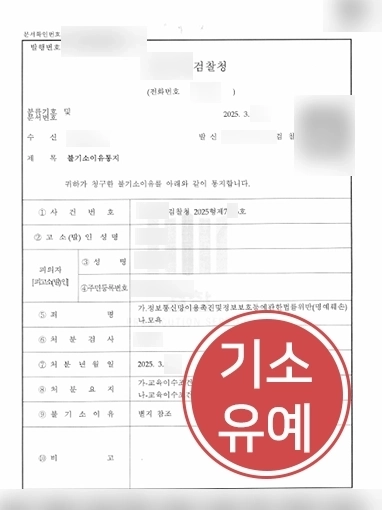
With the assistance of an attorney experienced in handling online defamation cases, the client received a suspension of indictment conditioned on completing education to prevent reoffending with malicious comments.
The client expressed sincere gratitude to the attorney for achieving the defense against punishment.
According to the National Police Agency, in 2024 the number of 🔗cyber defamation and insult offenses was 29,258, a 229% increase from 2014, ten years earlier .
In this way, defamation offenses under the Network Act are increasing day by day through online communities and social media, and particular care is required when writing comments.
If you have been placed at risk of criminal punishment after thoughtlessly posting a comment while caught up in the mood, we hope you may consult this firm's 🔗criminal law specialist attorney, establish a defense strategy against punishment, and respond actively from the early stage.
This content is based on actual case studies of Daeryun Law LLC with some adaptations, and the copyright belongs to our firm.
Unauthorized reproduction, duplication, or distribution and other copyright infringements may result in legal action under applicable laws.