
CONTENTS
- 1. The Client Who Requested a Debt Collection Response

- - The Interest Limitation Act Explained by a Debt Collection Lawyer
- 2. Establishing a Response Strategy for the Debt Collection
- - Debt Collection Lawyer: The Funds Were Provided as an Investment
- - Debt Collection Lawyer: The Case Is Not Subject to the Interest Limitation Act
- - Debt Collection Lawyer: The Complainant's Statement Lacks Credibility
- 3. Result of the Debt Collection Response: A Non-Prosecution Decision for No Suspicion of Crime
- - Debt Collection Response: Why a Specialized Lawyer Is Needed

1. The Client Who Requested a Debt Collection Response

This is the account of a client who requested help with responding to debt collection.
The client provided a certain amount of money to an acquaintance, A (hereinafter the complainant), for the purpose of business funds, and agreed to be allocated a certain profit.
However, when the complainant delayed paying the promised profits, the client requested return verbally several times, and thereafter demanded payment through content-certified mail.
The complainant claimed that the money in question was a loan and that the agreed profit amounted to high-rate interest exceeding the statutory maximum interest rate (20% per annum), and filed a criminal complaint against the client on suspicion of violating the Interest Limitation Act.
Accordingly, the client determined that a prompt and accurate response to the criminal complaint was necessary, and requested help from Daeryun Law Firm, which has handled numerous cases related to 🔗debt collection.
 The Interest Limitation Act Explained by a Debt Collection Lawyer
▶The maximum interest rate set by law is 20% per annum.
The maximum interest rate that a credit business operator or an unregistered credit business operator may charge when lending money cannot exceed 20% per annum.
▶An interest agreement exceeding 20% per annum is void.
If a credit business operator or an unregistered credit business operator has entered into an interest agreement at a rate exceeding 20% per annum, the agreement as to the excess interest is void from the outset.
That is, there is no need to pay the excess interest, and if it has already been paid, one may demand its return.
▶If excess interest has already been paid, it is deducted from the principal first.
Where a debtor has already paid interest exceeding 20% per annum, that amount is applied first to the principal.
And where more than the principal has been paid, the debtor may demand that the credit business operator return the remaining amount.
▶A violation of the Interest Limitation Act results in criminal punishment.
A violation of the Interest Limitation Act may be punishable by imprisonment for up to 1 year or a fine of up to 10 million won.
▶The Fair Debt Collection Practices Act must be observed.
In connection with debt collection, one must not engage in assault, intimidation, deception, the exercise of deception or force, visits or phone calls that seriously disturb the peace of one's private life or business by causing fear or anxiety, false representations, or unfair acts.
A violation may be punishable by imprisonment for up to 5 years or a fine of up to 50 million won.


2. Establishing a Response Strategy for the Debt Collection

The attorney set about establishing a strategy for responding to debt collection.
Debt Collection Lawyer: The Funds Were Provided as an Investment
The debt collection attorney organized the profit-sharing agreement, the joint business proposal, and the bank account deposit and withdrawal records concluded between the client and the complainant, and argued that it was not a simple money loan but an investment that involved bearing risk.
In addition, the attorney emphasized that the agreed payment amount was structured to be variable according to a certain rate of return, establishing that it was a linked distribution amount rather than fixed interest.
Debt Collection Lawyer: The Case Is Not Subject to the Interest Limitation Act
The Interest Limitation Act is a provision that applies to monetary loan-for-consumption agreements.
The debt collection attorney argued that the money the client had paid to the complainant was not a loan but an investment, and emphasized that it was not subject to the Interest Limitation Act.
Debt Collection Lawyer: The Complainant's Statement Lacks Credibility
The debt collection attorney pointed out the complainant's motive and inconsistent statements.
After receiving the money, the complainant paid the proceeds normally for some time.
However, once the relationship with the client deteriorated, the complainant suddenly claimed that it was illegal usurious lending.
The debt collection attorney submitted as evidence text message records, recorded telephone calls, and other materials that could prove that the complainant had at the time understood the purpose of the funds to be 'operating funds for the early stage of the business.'
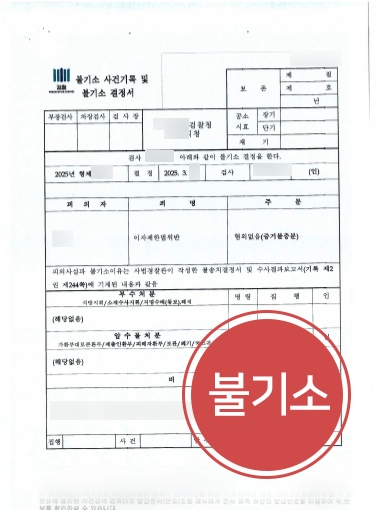
3. Result of the Debt Collection Response: A Non-Prosecution Decision for No Suspicion of Crime
As a result of the response to the debt collection, the prosecution issued a non-prosecution disposition of no suspicion of crime.
This was the result of all of Daeryun's debt collection attorney's arguments being accepted.
The prosecution made its determination for the following reasons.
-The money in question is interpreted not as a simple loan but as funds of an investment nature
-There is no evidence sufficient to recognize it as a monetary loan-for-consumption contract subject to the Interest Limitation Act
-It is judged to be an agreement within the scope of a legitimate distribution of investment profits and losses
Debt Collection Response: Why a Specialized Lawyer Is Needed
Conflicts arising in the course of debt collection often entail criminal risks in addition to civil disputes.
Representatively, in the process where a debtor deliberately avoids repayment or files a counter-complaint against the creditor, the matter actually often escalates into criminal charges such as a violation of the Interest Limitation Act, a 🔗violation of the Act on Registration of Credit Business, and even 🔗intimidation or 🔗coercion.
Even where someone is falsely accused of usury simply for having lent money, criminal punishment can be prevented if the precise nature of the contract and the circumstances can be proven.
In particular, in a complaint arising during the process of recovering a claim, the early response is decisive, and the key is active submission of materials and a response on legal principles rather than passive defense.
One must collect evidence that can clearly distinguish the nature of the contract and objectively prove the substance and legitimacy of the flow of funds.
It is best to respond with the help of an attorney with rich experience in debt collection and responding to criminal complaints.
Daeryun LLC, with specialized attorneys who have handled numerous debt collection cases, provides the following response legal services.
-Legal diagnosis of monetary transactions between individuals
-Design of legitimate debt collection procedures
-Response to complaints regarding violations of the Interest Limitation Act and usurious interest
-Advisory on preventing criminal complaints and forestalling disputes in advance

This content is based on actual case studies of Daeryun Law LLC with some adaptations, and the copyright belongs to our firm.
Unauthorized reproduction, duplication, or distribution and other copyright infringements may result in legal action under applicable laws.