
CONTENTS
- 1. The Story of the Client Who Lived in Common-Law Cohabitation

- 2. Explanation of the Concept of Common-Law Cohabitation
- - Procedure for a Lawsuit to Confirm a Common-Law Marriage
- 3. The Attorney's Assistance in the Common-Law Cohabitation Case
- - Organizing the Relationship Between the Parties
- - Asserting That Living Expenses Were Paid
- - Emphasizing That Funeral Arrangements Were Carried Out
- 4. Outcome of the Common-Law Cohabitation Case

1. The Story of the Client Who Lived in Common-Law Cohabitation
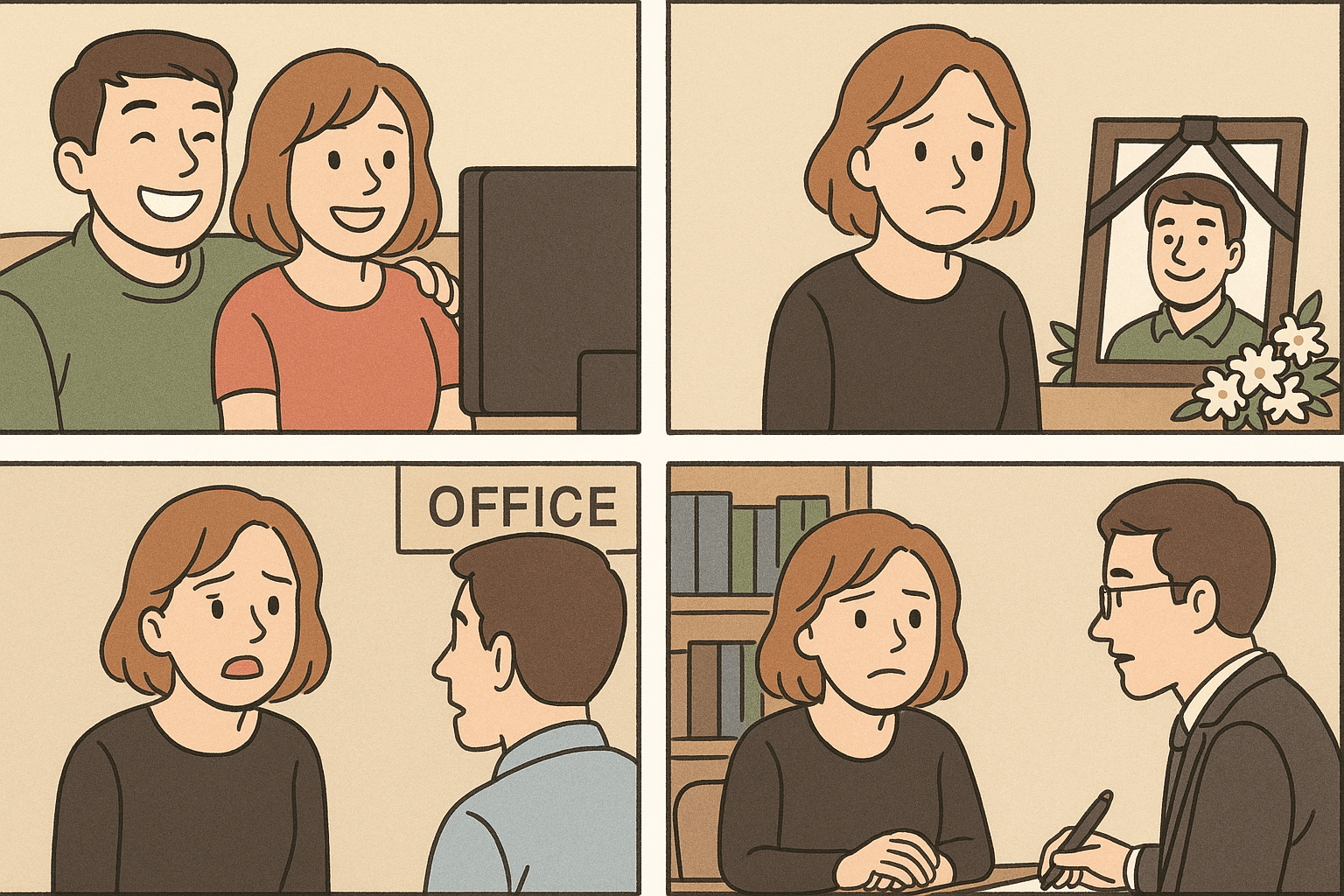
The client states that, after divorcing her husband once, the two reaffirmed their feelings for each other and lived together in a common-law cohabiting relationship.
Then her husband passed away, and the client sought to receive her husband's national pension. However, she stated that because most of the substantive marital relationship between her and her husband was in a state of common-law cohabitation, there was a problem with receiving the pension.
The client stated that, in determining whether the National Pension Service would recognize the period of the common-law relationship as a marital relationship, a judgment from the court recognizing the relationship was needed.
Accordingly, the client came to this firm, asking for help so that she could be recognized as having been in a common-law cohabiting relationship with her husband.
2. Explanation of the Concept of Common-Law Cohabitation
A common-law (de facto) marriage refers to a state in which the parties have not filed a marriage report but are in a substantive marital life as a married couple.
The courts recognize a common-law marriage where, regardless of whether a marriage report has been filed, there is an agreement to marry between the parties and the substance of an actual marital life.
Cohabitation in a common-law marriage means living together with an intention to marry.
▶Criteria recognized as a common-law marriage
The court determines whether a common-law marriage exists by comprehensively considering the following requirements.
They must share a common residence and livelihood
They must be recognized as a married couple by those around them
There must be economic cooperation or the birth and rearing of children
▶Legal effects of a common-law marriage
If a common-law marriage relationship is recognized, the following effects arise.
The party may succeed to the status of a lessee under the Housing Lease Protection Act and may be recognized as having the right to receive a pension
Legal protection equivalent to that of a spouse
Under the Supreme Court precedent below, even where one party to a common-law marriage relationship has died, a claim for confirmation of the existence of the common-law marriage relationship may be filed against the prosecutor.
Even where one party to a common-law marriage relationship has died, so long as it can serve as an effective and appropriate means of resolving present or potential legal disputes at once, the interest in confirmation is recognized in such a claim for confirmation of the existence of the common-law marriage relationship.
 Procedure for a Lawsuit to Confirm a Common-Law Marriage
The litigation procedure for obtaining confirmation of a common-law marriage is as follows.
① Preparing the lawsuit
Organize the circumstances of how the matter arose and the duration over which the common-law marriage was maintained
Secure materials proving the common-law marriage, such as cohabitation photos, travel photos, the residence lease contract, designation of an insurance beneficiary, and the testimony of those around them
Proceed with an attorney consultation and legal advisory
② Drafting and filing the complaint
File the complaint for the ‘suit for confirmation of a common-law marriage’ with the family court having jurisdiction over the matter
State the defendant's (the other party's) personal details and the circumstances of the relationship, the purport of the claim, and the cause of the claim (where the common-law spouse has died, the defendant is the prosecutor)
③ Preparing pleadings and submitting evidence
Organize the materials that can prove the common-law marriage as evidence and submit them to the court
④ Conducting the pleading date
The plaintiff (the claimant) or a representative attends and states each party's position
The existence of the common-law marriage is examined through the evidence and testimony
⑤ Pronouncement of judgment
If the court recognizes the existence of the common-law marriage, it pronounces a ‘judgment confirming the existence of the common-law marriage’
A claim for division of marital property and consolation money may then be made on the basis of that judgment


3. The Attorney's Assistance in the Common-Law Cohabitation Case
The specialist attorney argued as follows and proceeded with a lawsuit for confirmation of the existence of a de facto marital relationship in order to have the client's common-law cohabitation relationship recognized.
Organizing the Relationship Between the Parties
The specialized attorney organized the relationship between the client and her deceased husband as follows.
The client registered her marriage with her husband and, living together, built a harmonious family.
In the meantime, the business her husband ran ran into difficulty, and they came into very difficult economic circumstances, with a bankruptcy filing and the arrival of attachment notices.
Accordingly, the client and her husband proceeded with a divorce by agreement, by mutual consent.
However, the client and her husband had no real intention of terminating the marital relationship and continued to live together.
Asserting That Living Expenses Were Paid
The attorney emphasized that, because the client's husband had difficulty receiving his salary, he had received his salary through an account in the client's name and had paid living expenses.
To prove this, the attorney submitted the account records as evidence.
Emphasizing That Funeral Arrangements Were Carried Out
The attorney emphasized that the client had carried out her husband's funeral procedures.
The client and her husband had continued a common-law marriage relationship, and he died as a result of an industrial accident.
The client not only held her husband's funeral but also exchanged phone calls with him right up until his death.
The attorney requested a judgment recognizing the common-law relationship, stating that because most of the substantive marital relationship between the client and her husband was a common-law state, there was an impediment to her receiving her husband's pension as a surviving family member.
4. Outcome of the Common-Law Cohabitation Case

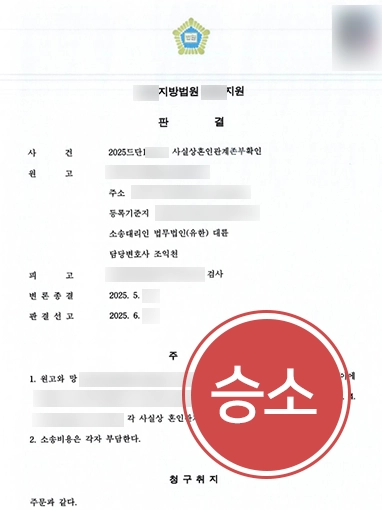
As a result of the specialized attorney providing assistance to have the client’s relationship confirmed, the court rendered a judgment confirming that a marital relationship had existed between the client and her husband.
Although the client had maintained a de facto marital relationship with her husband, she was at risk of not even being able to receive the national pension. With the specialized attorney’s assistance, she was able to protect her rights.
In the case of a de facto marital relationship, although there is no right of inheritance, division of marital property and consolation money may be obtained upon divorce, and a survivor’s pension may be received upon death.
To exercise such rights, a judgment recognizing that a de facto marriage cohabitation relationship existed is required from the court.
Because it can be difficult for an individual to assert a de facto marriage cohabitation relationship, you may proceed with a lawsuit to confirm the existence of a de facto marital relationship through a 🔗legal consultation reservation.
This firm accompanies clients not only through lawsuits to confirm a de facto marital relationship but also through all related legal procedures arising from it, such as dissolution of a de facto marriage and claims for division of marital property.
This content is based on actual case studies of Daeryun Law LLC with some adaptations, and the copyright belongs to our firm.
Unauthorized reproduction, duplication, or distribution and other copyright infringements may result in legal action under applicable laws.