
CONTENTS
- 1. The Client Who Violated the Child Welfare Act

- - The Client's Outcome in the Lower Court
- 2. The Act Violating the Child Welfare Act
- - Charges Including Coercion of Lewd Acts Against a Child, Procuring, and Sexual Harassment
- 3. The Criminal Attorney Who Mounted a Defense Against an Actual Sentence for Violating the Child Welfare Act
- - Acknowledgment of the Charge of Violating the Child Welfare Act
- - The Client Did Not Recognize It as Sexual Abuse
- 4. Appeal Outcome for the Client Who Violated the Child Welfare Act

1. The Client Who Violated the Child Welfare Act
This is the story of a client who came to the firm stating that he needed the assistance of a criminal law attorney in connection with a violation of the Child Welfare Act.
The client was facing charges including compelling lewd conduct of a child, acting as an intermediary, and sexual harassment.
The detailed facts of the client’s case, as ascertained through consultation with the client, were as follows.
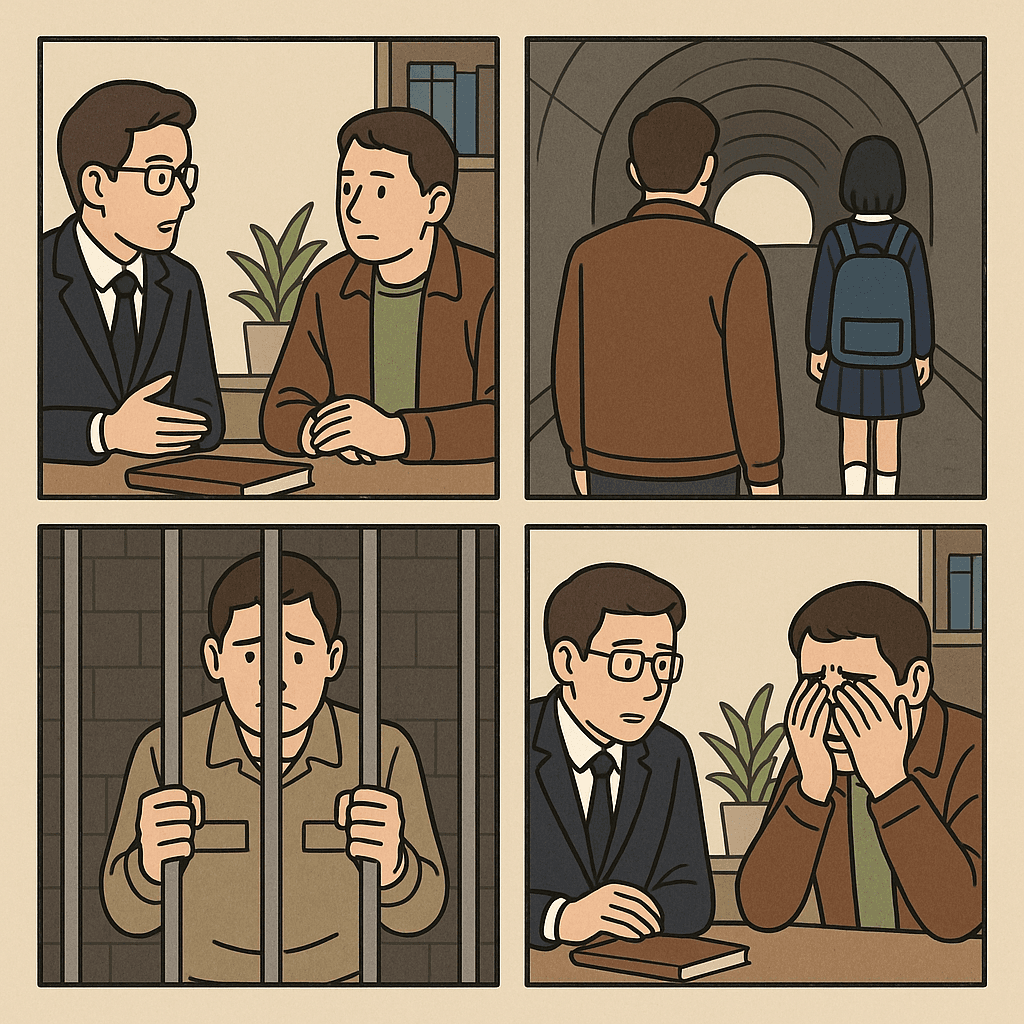
Upon seeing the victim, a middle school student, walking while wearing a skirt, the client followed her and, walking alongside her, made eye contact with the victim.
Although the client was aware that the victim felt anxious about being followed, he is said to have repeatedly looked at the victim’s legs beneath her skirt and harassed her.
In addition, the client committed acts of sexual abuse, such as sexual harassment, by causing the victim sexual humiliation, for example by looking at her body parts dozens of times or making gestures as if to film her with a camera.
 The Client's Outcome in the Lower Court
The other law firm that handled the client's defense at first instance reportedly denied all of the charges at the client's strong request.
The attorney at the other law firm requested, during the client's investigation and trial, that the court render a verdict of acquittal, asserting that the client was not guilty.
However, the court pronounced an actual sentence of imprisonment against the client on the basis of the victim's specific testimony and CCTV footage, among other evidence.
Accordingly, the client requested that a Daeryun criminal law attorney assist with the appellate trial, and the criminal law attorney reexamined the case.
2. The Act Violating the Child Welfare Act
The charge against the client in this case was a 🔗Violation of the Child Welfare Act.
1. The term “child” means a person under 18 years of age.
A child who can be protected under the Child Welfare Act is a person under 18 years of age, and if an adult, including a guardian, commits physical, mental, or sexual violence or cruel treatment that may harm a child's health or welfare or impede the child's normal development, that person is punished on a charge of violating the Child Welfare Act.
The prohibited acts under the Child Welfare Act are as follows.
2. The act of having a child engage in an obscene act, mediating such an act, or committing an act of sexual abuse such as sexual harassment against a child
3. The act of physical abuse that injures a child's body or harms the child's physical health and development
4. The act of emotional abuse that harms a child's mental health and development
5. The act of neglect by abandoning a child under one's protection and supervision or by neglecting the basic protection, upbringing, treatment, and education of the child, including food, clothing, and shelter
6. The act of exhibiting a child with a disability to the public
7. The act of having a child beg or using a child to beg
8. The act of having a child perform acrobatics harmful to the child's health or safety for the purpose of public entertainment or performance, or the act of delivering a child to a third party for such a purpose
9. The act of a person other than an authorized placement agency arranging the upbringing of a child and acquiring money or goods, or requesting or promising money or goods
10. The act of using money or goods donated or paid for a child for purposes other than that purpose
Charges Including Coercion of Lewd Acts Against a Child, Procuring, and Sexual Harassment
Among the violations of the Child Welfare Act, the client was accused of charges including coercion of a child into lewd conduct, procuring such conduct, and sexual harassment.
1. What is coercion of a child into lewd conduct?
▶ Concept
It refers to coercing a child, through coercive or deceptive means, into engaging in lewd or sexual conduct.
Even where no direct sexual act occurs, it includes any act of coercing sexual exposure, masturbation, or sexual expression.
▶ Examples
Directing a child to film sexual conduct on video online
Threatening the child upon refusal, or threatening to harm the child’s family
2. What is procuring lewd conduct involving a child?
▶ Concept
It is the act of connecting a child’s lewd conduct to a third party by arranging or brokering it.
It is similar to ‘procuring prostitution,’ but far stricter punishment follows because it targets a child.
▶ Examples
Arranging meetings with adult men using social media, chat apps, and the like
Connecting sexual services under the guise of a ‘compensated date’ or a ‘part-time job’
3. What is sexual harassment of a child?
▶ Concept
It is the act of subjecting a child to unwanted sexual words or conduct that causes shame, disgust, or a sense of threat.
It includes verbal, physical, and visual conduct, and even a single act, without repetition, may constitute sexual harassment.
▶ Examples
Remarks such as "Your breasts are pretty" or "When you grow up, become my girlfriend"
Showing sexual photographs, videos, and the like
If these charges are established, a person may be subject to imprisonment for not more than 10 years or a fine not exceeding 100 million won under the Child Welfare Act.


3. The Criminal Attorney Who Mounted a Defense Against an Actual Sentence for Violating the Child Welfare Act
The attorney specializing in criminal matters established a strategy to reverse the client’s actual custodial sentence and obtain a suspended sentence.
Acknowledgment of the Charge of Violating the Child Welfare Act
At the appellate stage, the criminal attorney persuaded the client to acknowledge the charges and show a remorseful attitude.
The client had been suffering from severe depression due to his family circumstances.
On the day of the incident, while walking near the tunnel where the incident occurred, he encountered the victim.
Perhaps thinking that the client was following her, the victim glanced at the client repeatedly.
Watching this, the client felt an inexplicable sense of satisfaction and made the mistaken judgment that he could resolve his problems without relying on psychiatric medication.
Thereafter, whenever something stressful happened, the client would go to that tunnel, and if he found the victim, he would follow her and look her up and down.
The client felt a sense of superiority watching the victim grow anxious and afraid at the sight of him, but he came to realize the wrongfulness of his conduct, and he also showed remorse, sent the victim an apology letter, and paid a settlement.
The Client Did Not Recognize It as Sexual Abuse
The attorney specializing in criminal law emphasized that, while admitting the client's charge, the client had been entirely unaware that the client's conduct amounted to sexual abuse.
The attorney requested leniency in consideration of the fact that the client had simply relieved stress upon seeing the victim appear anxious, and that the client felt guilt and remorse over the fact that the victim had felt anxiety because of the client's conduct.
4. Appeal Outcome for the Client Who Violated the Child Welfare Act

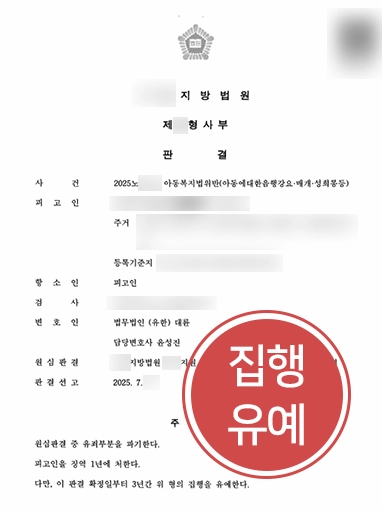
The client, who had been sentenced to an actual custodial sentence on charges of violating the Child Welfare Act, received a suspended sentence on appeal with the assistance of an attorney specializing in criminal matters.
The client had been sentenced to an actual custodial sentence and faced separation from society, but because of the assistance of the attorney specializing in criminal matters, the actual custodial sentence was avoided through a suspended sentence.
Violations of the Child Welfare Act carry severe punishment in that they are crimes targeting children.
If you are in a situation like that of the client in this case, it is important to establish a strategy suited to the case and respond actively, rather than denying the charges without basis.
Daeryun LLC carefully reviews the situation and details of each client’s case and prepares a response suited to the client.
If you require assistance on charges such as a violation of the Child Welfare Act, please proceed with a 🔗Legal Consultation Reservation right now.
This content is based on actual case studies of Daeryun Law LLC with some adaptations, and the copyright belongs to our firm.
Unauthorized reproduction, duplication, or distribution and other copyright infringements may result in legal action under applicable laws.