
CONTENTS
- 1. The Client Who Sought a Subcontracting Attorney

- - The Client's Request
- 2. Subcontracting Explained by a Subcontracting Attorney
- - Charge of Violating the Framework Act on the Construction Industry
- 3. The Subcontracting Attorney's Defense of the Client
- - Pre-Interview Simulation for Police Questioning and Attendance During the Actual Questioning
- - Submission of the Defense Counsel's Statement of Opinion
- 4. Result of the Subcontracting Attorney's Assistance

1. The Client Who Sought a Subcontracting Attorney

The client who sought a subcontracting attorney was accused of violating the Framework Act on the Construction Industry and was facing police questioning.
As the representative of a construction company, the client had entered into a re-subcontracting agreement with a subcontractor for part of the construction work that he was performing under a subcontract.
The client reportedly issued tax invoices to the re-subcontractor and proceeded with the construction.
Under the Framework Act on the Construction Industry, where a party performing construction under a subcontract enters into a re-subcontracting agreement, written consent must be obtained from the contracting company.
The Ministry of Land, Infrastructure and Transport visited the client’s construction site and, finding that no approval documents had been obtained, treated the conduct of the client’s company as illegal subcontracting.
As a result, the client was the subject of a criminal accusation and, facing police questioning on charges of violating the Framework Act on the Construction Industry, sought the assistance of a subcontracting attorney.
 The Client's Request
The client wondered whether, although the client had not obtained written approval, it could be argued that the client had obtained the ordering party's approval since the client held a payment guarantee.
The client took the position that it was very unjust, stating that in the construction industry there are many cases of re-subcontracting without obtaining written consent for convenience.
The client requested the subcontracting attorney to help the client clear the charge and return to daily life.
2. Subcontracting Explained by a Subcontracting Attorney
Subcontracting refers to a contract or act by which the principal contractor (the contractor) entrusts all or part of certain work back to a subcontractor (the subcontracted party), who is a third party.
This is a common transaction structure used in various fields, such as the construction industry, manufacturing, IT, and the content industry.
Taking as an example the construction business operated by the subcontracting attorney's client, when construction company A concludes a contract to build an apartment, it may entrust the concrete work to company B and the electrical work to company C, respectively.
In this case, companies B and C become subcontractors of construction company A.
In addition, re-subcontracting refers to a contract or act by which a subcontracted party (the subcontractor) entrusts all or part of the work commissioned to it by the principal contractor back to another business operator (the re-subcontracted party), who is a third party, in simple terms, the subcontracting of a subcontract.
If large construction company A wins an apartment construction project and subcontracts the civil engineering work to mid-sized company B, and company B entrusts the excavation work to small or medium-sized company C, this is re-subcontracting, and C becomes the re-subcontracted party, B the re-subcontractor, and A the principal contractor.
Charge of Violating the Framework Act on the Construction Industry
The client of the subcontracting attorney was charged with a violation of the Framework Act on the Construction Industry.
(3) A subcontractor may not further subcontract the construction work it has received to another person. Provided, that subcontracting is permitted in any of the following cases.
1. Where a constructor registered in a business category that performs general construction work receives a subcontract and further subcontracts, among the construction work it has received, construction work constituting specialized construction work to a constructor registered in a business category that performs that specialized construction work (limited to cases where the ordering party, deeming it necessary to improve construction quality or efficiency in the work, has given written consent)
2. Where a constructor registered in a business category that performs specialized construction work receives a subcontract and, meeting all of the requirements of the following items, further subcontracts part of the specialized construction work it has received to a constructor registered in a business category that performs that specialized construction work
A. Where it is necessary to improve construction quality or efficiency in the work and the case meets the requirements prescribed by Ordinance of the Ministry of Land, Infrastructure and Transport
B. Obtaining the written consent of the contractor
🔗Framework Act on the Construction Industry, in order for a subcontractor to further subcontract, it must obtain the written consent of the contractor.
Where a subcontractor further subcontracts without obtaining the written consent of the contractor, under Article 82(2)3 of the Framework Act on the Construction Industry, a business suspension of up to one year or a penalty surcharge of up to 30% of the contract amount of the work is imposed.
In addition, under Article 96 of the Framework Act on the Construction Industry, imprisonment for up to three years or a fine of up to 30 million won may be imposed.
See More

What are the violations of the Framework Act on the Construction Industry and what are the disadvantages?

What are the standards for illegal subcontracting, punishment cases, and punishment regulations for violations of subcontracting?
What are the standards for punishment for violations of the subcontracting law according to the type of unfair subcontracting transaction?
3. The Subcontracting Attorney's Defense of the Client
The subcontracting attorney provided assistance as follows in order to defend against the client’s punishment.
Pre-Interview Simulation for Police Questioning and Attendance During the Actual Questioning
The subcontracting attorney conducted an advance simulation program before the client’s police investigation took place.
At this time, the attorney provided expected questions and answer guidelines that the client would receive in the actual police investigation, thereby preventing the client from making unfavorable statements.
In addition, the attorney accompanied the client to the actual police investigation and helped the client receive questioning in a stable atmosphere.
Submission of the Defense Counsel's Statement of Opinion
The subcontracting attorney submitted a defense counsel's opinion to the police containing the following points, requesting a non-referral decision for the client.
1. Issue in this case
The subcontracting attorney argued that the issue in this case was whether the client violated the obligation to obtain written consent in this process.
2. Provisions of the Framework Act on the Construction Industry
On this basis, the subcontracting attorney argued that the construction payment guarantee the client received could be interpreted as written consent.
3. Denial of intent to engage in illegal subcontracting
In the client's case, the contractor company first requested a change to the work content from the client and selected the construction firm together with the client.
Accordingly, since the client did not subcontract again without authorization and without the contractor company's consent, there was no intent to engage in illegal subcontracting, and the attorney requested a non-referral decision.
4. Result of the Subcontracting Attorney's Assistance

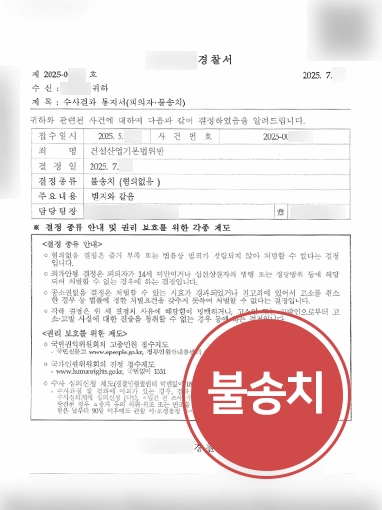
As a result of the subcontracting attorney's assistance in the client's case, the police issued a non-referral decision in the client's case.
As the subcontracting attorney argued, the police determined that in the client's case the prime contractor had first directed that the work be entrusted to and performed by another company and that an agreement had been reached, so it could not be said that the contract in this case had not received written approval.
At construction sites, a great many subcontracting agreements are inevitably made given the nature of the industry.
Because the Framework Act on the Construction Industry strictly regulates subcontracting, it is important for construction companies and others to understand these provisions and to prevent any violations in advance.
The firm's subcontracting attorneys prevent legal risks through advisory services for construction companies and, for companies that face the risk of punishment after a risk has materialized, as with the client in this case, analyze the matter and prepare a defense strategy against punishment.
In particular, the firm has established a one-stop response system in which legal experts related to subcontracting, including subcontracting attorneys, attorneys specializing in criminal law, and attorneys specializing in construction, work together, so if you need assistance, please proceed with a 🔗legal consultation reservation so that you can receive help and avoid any unjust outcome.
See More
This content is based on actual case studies of Daeryun Law LLC with some adaptations, and the copyright belongs to our firm.
Unauthorized reproduction, duplication, or distribution and other copyright infringements may result in legal action under applicable laws.