
CONTENTS
- 1. The Client Who Sought an Administrative Litigation Specialist Attorney

- - Laws Related to the Case
- - Organizing the Issues Related to the Administrative Litigation
- 2. The Key Points of the Administrative Litigation Specialist Attorney's Assistance
- - The Administrative Attorney's Assistance 1 | Analyzing Whether the Area Qualifies as a Livestock Farming Restriction Zone
- - The Administrative Attorney's Assistance 2 | Proving Whether the Permit Standards Were Met
- - The Administrative Attorney's Assistance 3 | Emphasizing Whether There Was an Abuse of Discretion and Citing Precedents
- 3. Result of the Administrative Litigation Specialist Attorney's Assistance: Revocation of the Disposition Denying a Building Permit
- - To Revoke an Unjust Disposition

1. The Client Who Sought an Administrative Litigation Specialist Attorney

The client who requested assistance from the administrative litigation attorney was planning to build a new livestock barn on a site that met the required distance and conditions.
The client had thoroughly reviewed the relevant statutes and the ordinance on livestock-raising restricted zones, had gone through the local government's planning deliberation process, and had all the documents in order.
However, the competent authority issued a disposition of non-permission on the ground of "resident complaints due to concerns over odor and water pollution."
As a result, the client faced the risk of substantial property loss and schedule delay.
The client therefore requested assistance with the administrative litigation from the administrative litigation attorney, in order to prove that the permit application was legally legitimate and to correct the authority's abuse of discretionary power.
 Laws Related to the Case
A livestock shed is not a facility that can be built just anywhere.
The installation of a livestock shed may be restricted under the relevant statutes, and prior permission may be required.
Act on the Management and Use of Livestock Excreta, Article 8 (Restrictions on Livestock Raising, etc.)
Accordingly, livestock raising may be restricted in the following areas in accordance with local government ordinances.
② Areas where water quality preservation is required, such as water source protection areas and special countermeasure areas
③ Riverside zones under the statutes governing the four major river systems (the Han, Nakdong, Geum, and Yeongsan and Seomjin Rivers)
④ Areas exceeding environmental standards
⑤ Other areas for which the Minister of Environment or a Mayor/Do Governor recognizes a need for restriction
Organizing the Issues Related to the Administrative Litigation
In this case, the administrative litigation attorney organized the logic presented by the competent local government as grounds for its disposition of refusal as follows.
② Group complaints by residents due to concerns about odor and water pollution
③ The possibility of future environmental disputes and an increased administrative burden
In response, the administrative litigation attorney established a response strategy on the basis of the following key issues.
▷ It satisfies all of the permit requirements and the standards for deodorization and excreta treatment facilities
▷ The permit is a discretionary act, but in this case it amounts in substance to bound discretion
▷ The grounds for refusal are based on vague resident opposition and lack objectivity
In particular, the administrative litigation attorney established a strategy by noting that an 'appropriate' determination had been made in the result of the planning review conducted immediately before the disposition, focusing on the point that even the administration's internal determination found no problem with the permit.


2. The Key Points of the Administrative Litigation Specialist Attorney's Assistance

The administrative litigation specialist attorney pursued the following strategy in order to prove that the agency's building permit denial disposition was an unlawful disposition exceeding the scope of discretionary power.
The Administrative Attorney's Assistance 1 | Analyzing Whether the Area Qualifies as a Livestock Farming Restriction Zone
The administrative attorney first clearly established that the planned construction site did not fall within a livestock-raising restricted zone under Article 8 of the 「Livestock Excreta Act」 or the relevant local government ordinance.
In particular, the attorney emphasized the appropriateness of the location, noting that it was situated at least a certain distance away from residential clusters in the area.
Together with this, the administrative litigation specialist attorney pointed out that the restricted-zone map submitted by the agency did not match the facts, and presented objective rebuttal materials through specific maps, cadastral maps, aerial photographs, and the like.
The Administrative Attorney's Assistance 2 | Proving Whether the Permit Standards Were Met
In this case, the client was in a state in which all of the permit standards under the relevant statutes and guidelines, including the deodorization facilities, the excreta treatment facilities, and the drainage system, had been met.
In response, the administrative attorney comprehensively combined the submitted documents, environmental design drawings, and verification materials from the design firm to specifically prove conformity with the relevant standards.
In particular, the attorney clearly organized the criteria related to the relevant statutes, adding persuasiveness to the argument.
The Administrative Attorney's Assistance 3 | Emphasizing Whether There Was an Abuse of Discretion and Citing Precedents
The administrative litigation specialist attorney emphasized that, although this disposition appears on its face to be a discretionary act that the agency may freely decide, it is in fact a matter in which, as a rule, permission is granted once the prescribed criteria are met.
In particular, the attorney pointed out that the 'grounds for refusal' were not based on specific facts but amounted to no more than vague resident opposition and concern over complaints.
Accordingly, the attorney requested revocation on the basis of Article 27 of the Administrative Litigation Act.
Article 27 of the Administrative Litigation Act (Revocation of a Discretionary Disposition)
3. Result of the Administrative Litigation Specialist Attorney's Assistance: Revocation of the Disposition Denying a Building Permit

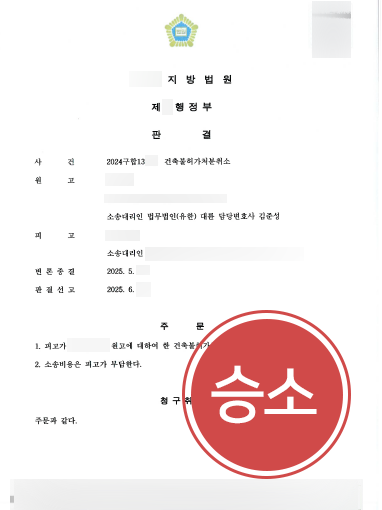
After the systematic litigation strategy of the administrative litigation specialized attorney, the court recognized that the relevant application for a permit to build the livestock barn was a legitimate application that met the requirements under the statutes.
Accordingly, it rendered a judgment revoking the disposition of non-permission of construction.
As a result of this judgment, the client was not only able to prevent enormous loss but was also able to proceed normally with the planned business schedule.
To Revoke an Unjust Disposition
To challenge an unjust administrative disposition decision, an accurate understanding of statutory interpretation and administrative litigation procedures is required.
Daeryun Law Firm has many administrative litigation specialist attorneys who have handled various administrative cases, including revocation and nullity of dispositions.
Through a dedicated consultation attorney system, the firm conducts an accurate legal review at the initial consultation stage and assigns a specialist attorney by case to maximize the efficiency of strategy development.
The firm also responds as a team of experts rather than alone, with experts in each field cooperating to assist with the case, including case-law analysis, litigation documents, and securing supporting evidence.
If you wish to set right an injustice through administrative litigation, please feel free at any time to entrust your case through an administrative litigation specialist attorney 🔗legal consultation booking.
See More

This content is based on actual case studies of Daeryun Law LLC with some adaptations, and the copyright belongs to our firm.
Unauthorized reproduction, duplication, or distribution and other copyright infringements may result in legal action under applicable laws.