
CONTENTS
- 1. The Client Who Sought a Defamation Lawyer

- - Background of the Defamation Case
- 2. Laws Relevant to the Case as Explained by a Defamation Lawyer
- - Requirements for Establishing Defamation
- - Levels of Punishment for Defamation
- 3. Assistance Provided by the Defamation Attorney
- - Dispute Over Whether a Specific Fact Was Disclosed
- - Proof of the Absence of a Purpose of Defaming
- - Denial of the Occurrence of a Defamatory Result
- 4. Result of the Defamation Attorney's Assistance: No Suspicion of Crime
- - How to Respond to a Defamation Charge

1. The Client Who Sought a Defamation Lawyer
This is the account of a client who, with the assistance of a defamation lawyer, defended against criminal punishment arising from defamation.
 Background of the Defamation Case
The client, a career military officer, was experiencing a dispute over a refund in the course of entrusting administrative work to an administrative affairs office.
The client attempted to make contact several times, but the administrative affairs office unilaterally ignored the client's communications.
Feeling frustrated, the client posted a comment to the effect of "I am preparing for a lawsuit" on the administrative affairs office's blog post.
However, the administrative agent's side immediately regarded this as the statement of a false fact and filed a criminal complaint on the ground that it had damaged the office's social credit.
As a result, the client unintentionally became a defamation suspect subject to investigation by the military police, and requested assistance from a defamation lawyer.



2. Laws Relevant to the Case as Explained by a Defamation Lawyer
The client who sought a defamation lawyer was charged with "defamation" in violation of Article 70 of the Act on Promotion of Information and Communications Network Utilization and Information Protection, Etc.
Defamation is a crime that is established when a person, with the intent to disparage another, openly reveals a true or false fact through an information and communications network and thereby damages another person's reputation.
Requirements for Establishing Defamation
For defamation to be established, the following requirements must be met.
Category | Content |
Actor | A person who posted or transmitted an expression through an information and communications network |
Manner of conduct | Disclosing a true fact or a false fact |
Publicity | It must be done in a state in which an unspecified or large number of people can perceive it |
Purpose | There must be a purpose of defaming the other party |
Result | A case in which another person's social evaluation or credit was lowered |
Levels of Punishment for Defamation
Defamation is subject to different levels of punishment depending on whether the publicly disclosed fact is false.
Network Act Article 70 (Penalty Provisions)
Category | Level of punishment |
Disclosure of a fact | Imprisonment with labor for not more than 3 years or a fine of not more than 30 million won |
Disclosure of a false fact | Imprisonment with labor for not more than 7 years, suspension of qualifications for not more than 10 years, or a fine of not more than 50 million won |
3. Assistance Provided by the Defamation Attorney

The Defamation Attorney mounted a defense using the following legal principles and materials in order to specifically demonstrate that the client's conduct did not meet the elements of the crime of defamation under the Network Act.
Dispute Over Whether a Specific Fact Was Disclosed
The complainant claimed that the client's comment stating ‘A lawsuit is in preparation’ lowered the credit of the office.
However, the comment in question did not contain the complainant's name, the office's name, or any specific content at all.
Accordingly, the attorney presented the argument that it did not reach the standard of a ‘disclosure of a specific fact’ and was, rather, merely an expression of opinion or in the nature of a complaint.
In fact, by submitting material showing that even a third party at the military police investigation stage could not clearly understand the meaning of the comment and reacted by asking “What does this mean?”, it was possible to demonstrate that the comment was not specific enough to directly lower the social evaluation of a particular person.
Proof of the Absence of a Purpose of Defaming
The key to establishing defamation is the ‘purpose of defaming,’ and the complainant also claimed that the client's comment was a malicious act intended to disparage the complainant.
In response, the attorney presented as material the fact that, in a situation where the complainant did not respond to the client's refund request and unilaterally cut off contact, the blog was the last channel through which the client could convey an opinion.
In addition, the attorney emphasized that this conduct was not for the purpose of insulting the other party, but was simply an act intended to announce a claim of right and to request communication.
In the course of the military police investigation as well, the client's statements and the text message conversation history were consistently confirmed, and it was demonstrated that the circumstances of writing the comment were closer to ‘an appeal of an unfair situation’ than to ‘defaming.’
Denial of the Occurrence of a Defamatory Result
The complainant claimed that, due to the comment, the office's social evaluation was substantially lowered.
In response, the attorney emphasized, pointing to the fact that the comment did not even provide information by which an unspecified number of people could identify the complainant, and the fact that even a third party who saw the comment could not grasp its meaning, that the social reputation was not substantially harmed.
4. Result of the Defamation Attorney's Assistance: No Suspicion of Crime

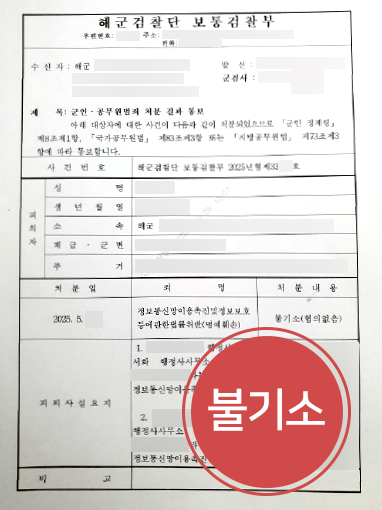
As a result of the Defamation Attorney's arguments and submission of evidence, the military prosecutors comprehensively recognized the following points and rendered a disposition of no suspicion of crime (non-prosecution) in this case.
② The point that the client did not have a ‘purpose of defaming’
③ The point that a result of an actual lowering of social evaluation was not confirmed
As a result, the client was able to avoid the risk of being referred to a military criminal trial and suffering any disadvantage to military status or damage to reputation.
How to Respond to a Defamation Charge
Defamation cases are not determined solely by the content of a statement or post; rather, multiple factors are considered comprehensively, including whether a fact was asserted, the manner of expression, and the context.
Through its dedicated consultation attorney system, Daeryun LLC carefully identifies the facts and issues of the matter and assigns a dedicated attorney by case type to establish a response strategy tailored to the client.
When the evidence related to a case is insufficient, the collection and analysis of evidence can also be handled through coordinated collaboration with the Evidence Examination Center and the Digital Forensics Center.
If you are facing the risk of punishment on a charge of defamation, please feel free to entrust your case at any time through the 🔗Legal Consultation Reservation.
See More

This content is based on actual case studies of Daeryun Law LLC with some adaptations, and the copyright belongs to our firm.
Unauthorized reproduction, duplication, or distribution and other copyright infringements may result in legal action under applicable laws.