
CONTENTS
- 1. Serious Accidents Punishment Act | An Unforeseeable Accident and the Beginning of Legal Liability

- 2. Serious Accidents Punishment Act | A Strategy Emphasizing That It Was a Natural Phenomenon of Force Majeure
- - Collaboration With a Domestic Civil Engineering Expert
- - Thorough Demonstration of Fulfillment of the Duty to Secure Safety
- - An Amicable Settlement With the Bereaved Family and the Securing of Sentencing Materials
- 3. Serious Accidents Punishment Act | Overcoming the Crisis Through a Closing of the Preliminary Inquiry in a Suspected Violation of the Serious Accidents Punishment Act
- - Analysis of Acquittal Cases Under the Serious Accidents Punishment Act

1. Serious Accidents Punishment Act | An Unforeseeable Accident and the Beginning of Legal Liability
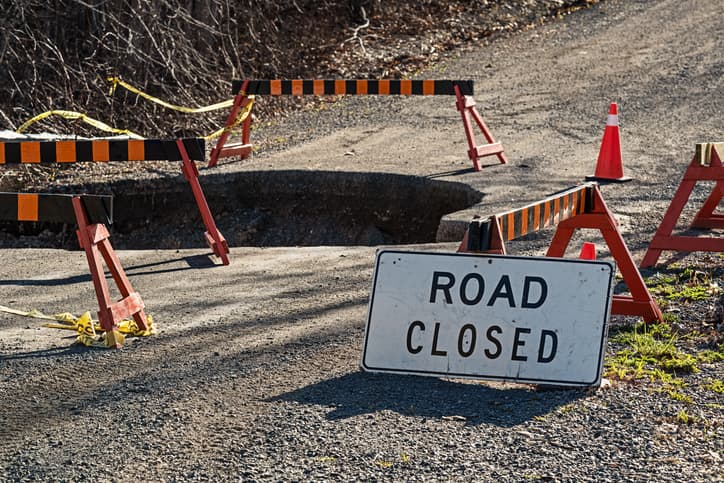
The circumstances that gave rise to this Serious Accidents Punishment Act case are as follows.
G Construction, the corporate client, faced an unexpected accident while carrying out a repair-facility refurbishment project ordered by a local government.
At the site where ready-mixed concrete pouring was in full progress, a sinkhole phenomenon occurred in which the ground beneath the outrigger (a protruding structure that serves as a support to prevent the equipment from overturning) that was bearing the weight of the pump truck suddenly collapsed.
As a result, the pump truck equipment toppled over, and regrettably this led to the tragic outcome of one worker at the site losing his life.
Immediately after the accident, the Regional Labor Office promptly commenced a site investigation and booked the construction company's representative director, along with the corporation and site personnel, on suspicion of a violation of the Serious Accidents Punishment Act.
The company's representative faced the risk of a heavy sentence, including imprisonment, and the company likewise came to face a compound crisis of substantial administrative dispositions and a decline in social reputation.


2. Serious Accidents Punishment Act | A Strategy Emphasizing That It Was a Natural Phenomenon of Force Majeure
In an investigation related to the Serious Accidents Punishment Act, the most important issue is whether the cause of the accident lies in the chief safety officer's failure to perform the ‘duty to secure safety and health.’
The investigative authorities identified insufficient ground surveys at the site, deficiencies in the process of preparing the work plan, and improper measures during the installation of the outrigger as causes of the accident.
Furthermore, they determined that the fact that the deceased worker was not wearing protective equipment at the time of the accident also left considerable room to be interpreted as a failure of the company's management and supervision.
If all of these points were to be found in court, the client could not avoid an outcome in which imprisonment of at least one year would be imposed together with a fine of up to 1 billion won, and a fine of up to 5 billion won would be imposed on the corporation.
However, the attorney in charge who consulted on the matter concentrated his capabilities on proving that the essence of the case lay not in ‘management failure’ but in a natural phenomenon of force majeure.
Accordingly, scientifically proving that the fundamental cause of the accident was a ground collapse that no one could have predicted was the key strategy that would determine whether the Serious Accidents Punishment Act applied.
 Collaboration With a Domestic Civil Engineering Expert
The attorney in charge collaborated closely with a domestic civil engineering expert to thoroughly analyze the cause of the accident.
Based on the professional advice of a national university professor in the field of civil engineering, the attorney actively argued, by presenting the following scientific grounds, that the matter did not amount to a violation of the duty to secure safety and health under the Serious Accidents Punishment Act.
Thorough Demonstration of Fulfillment of the Duty to Secure Safety

The attorney in charge also did not overlook specifically demonstrating that the client company had faithfully fulfilled the duty to secure safety and health prescribed by law.
As whether the chief safety officer fulfilled his duties is the key issue under the Serious Accidents Punishment Act, the attorney constructed the response strategy centered on the measures taken before the accident occurred.
The attorney confirmed the fact that, before the accident, the persons involved, including the site supervisor, the construction company's representative, and the equipment operator, had 1) carefully inspected the ground condition in advance, and that the paved surface showed no abnormality at the time.
The attorney logically explained that an additional boring survey and the like were not a common practice in the industry at the time and, given the nature of the private land, were a circumstance that was practically impossible.
In addition, the attorney proved that, when installing the pump truck outrigger, the company had taken safety measures exceeding the legal standard, such as 2) using a safety plate to distribute the load.
In accordance with the result of a comprehensive review of matters such as the scope of the contractor's duty to take safety measures under Article 63 of the Occupational Safety and Health Act, the attorney also made clear that 3) the provision of protective equipment such as safety helmets and prior safety training had likewise been thoroughly conducted for the workers, but that the victim's failure to wear it at the time of the accident was personal negligence.
An Amicable Settlement With the Bereaved Family and the Securing of Sentencing Materials
Under the Serious Accidents Punishment Act, an amicable settlement with the victim is a major ground for consideration in sentencing.
The attorney in charge broadly secured the following mitigating factors and submitted them to the investigative authorities.
3. Serious Accidents Punishment Act | Overcoming the Crisis Through a Closing of the Preliminary Inquiry in a Suspected Violation of the Serious Accidents Punishment Act
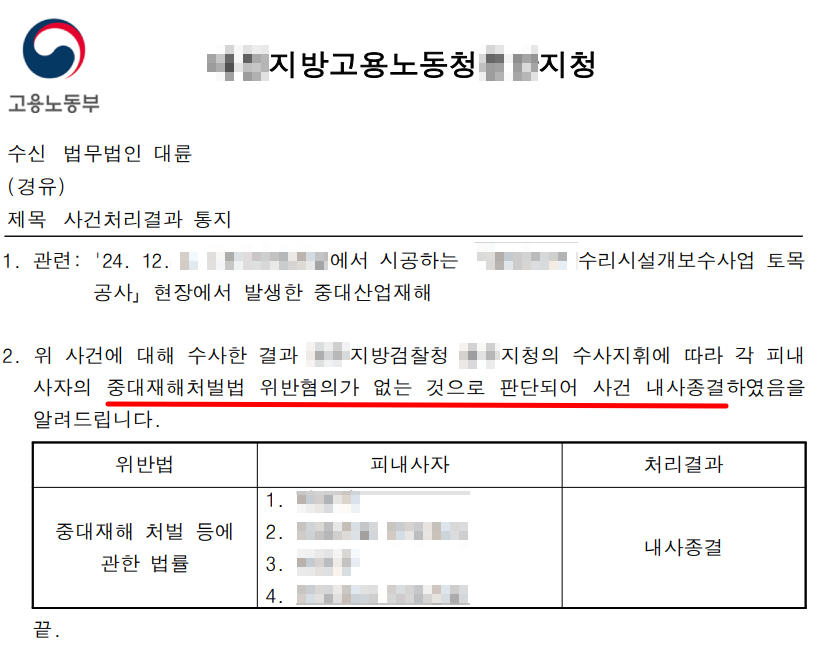
As a result of a combined systematic legal, engineering, and labor response, the Ministry of Employment and Labor ultimately determined that it was difficult to hold the client and the related persons legally responsible under the Serious Accidents Punishment Act.
The case was concluded with a closing of the preliminary inquiry on the ground of ‘no suspicion of crime.’
The corporate client, who had hoped that the worker-fatality accident would be concluded even if only with a fine, was greatly satisfied and subsequently also entrusted Serious Accidents Punishment Act compliance advisory to this firm.
As legal liability for serious accidents has been strengthened, the government is in the process of reforming the system in the direction of substantially strengthening public-bidding sanctions against companies that experience a violation of the Serious Accidents Punishment Act and embedding a safety management system throughout public contracts.
Establishing a proactive safety management system, together with legal preparation for the Serious Accidents Punishment Act, will be the answer that turns a company's legal and managerial crisis into an opportunity.
If you have a concern regarding a matter of a violation of the Serious Accidents Punishment Act, we encourage you to seek a solution to your matter through a 🔗legal consultation booking with Daeryun, the ninth-largest law firm in Korea (based on 2025 value-added tax filings with the National Tax Service), where a specialist attorney for each type of matter consults directly.
Analysis of Acquittal Cases Under the Serious Accidents Punishment Act
An analysis of cases of acquittal under the Serious Accidents Punishment Act reveals that substantive liability, causation, and formal assessment of the scope of the law's application are the main grounds.
Please note that liability under the Serious Accidents Punishment Act is recognized not for a formal breach of duty, but only where the actual intent or negligence of the chief safety officer, foreseeability, and failure to perform become the direct cause of the accident.
Type of Acquittal Under the Serious Accidents Punishment Act | Main Reason for the Acquittal |
Absence of direct causation between the prime contractor's representative and the accident | There was no foreseeability of the danger or neglect by the chief safety officer, and proximate causation was not established. |
Absence of causation between the accident and the preventive measures | The preventive measures (such as protective devices) were not a duty under the law, or the accident was unforeseeable, so there was no liability. |
Acquittal of the prime contractor due to the subcontractor's negligence | Where the subcontractor violated the work standards and the prime contractor was not aware of the specific danger or of the unauthorized work, liability is limited. |
Formal violation, absence of causation | Non-performance of duties, such as the lack of a dedicated organization and the composition of work, is a formal deficiency, and no direct causation with the accident is recognized. |
See More
This content is based on actual case studies of Daeryun Law LLC with some adaptations, and the copyright belongs to our firm.
Unauthorized reproduction, duplication, or distribution and other copyright infringements may result in legal action under applicable laws.