
CONTENTS
- 1. Appeal Against Military Disciplinary Action | Details of the Case

- 2. Appeal Against Military Disciplinary Action | Types of Military Disciplinary Action
- 3. Appeal Against Military Disciplinary Action | Explanation of the Concept
- - The Procedure for Responding to a Military Disciplinary Action
- 4. Appeal Against Military Disciplinary Action | Assistance by an Attorney Experienced in Military Matters and an Administrative Law Attorney
- - Proof of the Nonexistence of a Violation of the Duty of Diligence
- - Analysis of the Disciplinary Committee Records and Rebuttal on the Law
- - Argument of Violation of the Principles of Proportionality and Equality
- - Presentation of Grounds Concerning Personnel and Service Disadvantages
- - Representation in the Appeal Procedure Against the Military Disciplinary Action
- 5. Appeal Against Military Disciplinary Action | Result of the Review
- - How to Respond When You Receive a Military Disciplinary Action

1. Appeal Against Military Disciplinary Action | Details of the Case
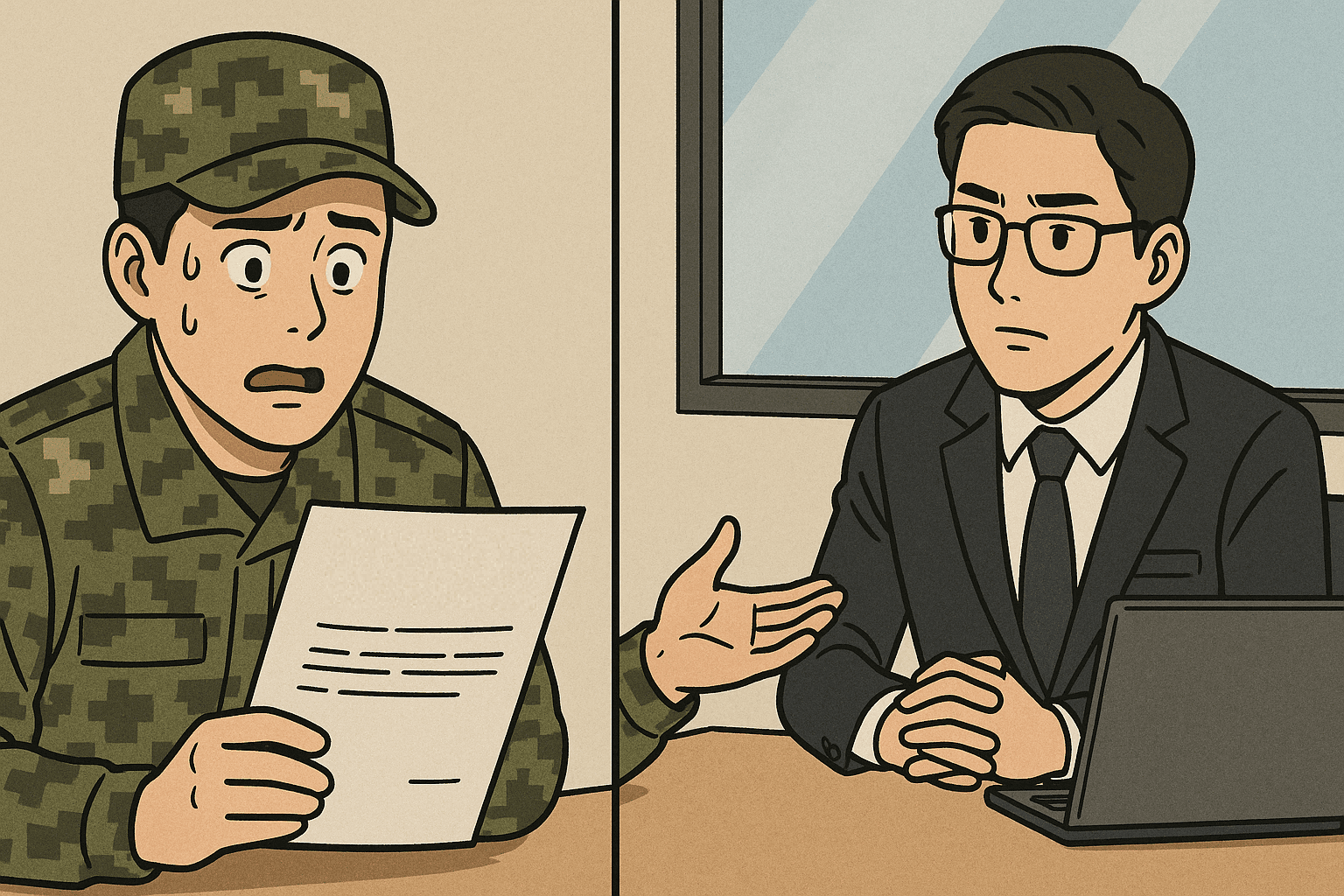
The client who requested assistance with the appeal against the military disciplinary action was an active-duty noncommissioned officer who had served for more than 30 years. His attitude toward military service was consistently diligent, and his record of commendations was excellent.
In the meantime, a service member in charge of a gender-sensitivity training course recently conducted at his unit reportedly offered to record him as having completed the course even if he did not actually attend it.
Even though the client declined this offer and clearly stated that he would complete the training himself, the service member in charge arbitrarily recorded him as having completed it.
The client's false completion record was later discovered, and the military disciplinary committee, stating that the client had recognized the misconduct yet condoned it, imposed a reprimand among the military disciplinary measures for violation of the duty of diligence.
The client appealed his sense of injustice, explaining that he had intended to attend the training himself but had been unable to control the other party's unilateral conduct.
In response, the military affairs attorney of Daeryun LLC who conducted the consultation and an administrative law attorney worked together and decided to pursue the appeal procedure against the military disciplinary action.
2. Appeal Against Military Disciplinary Action | Types of Military Disciplinary Action
Disciplinary measures against service members are classified as follows according to the severity of the violation.
| Category | Description | |
| Heavy disciplinary action | Removal, dismissal | Depriving an officer, warrant officer, or noncommissioned officer of his or her status |
| Demotion | Lowering the relevant rank by one grade | |
| Suspension from duty | Retaining the position but, for a period of not less than one month and not more than three months, being unable to perform duties and being confined in reflection at a designated place | |
| Light disciplinary action | Reduction of pay | Reducing an amount equal to one-third of pay for a period of not less than one month and not more than three months |
| Confinement in reflection | For a period of up to 10 days, performing normal duty and then reflecting on the misconduct at a designated place within the barracks specified by the disciplinary authority | |
| Reprimand | Examining the misconduct and admonishing the person so as not to commit misconduct in the future | |


3. Appeal Against Military Disciplinary Action | Explanation of the Concept
An appeal against military disciplinary action refers to a procedure by which a service member or military civilian employee requests a higher authority to correct an unjust disciplinary action.
This is an internal remedy system used within the military, through which one may contest matters such as procedural illegality of the disciplinary action, abuse of discretionary power, and violation of the principle of proportionality.
A person who has received a military disciplinary action must appeal within 30 days from the date of notification of the action, and the military disciplinary action appeal review committee examines it and reconsiders the appropriateness of the original disposition.
If, as a result of the appeal, a procedural defect or a deviation from discretionary power is recognized, the original disposition may be revoked or mitigated.
 The Procedure for Responding to a Military Disciplinary Action
The basic procedure for responding when an unjust disciplinary action has been imposed in the military is as follows.
1. Receipt of the disciplinary notice
→ Receiving the disciplinary resolution, the statement of grounds for the disposition, and similar documents, and then reviewing and examining them
2. Submission of the letter of appeal
→ Submission within 30 days from the date of receiving the disciplinary notice
3. Examination by the appeal review committee
→ Review of the grounds for appeal (procedural violations, violations of the principles of proportionality and equality, and the like)
4. Notification of the decision
→ A final decision of one of “dismissal,” “mitigation,” or “revocation”
4. Appeal Against Military Disciplinary Action | Assistance by an Attorney Experienced in Military Matters and an Administrative Law Attorney
At Daeryun LLC, an attorney experienced in military matters who is well versed in internal military procedures and an administrative law attorney with strengths in the field of administrative procedure jointly provided assistance.
Proof of the Nonexistence of a Violation of the Duty of Diligence
The attorney submitted a printout of the completion results showing that the client had in fact completed all gender-sensitivity training in the past.
On this basis, the attorney emphasized that “the client had no reason to complete the training improperly,” and this served as key evidence demonstrating the absence of any intent to violate his duty.
Analysis of the Disciplinary Committee Records and Rebuttal on the Law
The resolution of the disciplinary committee stated that “there is no evidence to overturn the point that the client had explicitly declined the offer.”
The attorney pointed out that this meant the disciplinary action itself had been imposed in a state of insufficient evidence.
In other words, the argument was that imposing a disciplinary action even though the existence of the grounds for discipline had not been proven was procedurally unlawful.
Argument of Violation of the Principles of Proportionality and Equality
Relying on Supreme Court Judgment 98Du6951, the attorney argued that “imposing a disciplinary action that is excessive relative to the degree of the misconduct violates the principle of proportionality, and failing to apply a consistent standard to conduct of the same degree violates the principle of equality.”
The attorney went on to emphasize that imposing a disciplinary action on the client, who had declined an improper offer to record course completion and was not the person actually in charge of the training, was a clear imbalance.
Presentation of Grounds Concerning Personnel and Service Disadvantages
If the disciplinary action were upheld, the client faced a situation in which he could suffer substantial disadvantages, such as forfeiture of his honorable discharge allowance and ineligibility for the award of a decoration.
The attorney presented this as a factor in assessing the substantive proportionality of the disciplinary action, emphasizing that the disciplinary outcome was excessive relative to the minor nature of the conduct.
Representation in the Appeal Procedure Against the Military Disciplinary Action
The attorney experienced in military matters prepared the letter of appeal in accordance with the disciplinary regulations (the Military Personnel Management Act, the Military Criminal Act, and the like), and the administrative law attorney logically structured the statement of grounds for the appeal around the deviation from and abuse of discretionary power, violation of the principle of proportionality, and insufficiency of evidence.
In addition, they appeared in person before the appeal review committee, presented oral arguments, and actively explained the client's innocence.
5. Appeal Against Military Disciplinary Action | Result of the Review

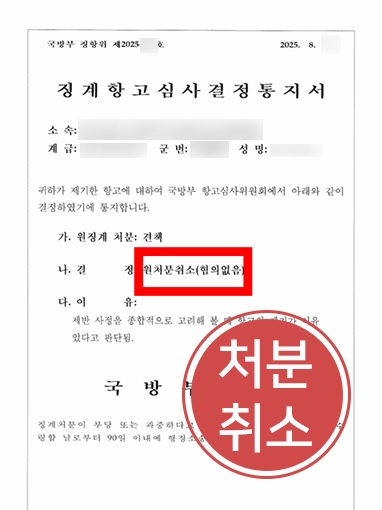
The military disciplinary action appeal review committee issued a decision revoking the reprimand imposed on the client.
The client was ultimately able to conclude his 30 years of military service honorably, and he was not excluded from the honorable discharge allowance or from consideration for commendation.
How to Respond When You Receive a Military Disciplinary Action
→ You should confirm what evidence forms the basis of the disciplinary action and immediately apply to copy and inspect it.
2. Review the procedural illegality of the disciplinary action
→ If there is a defect in the composition of the disciplinary committee or in the deliberation procedure, it is recognized as a ground for appeal.
3. Submit the letter of appeal (within 30 days)
→ If you do not appeal within 30 days from the date of notification of the disciplinary action, the right to contest it is extinguished.
4. Review whether the principles of proportionality and equality have been violated
→ If a disposition that is excessive relative to the same violation has been imposed, it can be contested on the law.
5. The assistance of an attorney is essential
→ Because internal military regulations and administrative litigation principles operate together, the assistance of an attorney with experience in military disciplinary matters is necessary.
A military disciplinary action can determine a service member's career and honor.
As in this case, if there is a violation of the principle of proportionality, insufficiency of evidence, or a procedural violation, one can be adequately relieved through an appeal against the disciplinary action.
In particular, where an attorney experienced in military matters and an administrative law attorney work together to combine proof of the facts, legal argument, and oral advocacy at the appeal review, there is a strong possibility of obtaining a decision revoking the original disposition for an unjust disciplinary action.
If you need assistance, please proceed with a 🔗legal consultation reservation.
This content is based on actual case studies of Daeryun Law LLC with some adaptations, and the copyright belongs to our firm.
Unauthorized reproduction, duplication, or distribution and other copyright infringements may result in legal action under applicable laws.