
CONTENTS
- 1. Wages Litigation | The Client's Story

- 2. Wages Litigation | The Concept of Wages
- - The Concept of Wages Litigation and Its Main Issues
- 3. Wages Litigation | The Assistance Provided by Daeryun's Corporate Attorney
- - Argument That the Additional Claim Is Unlawful Due to Res Judicata
- - Argument That the Collective Agreement Cannot Be Applied Retroactively
- - Argument of Error in the Basis for Calculating the Additional Compensation
- 4. Wages Litigation | Result
- - How to Respond When Sued by an Employee
- - The Need for a Corporate Attorney

1. Wages Litigation | The Client's Story
The client who came to Daeryun to seek assistance in defending against wages litigation was a company representative who had run a manufacturing business for more than 20 years.
The client's company had previously been through a prolonged legal dispute with an employee over an unfair dismissal issue.
That employee prevailed in the unfair dismissal lawsuit and obtained a judgment for reinstatement, but thereafter filed yet another wages lawsuit against the client's company.
The issue in this lawsuit was a claim for unpaid wages during the period of the unfair dismissal and for an additional compensation amount under the collective agreement.
The employee, who was the plaintiff in this case, claimed an additional amount on the basis that a collective agreement newly concluded during the period of the unfair dismissal lawsuit included a clause providing that, in the event of an unfair dismissal, an additional 50% of wages would be paid.
Feeling that it was unjust that a duplicative claim was again being raised even though the company had already lost the unfair dismissal lawsuit and had sufficiently compensated the employee, the client sought the assistance of Daeryun's corporate attorney.

2. Wages Litigation | The Concept of Wages
The Labor Standards Act defines wages as all money and valuables that an employer pays to an employee as compensation for work, whether under the name of wages, salary, or any other name.
In other words, wages are compensation for work provided under an employment contract, and they are calculated based on the hours the employee actually worked and on work performance.
Wages include not only the base pay but also various allowances (overtime, night work, and holiday allowances, position allowances, performance pay, and the like), and the employer has the duty to calculate and pay them accurately.
 The Concept of Wages Litigation and Its Main Issues
Wages litigation is a civil lawsuit in which an employee claims against an employer for unpaid wages, severance pay, allowances, or an amount equivalent to wages during a period of unfair dismissal.
Most cases arise from disputes over the interpretation of the Labor Standards Act, the collective agreement, and the employment contract.
The core issues in wages litigation such as this case are as follows.
① Whether a wage claim exists: A determination of whether work was actually performed and whether a contractual duty to pay remains
② The scope of application of the collective agreement: A legal dispute over the time of conclusion of the collective agreement and its scope of application
③ Res judicata: The legality of an additional claim where a final and binding judgment already exists on the same matter
④ The standard for calculating wages: The validity of calculating the base amount, such as working hours, ordinary wages, and average wages
In this case, it was precisely res judicata and the timing of the application of the collective agreement that emerged as the main issues.


3. Wages Litigation | The Assistance Provided by Daeryun's Corporate Attorney
From the early stage of the case, Daeryun's corporate attorney established a defense strategy focused on the res judicata of the prior lawsuit (the unfair dismissal lawsuit) and the impossibility of retroactively applying the collective agreement.
The attorney developed the following legal reasoning at each stage.
Argument That the Additional Claim Is Unlawful Due to Res Judicata
The corporate attorney first emphasized that an additional wage claim for the period of the unfair dismissal conflicts with the res judicata of the lawsuit that had already concluded.
This was based, in accordance with the precedent below, on the point that unless only part of a divisible claim is sought while reserving the remainder, the effect of a final and binding judgment extends to the entire claim.
In addition, in accordance with the precedent below, the attorney argued that a subsequent action repeating the same claim is unlawful because there is no "interest in protecting the right".
On this basis, the attorney highlighted that the plaintiff's additional wage claim was identical to the matter already adjudicated in the unfair dismissal lawsuit and therefore could not be claimed again.
Argument That the Collective Agreement Cannot Be Applied Retroactively
Next, the corporate attorney argued that the additional compensation clause for unfair dismissal under the collective agreement applies only to dismissals occurring after the time that collective agreement was concluded.
The attorney made clear that, because the dismissal in this case occurred before the date the collective agreement was concluded, there was no room for the additional compensation clause under the collective agreement to apply.
The point was that a collective agreement applies, in principle, to employment relationships arising after the time of its conclusion, and it cannot be retroactively applied to a past dismissal or to a matter that has already concluded.
On this basis, the attorney proved that the 50% additional payment claimed by the plaintiff was a claim without any legal basis.
Argument of Error in the Basis for Calculating the Additional Compensation
The corporate attorney argued that, even if the collective agreement were to apply, the basis for calculating the additional compensation was incorrect.
Even if the dismissal was rendered retroactively void by the final and binding judgment on the unfair dismissal, this merely means that the legal effect of reinstatement arose; it does not mean that the additional compensation is retroactively applied even to the period before the collective agreement was concluded.
Accordingly, the corporate attorney submitted that the additional payment should be calculated only for the period from the date the collective agreement was concluded to the date of reinstatement to the original position, and that the period before that could not be the subject of the claim.
4. Wages Litigation | Result

The court accepted all of the arguments made by Daeryun's corporate attorney.
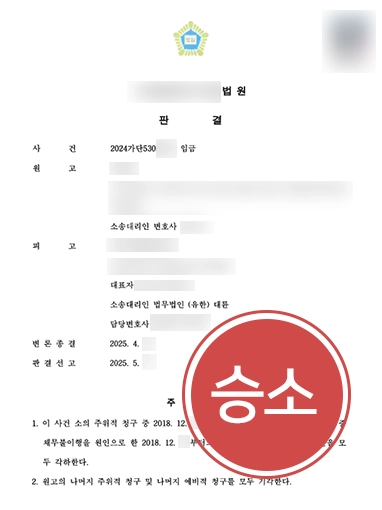
The court rejected the additional wage claim as unlawful because it conflicted with the res judicata of the prior lawsuit, and dismissed the additional compensation portion as being without merit because the collective agreement did not apply.
In other words, it was clearly recognized that the company had no obligation to pay the plaintiff any additional compensation, and the prolonged dispute was brought to a close.
How to Respond When Sued by an Employee
When a company is sued in employee-related litigation such as wages litigation, a lawsuit for confirmation of the nullity of dismissal, or an unfair labor practice lawsuit, it should respond in the following order.
Stage | Response Point | Practical Advice |
① Immediately After Receiving the Complaint | Organizing the facts and securing evidence | Collecting the dismissal date, payment statements, the collective agreement, the written judgment, and the like |
② Legal Review | Reviewing res judicata, the statute of limitations, and whether the collective agreement applies | Confirming whether the claim is duplicative |
③ Establishing a Response Strategy | Organizing the defense reasoning and submitting an answer | Distinguishing the portions that can be dismissed |
④ Responding at Trial | Attending the hearing dates and submitting materials | Argumentation on both the legal and factual sides is required |
⑤ Responding After the Judgment | Reviewing whether to appeal and checking corporate risks | Building a system to prevent the recurrence of the same dispute |
The Need for a Corporate Attorney
Wages litigation is a complex matter in which labor law, civil law, the collective agreement, and the legal principles of res judicata intersect.
In particular, the relationship with a prior lawsuit, the extinctive prescription, and the validity of the collective agreement involve difficult legal interpretation, so professional assistance is absolutely necessary from the early stage of the response.
The corporate attorney collaborates with related legal experts, such as labor attorneys, to accurately analyze the legal foundation of the case, construct defense reasoning based on the interpretation of precedents and the collective agreement, and provide a systematic response so that the company's future labor risks can be examined.
As in this case, even where additional wages litigation is filed after an unfair dismissal, unnecessary losses can be prevented if the legal principles are clearly interpreted and a response strategy is established.
🔗Legal Consultation Reservation If you seek the assistance of our firm's corporate attorney, we will provide a one-stop service that covers not only the litigation response but also consulting to block any legal risks that may arise.
This content is based on actual case studies of Daeryun Law LLC with some adaptations, and the copyright belongs to our firm.
Unauthorized reproduction, duplication, or distribution and other copyright infringements may result in legal action under applicable laws.