
CONTENTS
- 1. The Client Who Sought a Corporate Litigation Attorney

- - The Corporate Client's Story
- - The Key Issues of the Corporate Litigation Concerning Service Fees
- 2. The Assistance Provided by the Corporate Litigation Attorney
- - Corporate Litigation Defense Strategy ① | Emphasizing the Conditional Nature of the ‘Order of Fund Disbursement’
- - Corporate Litigation Defense Strategy ② | Shifting the Burden of Proof and Developing the Argument of Non-Fulfillment of the Condition
- - Corporate Litigation Defense Strategy ③ | Comprehensive Review of the Validity of the Contract and the Structure of Interests
- 3. The Result of the Corporate Litigation Attorney's Assistance, Successful Defense of the Entire 700 Million Won
- - Examining the Statutes Relating to Corporate Service Fee Litigation
- - If Your Company Has Been Sued in Corporate Litigation
- - FAQ on Service Fee Claim Lawsuits

1. The Client Who Sought a Corporate Litigation Attorney
This case, handled by a corporate litigation attorney, was a claim for service fees arising in connection with an apartment housing development project.
 The Corporate Client's Story
The client was the representative of a mid-sized corporation engaged in real estate development and leasing, and was carrying out a project structured as a management-type land trust in cooperation with a developer.
After the project ended, the developer filed a lawsuit, claiming that it had “performed the overall project management services but had not been paid the service fees of 700 million won.”
However, under the actual contract structure, the service fees were a conditional claim that could be paid only after the construction costs and project costs had all been settled.
In other words, even though that precondition had not yet been satisfied, the other party made its claim as if the client had broken a promise.
Bewildered by the unexpected, large claim, the client felt extreme anxiety, asking, “Should I unjustly have to pay money that I have no legal obligation to pay?”
Accordingly, the client requested the assistance of a corporate litigation attorney who could precisely analyze the structure of the matter and the principles of contract law.



The Key Issues of the Corporate Litigation Concerning Service Fees
The essence of this corporate litigation was not whether the services had been performed, but whether the service fees had actually reached a ‘payable state.’
In other words, it depended on whether the payment condition had been fulfilled.
① The Legal Nature of the Agreement on the Order of Fund Disbursement
If this clause is not a mere ordering provision but a ‘conditional claim,’ the service fees cannot be claimed until all of the senior-priority costs have been processed.
② The Burden of Proving Fulfillment of the Condition Precedent
If the plaintiff cannot prove this, the claim does not legally hold.
③ The Authentic Establishment of the Contract and the Legality of the Internal Approval Procedure
These were major issues that would determine the validity of the contract.
④ The Company's Internal Decision-Making and the Possibility of a Conflict of Interest
In addition, a conflict of interest between the other party and persons related to the company, as well as whether there was self-dealing, had to be carefully reviewed.
2. The Assistance Provided by the Corporate Litigation Attorney

The corporate litigation attorney identified, as the key issue of the case, the problem of a claim subject to a condition based on the order of fund disbursement within the trust business structure.
The attorney then provided the following assistance so that the corporate client would not bear unjust service fees.
Corporate Litigation Defense Strategy ① | Emphasizing the Conditional Nature of the ‘Order of Fund Disbursement’
The corporate litigation attorney viewed the core of the case as the fund flow structure of the trust business.
Accordingly, the attorney interpreted the clause specified in the contract, “payment of the remaining funds after the priority disbursement of construction costs and project costs,” not as a mere timing provision but as an agreement subject to a condition precedent, and established the argument that “there is no obligation to pay because the condition has not yet been fulfilled”.
The attorney emphasized that this also accords with the purport of the following Supreme Court judgment.
Supreme Court Judgment of June 29, 2023, Case No. 2023Da221830
Corporate Litigation Defense Strategy ② | Shifting the Burden of Proof and Developing the Argument of Non-Fulfillment of the Condition
In accordance with the above argument, the corporate litigation attorney focused on the point that the plaintiff must prove the fulfillment of the condition precedent.
The attorney then pointed out that no specific evidence existed as to whether the construction costs and project costs had all been paid in full.
Accordingly, the attorney emphasized that the claim in this case was a groundless claim filed without the legal requirements having been satisfied.
Corporate Litigation Defense Strategy ③ | Comprehensive Review of the Validity of the Contract and the Structure of Interests
In addition to the key issues above, the corporate litigation attorney also carefully reviewed ancillary issues such as the authentic establishment of the contract, the resolution of the board of directors, and the conflict-of-interest structure, and established an all-around defense strategy.
The attorney also examined all of the preparation, sealing, and approval procedures of the contract documents.
Through this, the attorney clearly established the “legality of the conclusion of the contract” and the “substantive validity of the service fee agreement,” thereby securing the initiative in the litigation.
3. The Result of the Corporate Litigation Attorney's Assistance, Successful Defense of the Entire 700 Million Won

The court, having reviewed the corporate litigation attorney's argument that the agreement on the order of fund disbursement had the effect of a condition precedent and the argument that the plaintiff had failed to prove the fulfillment of that condition, accepted all of these arguments.
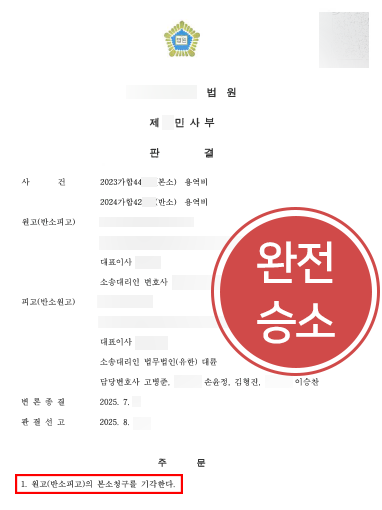
In the end, the court rendered a judgment dismissing the entire claim for service fees of 700 million won, and the client was able to escape from an enormous financial burden and breathe a deep sigh of relief.
The Court's Reasoning for the Judgment
“Based solely on the materials submitted by the plaintiff, it is difficult to recognize that the time for payment of the service fee claim has arrived, and there is no other evidence sufficient to recognize this.”
Examining the Statutes Relating to Corporate Service Fee Litigation
A claim for service fees is generally filed based on a company's ‘contract for work’ relationship.
The Civil Act provides for the formation of a contract for work and the time of payment of remuneration as follows.
Article 664 of the Civil Act (Definition of a Contract for Work)
Article 665 of the Civil Act (Time of Payment of Remuneration)
In other words, the obligation to pay service fees arises only when the task is completed pursuant to the contract for work.
However, where, as in this case, the order of fund disbursement under a trust business structure has been separately agreed, the obligation to pay does not arise immediately merely because the services have been completed.
Only when the condition precedent of the completion of disbursement of the senior-priority costs is fulfilled can the service fees, which are a junior-priority claim, be finalized.
If Your Company Has Been Sued in Corporate Litigation
This case went beyond a simple contract interpretation; it was a complex lawsuit that required a comprehensive analysis of the business structure, fund flows, and board approval procedures.
The corporate litigation attorney reconstructed the essence of the case based on multilayered legal principles, including finance, contracts, and trusts, and obtained a legal determination favorable to the client.
The client expressed deep gratitude, stating, “I am relieved to have been freed from an unjust claim and to be able to operate the company normally.”
At Daeryun Law Firm, we provide client-tailored assistance based on the experience and know-how gained from handling a range of complex corporate matters, including corporate litigation, contract disputes, and management control disputes.
Through a collaborative system of specialized personnel, including corporate legal attorneys, certified public accountants, tax accountants, labor consultants, and patent attorneys, we resolve cases from multiple perspectives. Please feel free to request assistance at any time through 🔗Legal Consultation Reservation.
FAQ on Service Fee Claim Lawsuits
A. If the degree of performance of the services differs from the terms of the contract, you may assert a reduction on the grounds of incomplete performance or partial performance.Q. Corporate litigation attorney, the other company performed only part of the services but is claiming the full amount. How should we respond?
Because the court determines the matter based on the actual contribution of the services and the completeness of the deliverables, the company should secure evidence such as deliverable inspection records, reports, and emails pointing out deficiencies.
A. Service fees are consideration premised on “the provision of the services.”Q. Corporate litigation attorney, we signed the contract, but the other company did not actually perform the work. Do we still have to pay the service fees in such a case?
Accordingly, if the other party did not substantially perform the work under the contract, no obligation to pay arises.
In practice, the key is to prove the “nonexistence of service performance” through records, work logs, reporting details, and delivery records.
This content is based on actual case studies of Daeryun Law LLC with some adaptations, and the copyright belongs to our firm.
Unauthorized reproduction, duplication, or distribution and other copyright infringements may result in legal action under applicable laws.