
CONTENTS
- 1. Immigration Act | Main Contents

- - Key Terms and Basic Concepts
- 2. Immigration Act | Laws and Regulations on Nationals' Entry and Departure
- 3. Immigration Act | Entry Procedure for Foreigners
- - Entry Screening and Entry Denial
- - Status of Stay for Foreigners
- - Points to Note When Foreigners Seek Employment
- - Permanent Residency Status for Foreigners
- 4. Immigration Act | Deportation and Detention Order
- 5. Immigration Act | Sanctions for Illegal Stay and Employment of Residents
- - Liability of Violating Companies for Employing Illegal Residents
- - Expansion of the Employment Quota for Foreign Workforce (E-9)
- 6. Immigration Act | Summary of Penalties for Violations and Response Measures
- - Retaining an Attorney Who Can Respond Quickly

1. Immigration Act | Main Contents

The Immigration Act is a representative law governing foreigners that regulates overall matters such as the entry, stay, and departure of nationals and foreigners of the Republic of Korea, enacted to facilitate international exchange while maintaining national security and public order.
The Immigration Act regulates the rights and obligations of foreigners residing in Korea, and at the same time, it sets out the methods of departure for Koreans, as well as the obligations that employers such as companies must observe when hiring foreigners or supporting their stay.
The crackdown on illegal residents and deportation procedures, changes to status of stay within the country, and regulations related to permanent residency and refugees are all administered within the framework of the Immigration Act.
 Key Terms and Basic Concepts
The Immigration Act clearly defines the related terms that are frequently used.
Representative examples include ‘foreigner,’ ‘status of stay,’ ‘visa,’ ‘illegal resident,’ and ‘deportation order.’
2. Immigration Act | Laws and Regulations on Nationals' Entry and Departure
Under the Immigration Act, a national of the Republic of Korea must undergo departure screening before departing.
However, in the following cases, departure is prohibited for a period within 6 months.
- When a criminal trial is ongoing
- When the execution of a sentence of imprisonment with or without labor has not been completed
- When a fine of 10 million won or more, or national taxes of 50 million won or more, remain unpaid
- When a person liable for child support has been through deliberation by the Child Support Enforcement Deliberation Committee or similar
In addition, if a person is a criminal suspect suspected of having committed a crime punishable by the death penalty, life imprisonment, or imprisonment for a definite term of 3 years or more, and there is a concern that the suspect may destroy evidence or flee, an emergency departure ban may be decided.
A person may file an objection to a decision imposing a departure ban or extending the ban period within 10 days of receiving the decision.


3. Immigration Act | Entry Procedure for Foreigners

Under the Immigration Act, in order for a foreigner to enter the Republic of Korea, the foreigner must in principle hold a visa (VISA).
However, nationals of countries with mutual visa-waiver agreements or visa exemption agreements may exceptionally enter without a visa.
A visa is issued by an overseas diplomatic mission (embassy or consulate general), and when applying, the applicant must submit a passport, an invitation letter, documents proving the purpose of stay, and similar items.
The required documents vary depending on the purpose, such as study (overseas study), employment, or investment, and if false documents are submitted, the issuance of the visa is denied.
Entry Screening and Entry Denial
When a foreigner enters through an airport or seaport, an immigration officer conducts entry screening.
If necessary, an interview may be conducted in a waiting room for additional investigation, and if the purpose of entry is unclear or a false statement is found, entry may be denied.
In addition, a person who has an infectious disease, a drug addict, or a person attempting to enter while unlawfully carrying a gun, knife, or similar item is prohibited from entering.
Status of Stay for Foreigners
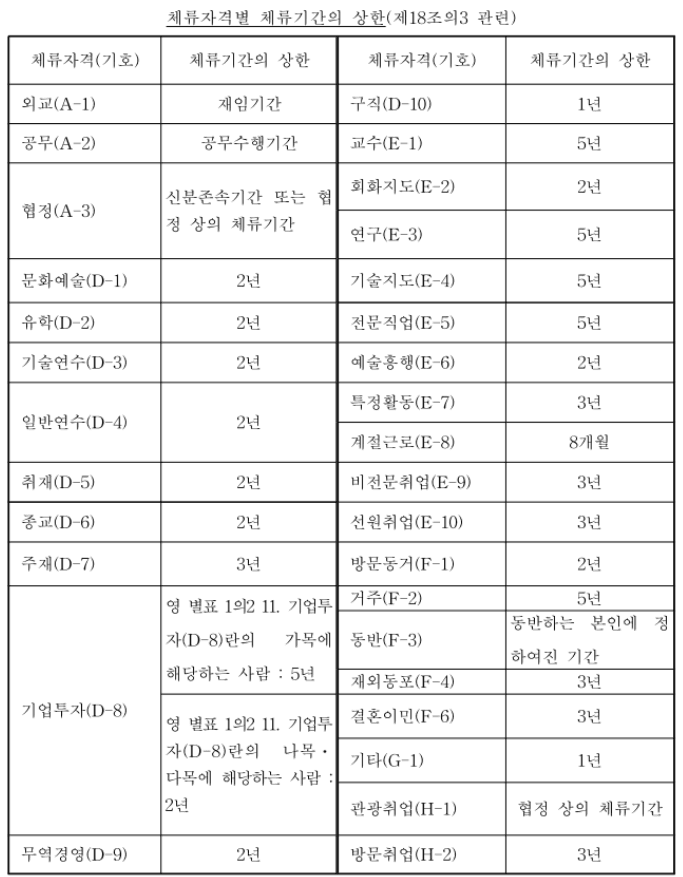
The Immigration Act broadly divides foreigners' status of stay into general status of stay and permanent residency status.
Each status of stay strictly limits the scope of activity and the period of stay, and a violation is regarded as illegal stay, which may result in deportation or a fine.
In particular, after lawfully entering, a foreigner must apply for a change permit if a change of status of stay becomes necessary.
Short-term status of stay (90 days or less) | May stay in the Republic of Korea for the purpose of tourism or a visit |
Long-term status of stay (more than 90 days) | May stay in the Republic of Korea for purposes such as study, training, investment, dispatch, or marriage |
Permanent residency status | May reside in the Republic of Korea permanently, without limitation on the scope of activity or the period of stay |
Points to Note When Foreigners Seek Employment
In order for a foreigner to obtain employment in the Republic of Korea, a status of stay that permits employment activity is required.
Companies, too, must not employ a foreigner who holds a status of stay in such a way that the foreigner works at a place other than the designated workplace.
If, after employing a foreigner, there is a dismissal, a change in the contents of the employment contract, or a similar event, a report must be made to the head of the local immigration and foreigner office within 15 days.
Permanent Residency Status for Foreigners
In order for a foreigner to hold permanent residency status, the following requirements are necessary.
- Stay in the Republic of Korea for 5 years or more under a specific status of stay
- Stay for 2 years or more as the spouse or minor child of a national or a person holding permanent residency status
- A foreign investor who has invested 500,000 U.S. dollars (plus employment of 5 or more nationals)
- Having made a special contribution to the Republic of Korea
- Having outstanding ability in science, business, education, culture and the arts, or similar fields
In addition, the person must be of upright conduct, such as complying with the statutes of the Republic of Korea, and must have the ability to maintain a livelihood through the income or assets of themselves or their family, or otherwise possess the basic competencies needed to live in Korea.
4. Immigration Act | Deportation and Detention Order

Under the Immigration Act, ‘deportation (expulsion)’ is the most severe disposition that the Minister of Justice may issue on their own authority where a foreigner residing in the country violates the statutes or the status of stay has lapsed.
Not only illegal residents but also those caught engaging in a sham marriage, a false student status, activities outside their employment qualification, smuggling themselves into the country, or similar acts are immediately subject to the deportation procedure.
At this point, the foreigner may be temporarily held in a forced-departure detention facility, and this is called a ‘detention order.’
A detention order is a procedural mechanism that holds a foreigner in a detention facility during the period leading up to deportation in order to prevent flight and verify identity.
The detention period is, in principle, within 10 days, but in practice it is sometimes extended due to factors such as securing a return airline ticket or obtaining the cooperation of the home country's embassy.
5. Immigration Act | Sanctions for Illegal Stay and Employment of Residents
A representative violation of the Immigration Act is a foreigner's exceeding the period of stay.
Article 94 of the Immigration Act provides that an administrative fine may be imposed on a person who violates this.
If false facts are uncovered, such as submitting forged documents in order to unlawfully extend the period of stay, illegal employment in an industry outside the permitted scope of stay, or a sham marriage, a deportation order is issued, and entry restriction measures are applied in conjunction.
If the violation is minor, a person may receive a recommendation to depart, and in this case, a departure order is not issued if the person voluntarily departs within 5 days.
However, if a person receives a recommendation to depart and still fails to comply, a departure order or deportation order is issued, and entry itself may subsequently be prohibited for several years.
Liability of Violating Companies for Employing Illegal Residents
The Immigration Act also imposes liability on Korean nationals and corporations that employ foreigners.
Representatively, a violation of the following obligations may result in an administrative fine or criminal punishment.
A company must, before hiring a foreign worker, verify the worker's lawful status of stay and whether employment is permitted.
In addition, if a foreign worker is found to be in an illegal stay, this can result not only in deportation but also in an adverse effect on the company's quota for employing foreign workers, so regular verification of qualifications and retention of related records are required.
Expansion of the Employment Quota for Foreign Workforce (E-9)
The government has set the scale of introduction of foreign workforce (E-9) for 2025 at 130,000 persons, giving priority allocation to industries facing serious labor shortages such as manufacturing and agriculture and livestock farming, and has separately organized a flexible allocation of 32,000 persons so as to respond to unexpected increases in demand arising from factors such as economic fluctuations.
Employers must lawfully hire foreign workforce within the quota allocated to their industry, and they should also note that they must undertake efforts to recruit domestic workers (at least 7 days) before obtaining an employment permit.
- Compliance with the Immigration Act when employing foreign workforce
- Compliance with labor standards statutes, including no discrepancy in working conditions
- Restriction of employment permits upon designation as an employer with habitual wage arrears
6. Immigration Act | Summary of Penalties for Violations and Response Measures
Illegal entry of foreigners, arranging it, or assisting in concealing or helping an illegal entrant escape | Imprisonment for up to 7 years or a fine of up to 70 million won |
A person who entered without entry screening | Imprisonment for up to 5 years or a fine of up to 50 million won |
Departure without departure screening, violations such as a false invitation, and illegal residents | Imprisonment for up to 3 years or a fine of up to 30 million won |
A person who, in violation of the employment restriction for foreigners, worked at a place other than the designated workplace | Imprisonment for up to 1 year or a fine of up to 10 million won |
Arranging or soliciting the employment of a foreigner who lacks a status of stay permitting employment activity | A fine of up to 5 million won |
Violation of the obligation to carry and present a passport | A fine of up to 1 million won |
Violation of a foreign-worker employer's reporting obligation | An administrative fine of up to 2 million won |
The Immigration Act makes punishable not only the violations committed by foreigners but also Korean nationals and employers who aid illegal stay or provide forged documents.
In addition, brokers who arrange illegal employment and entry are detected and subjected to arrest and punishment, and a penalty is also imposed on employers who hired illegal residents.
In line with its plan to reduce illegal stay, the Ministry of Justice is pursuing a strict enforcement policy, and the number of illegally residing foreigners in the country has shown a decrease from 430,000 in October 2023 to 394,000 in January 2025.
Retaining an Attorney Who Can Respond Quickly
Punishment for immigration offenses goes beyond personal disadvantage and directly affects a company's credibility.
In industries subject to foreign employment quotas (construction, manufacturing, agriculture and livestock, and others), a single detected instance of illegal employment can lead to quota reductions or recruitment restrictions, dealing a serious blow to operations.
Before hiring a foreign national, an employer should verify the residence status, visa validity, and the presence of any false documents, and if there are suspicious circumstances, the employer should immediately consult an attorney experienced in immigration matters and others.
To contest an objection or take similar action in an immigration case, speed is key.
At Daeryun, Korea's ninth-largest law firm (based on 2025 value-added tax filings with the National Tax Service), legal professionals with strong expertise in immigration law and the Immigration Control Act, including foreign attorneys advising on U.S. law (United States), international trade attorneys, and international trade specialists, collaborate to review the client's case.
The firm also provides legal assistance across a range of areas related to the Immigration Control Act, including visa issuance, residence permits, immigration applications, and entry restrictions and customs clearance procedures.
If you need advice regarding the Immigration Control Act, you may at any time 🔗submit a request for a consultation with a customs attorney.
See More