
CONTENTS
- 1. Indecent Act by Compulsion against Military Personnel | Details of the Case

- - Background of the Incident
- 2. Indecent Act by Compulsion against Military Personnel | Assistance Provided by the Military Law Attorney
- - Review of the Credibility and Consistency of the Complaint
- - Legal Defense Through Citation of Supreme Court Precedent
- - Rebutting the Credibility of the Complainants' Statements and Presenting Contrary Circumstances
- 3. Indecent Act by Compulsion against Military Personnel | Result of the Case
- - Provisions for Punishment of an Indecent Act by Compulsion against Military Personnel
- - Key Points for Responding to a Wrongful Allegation
- 4. Indecent Act by Compulsion against Military Personnel | The One-Stop Response of Daeryun LLC
- - Daeryun LLC's Strategy

1. Indecent Act by Compulsion against Military Personnel | Details of the Case

This is the account of a client who sought the assistance of a military law attorney, stating that he was under suspicion of an indecent act by compulsion against military personnel.
 Background of the Incident
The client, an active-duty corporal, was accused of an indecent act by compulsion against military personnel by fellow enlisted soldiers who served in the same barracks within his unit.
The complainants alleged that the client had repeatedly engaged in inappropriate physical contact, such as fondling their chests and slapping their buttocks.
The client, however, completely denied these allegations.
On the contrary, it was the complainants who had frequently harassed the client through physical contact or tormented him with sexual words and conduct within the unit.
The client said that, although several sexual misconduct incidents had already occurred within the same platoon, he had hesitated to report them for the reason that he did not want to create yet another problem.
However, when he said, “I will no longer tolerate this; if anything like that happens one more time, I will file a complaint,” the complainants, on the contrary, filed a retaliatory complaint.
The client, who pleaded his innocence, prepared his defense with the assistance of a military law attorney.


2. Indecent Act by Compulsion against Military Personnel | Assistance Provided by the Military Law Attorney
Given the nature of this case, the military law attorney established a step-by-step response strategy that took into account all relevant factors, including the closed organizational structure, the culture of strict hierarchy, and the procedural characteristics of military cases.
Review of the Credibility and Consistency of the Complaint
A comparative analysis of the complainants' statements confirmed that their specific descriptions of time, place, and circumstances were inconsistent and that there were numerous contradictions among their mutual statements.
In particular, in order to prove that the alleged time of the harm did not match the actual service schedule, the barracks duty records, the duty officer's log, and the service log, among others, were obtained.
Legal Defense Through Citation of Supreme Court Precedent
The defense presented the Supreme Court precedent holding that, in a sex crime, guilt cannot be established on the basis of the victim's statement alone and that the objective credibility of that statement must be assured (Supreme Court Decision 2009Do12048).
Through this, the defense emphasized that it is difficult to prove the fact of a crime on the basis of mere emotional statements or unclear circumstances.
Rebutting the Credibility of the Complainants' Statements and Presenting Contrary Circumstances
By submitting the full text of the diary kept by the client as evidence, the defense specifically proved that the client had been subjected to continuous sexual harassment and inappropriate words and conduct by the complainants.
The defense supported the circumstances of the indecent act by obtaining statements from fellow service members establishing that the complainants had, on the contrary, first attempted physical contact with the client.
In addition, pointing out that the complaint was filed immediately after the client said that he would respond legally the next time, the defense emphasized that there was a high likelihood that the complaint was a false report made for the purpose of retaliation.
3. Indecent Act by Compulsion against Military Personnel | Result of the Case
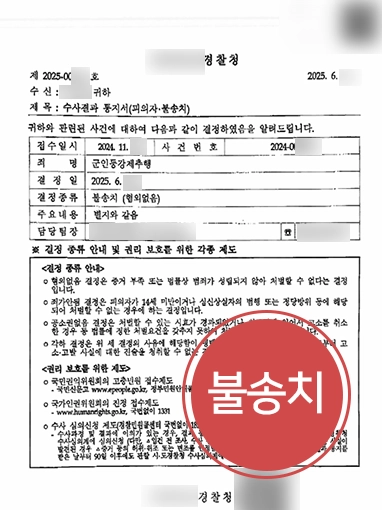
The police acknowledged that ① the complainants' statements were mutually contradictory, ② objective evidence was lacking, and ③ there was a possibility that the client was, on the contrary, the victim.
Accordingly, a non-referral decision was rendered on the charge of an indecent act by compulsion against military personnel.
‘Non-referral’ refers to a disposition in which, where the fact of a crime is not established, the police conclude the case at the police stage without referring it to the prosecutors.
This is, in effect, a decision that removes the risk of criminal punishment.
Provisions for Punishment of an Indecent Act by Compulsion against Military Personnel
Article 92-3 of the Military Criminal Act provides as follows.
“A person who commits an indecent act against military personnel by violence or intimidation shall be punished by imprisonment for a definite term of not less than 1 year.”
This provision sets a far stricter standard than the crime of indecent act by compulsion under the general Criminal Act, as the option of a fine is not available and the offense must necessarily be punished by imprisonment or heavier.
Here, military personnel and the like include the following persons.
· Officers, warrant officers, noncommissioned officers, and enlisted personnel serving on active duty
· Military civilian employees, military academy cadets, noncommissioned officer candidates, and other students holding military status
· Reservists and supplemental service personnel called up for service
In other words, it applies equally to members of all ranks belonging to the military.
| Category | Specific Content |
|---|---|
| Status of the victim | Active-duty service members (officers, noncommissioned officers, enlisted personnel), military civilian employees, military academy cadets, noncommissioned officer candidates, called-up reservists, and others |
| Existence of an indecent act | Includes not only physical contact but also cases in which words or conduct cause a sense of sexual humiliation |
| Causal link of violence or intimidation | The violence or intimidation must be the cause that made the indecent act possible (a sudden indecent act is also recognized as involving violence or intimidation) |
| Intent | The act must be one carried out with sexual intent |
| Whether there was consent | Where the victim voluntarily complied, it is difficult to establish an indecent act by compulsion |
Key Points for Responding to a Wrongful Allegation
· Securing consistency at the early statement stage
– Because an unfavorable statement made early in the investigation is difficult to rebut afterward, statements must be given with the assistance of an attorney.
· Securing objective material
– Materials that prove a ‘pattern of daily life,’ such as a diary, text messages, KakaoTalk messages, and a duty log, become key evidence against a presumption of guilt.
· Analyzing whether there was a retaliatory purpose
– A motive analysis that takes into account interpersonal relationships within the military organization, service conflicts, and the chain of command is necessary.
· Considering the distinctive features of military investigative agencies
– The investigation process of the military police is faster than ordinary criminal procedure, and the proportion of statements that are reduced to a written record is high, so an early response is very important.
· Being mindful of military disciplinary action
– Separately from the criminal outcome, internal military disciplinary action (such as demotion or discharge) may proceed in parallel, so a response on both the criminal and administrative fronts is necessary.
4. Indecent Act by Compulsion against Military Personnel | The One-Stop Response of Daeryun LLC

Daeryun LLC maintains a system in which a military law attorney, a sex crime attorney, and a digital forensics center and an evidence investigation center (partner companies) work in collaboration.
In this case as well, the firm did not stop at ‘asserting that there was no charge’ but obtained fact-based evidence from multiple angles, including the client's military service records, barracks CCTV footage, and text message conversation histories, and it composed an integrated defense strategy that also took into account the risk of internal military disciplinary action.
As a result, through the non-referral decision, the client was relieved from the military police investigation and was able to continue his military service normally.
Daeryun LLC's Strategy
A sexual misconduct case involving a person in military status is treated far more seriously than an ordinary criminal case.
Article 92-3 of the Military Criminal Act provides only for imprisonment for a definite term of not less than 1 year, with no option of a fine, so becoming the subject of an investigation on a wrongful allegation can jeopardize an entire military career.
Therefore, from the early investigation-response stage, the assistance of a military law attorney well versed in the Military Criminal Act and military trial procedure is essential.
If objective evidence and consistency of statements are secured, a non-referral conclusion can be achieved, as in this case.
After resolving his grievance through the non-referral decision, the client in this case is, with the assistance of a military law attorney, preparing a counter-complaint against the complainants.
If you need legal assistance in a similar situation, please proceed with Daeryun LLC 🔗Schedule a Legal Consultation with an Attorney.
The firm maintains branch offices throughout the country, so you can quickly arrange a consultation near the region where you are serving.
Daeryun provides tailored legal services.
This content is based on actual case studies of Daeryun Law LLC with some adaptations, and the copyright belongs to our firm.
Unauthorized reproduction, duplication, or distribution and other copyright infringements may result in legal action under applicable laws.