
CONTENTS
- 1. A Client Facing the Risk of Intrusion Upon Habitation Charges

- - The Detailed Background of the Case
- 2. The Assistance Provided to Defend Against Intrusion Upon Habitation Charges
- - Organizing the Facts and Establishing the Slightness of the Criminal Intent
- - Emphasizing the Reflective Attitude and Cooperation With the Police Investigation
- - Support for the Settlement With the Victim
- 3. Successful Defense Against Intrusion Upon Habitation Charges, Concluded With a “Suspended Sentence”
- 4. The Sentence for Intrusion Upon Habitation Charges and the Sentencing Factors
- - The Level of Punishment and the Sentencing Factors
- - FAQ on the Crime of Intrusion Upon Habitation
- 5. If You Need to Defend Against Intrusion Upon Habitation Charges

1. A Client Facing the Risk of Intrusion Upon Habitation Charges
A client facing the risk of punishment for intrusion upon habitation, who had entered the home where a coworker resided out of curiosity and was discovered, requested assistance to defend against criminal punishment.
 The Detailed Background of the Case
The client in this case was an ordinary office worker who had a personal acquaintance with a coworker.
The coworker, as a joke, told the client the door code to his home, and the client, taking advantage of the moment while the coworker was out, entered out of curiosity.
However, the coworker returned home earlier than expected, the client was discovered on the spot, the matter was reported to the police, and the client was referred for trial on the charge of intrusion upon habitation.
In response, the client requested assistance from a criminal law specialist attorney in order to minimize the anxiety about the possibility of punishment as well as the social and occupational harm.



2. The Assistance Provided to Defend Against Intrusion Upon Habitation Charges
The core issue in this case was whether the client entered the residence out of mere curiosity, or whether there was an unlawful intent sufficient to infringe upon the peace of the residence.
When determining whether the crime of intrusion upon habitation is established, the court focuses on whether the actual peace of the residence was disturbed, as well as on the motive for the entry and the method of the offense, rather than on the mere act of entry itself.
Accordingly, the criminal attorney concentrated on the following matters in order to maximize the defense against the client’s punishment.
▷ Emphasizing the low risk of reoffending
▷ The possibility of a settlement with the victim
Organizing the Facts and Establishing the Slightness of the Criminal Intent
The criminal attorney organized in detail the circumstances, the motive, and the situation at the time of the client’s entry and submitted them to the investigative authorities and the court.
The attorney established that there was no sexual or theft-related purpose, that the visit was made out of mere curiosity, and that there was no damage to property or theft of any kind.
In addition, the attorney emphasized the fact that the client was a first-time offender with no prior record of the same type of offense and highlighted that the criminal intent was slight.
Emphasizing the Reflective Attitude and Cooperation With the Police Investigation
The criminal attorney emphasized that the client had been sincerely reflecting on his conduct from the early stage of the case.
The attorney also emphasized that, during the police investigation, the client actively admitted the facts and cooperated, and that he did not cause any unnecessary delay or confusion in the progress of the investigation.
Through this, the attorney emphasized that the client’s criminal intent was slight and that his attitude of seeking to observe social norms was clear.
Support for the Settlement With the Victim
Considering that an unfavorable situation could arise if the client and the victim made direct contact, the criminal attorney conveyed the intent to settle on behalf of the client and led the settlement process.
To ease the victim’s anxiety, the attorney coordinated both in-person and remote methods of negotiation and arranged realistic settlement terms.
During the settlement process, the attorney continually confirmed the views of both the client and the victim in order to maximize the likelihood of reaching a settlement.
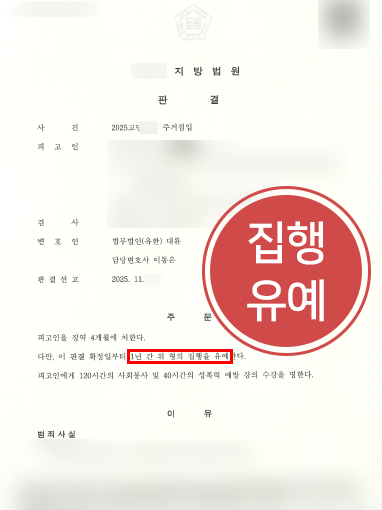
3. Successful Defense Against Intrusion Upon Habitation Charges, Concluded With a “Suspended Sentence”
The court, taking the following circumstances into comprehensive consideration, ultimately imposed a suspended sentence.
▷ The fact that the client was a first-time offender with no prior record of the same type of offense
▷ The fact that the client showed a sincere reflective attitude during the investigation and the trial
As a result, the client was able to avoid the disruption to his work life and social activities that an actual custodial sentence would have caused, and to return to his normal daily life.
4. The Sentence for Intrusion Upon Habitation Charges and the Sentencing Factors

The crime of intrusion upon habitation is established when a person intrudes upon another person’s residence, a structure under management, a vessel or aircraft, or an occupied room.
According to the precedents, whether the crime is established is determined not by the mere fact of entry but by whether the actual peace of the residence was disturbed.
Accordingly, intrusion is not established merely by the fact of entry, and whether the entry was contrary to the occupant’s will is only one factor to be considered, not the principal standard for the determination.
▶ Supreme Court, en banc Judgment of March 24, 2022, Case No. 2017 Do 18272
The Level of Punishment and the Sentencing Factors
Where the crime of intrusion upon habitation is recognized, a person may be subject to imprisonment for not more than three years or a fine not exceeding 5 million won.
▶ Article 319 of the Criminal Act
Intrusion upon habitation | Imprisonment for not more than three years or a fine not exceeding 5 million won |
In determining the sentence for the crime of intrusion upon habitation, various factors are considered, such as the circumstances of the offense, the attitude of the defendant, and the degree to which the harm has been remedied.
▶ Mitigating Factors
ㆍ Where the degree of infringement upon the peace of the residence is minor
ㆍ A sincere reflective attitude
ㆍ A first-time offender with no record of criminal punishment
ㆍ Where a deposit or a settlement has been made to remedy the harm
▶ Aggravating Factors
ㆍ Where the method of the offense was highly improper
ㆍ Where the offense was committed repeatedly or over a long period
ㆍ Where the offense was committed for a blameworthy motive
ㆍ A repeat offense of the same type
ㆍ A joint offense by two or more persons
ㆍ A planned and organized offense
The sentencing factors are not merely for reference; they serve as a very important standard when the court actually determines the sentence.
Therefore, systematically preparing the organization of the facts, the remedy of the harm, and efforts to prevent reoffending from the early stage of the case can be a key strategy for obtaining a favorable result, such as a suspended sentence.
FAQ on the Crime of Intrusion Upon Habitation
A. For the crime of intrusion upon habitation, the key standards for the determination are whether the peace of the residence was infringed and the criminal intent, rather than the mere fact of entry.
Therefore, it is important at the early stage to accurately organize the background of the case, the motive for the entry, and whether any harm occurred.
If you demonstrate efforts to remedy the harm, such as a settlement with the victim, this can serve as a factor that lowers the level of punishment when the court makes its determination.
A. A settlement with the victim is not essential, but it has a significant effect on the outcome of the case. This is because, when a settlement is reached, the degree to which the harm has been remedied is recognized and serves as a mitigating factor.
Where a settlement is difficult, you can demonstrate efforts to remedy the harm through legal means such as a criminal deposit, which may be reflected in the sentencing.
Therefore, it is important to realistically assess the possibility of a settlement with the victim and, even where a settlement is difficult, to devise a response strategy through lawful procedures such as a deposit.
5. If You Need to Defend Against Intrusion Upon Habitation Charges

If you have been accused of intrusion upon habitation, the initial response to the case is very important.
If you simply admit the charge or fail to prepare a response to the case, there is a risk that the background of the case may be misinterpreted or that the criminal intent may be judged excessively.
Because the crime of intrusion upon habitation involves various factors that affect the sentencing and the punishment, such as the degree of infringement upon the peace of the residence, the motive for the offense, and efforts to remedy the harm, beyond the mere fact of entry, a strategic response is needed at the early stage.
Our firm establishes a stage-by-stage strategy suited to the nature of the case, from the police and prosecution investigation through to trial, and systematically assists the client.
In addition, the firm reviews the possibility of a settlement with the victim and, where a settlement is difficult, supports legal procedures such as a criminal deposit, devoting its best efforts to defending against punishment.
If you are facing punishment for intrusion upon habitation and need legal help, please feel free at any time to request assistance through the 🔗Legal Consultation Reservation.
See More


Watch related video content
for this case study.

3 ways to make a police investigation statement without raising suspicion
This content is based on actual case studies of Daeryun Law LLC with some adaptations, and the copyright belongs to our firm.
Unauthorized reproduction, duplication, or distribution and other copyright infringements may result in legal action under applicable laws.