
CONTENTS
- 1. The Client Charged with a Financial Transaction Violation

- - Background of the Case
- - The Criminal Defense Attorney's Explanation of the Case
- 2. Response Strategy for the Financial Transaction Violation
- - The Criminal Defense Attorney's Strategy ① | Proving the Absence of Intent
- - The Criminal Defense Attorney's Strategy ② | Analysis of the Fraud Organization's Method of Deception
- - The Criminal Defense Attorney's Strategy ③ | Preemptive Response After Recognizing the Fraud
- - The Criminal Defense Attorney's Strategy ④ | Composition of Credibility Materials
- 3. Result of the Financial Transaction Violation Case, a ‘Non-Referral (No Suspicion of Crime)’
- - The Risk of the Act of Transferring Account Information
- - If You Are Facing a Police Investigation
- - Frequently Asked Questions Related to the Case

1. The Client Charged with a Financial Transaction Violation
The client who requested a consultation regarding a financial transaction violation case was an ordinary citizen who had lived a life unrelated to crime.
However, after receiving a loan information text message and coming into contact with an unidentified person, the client became caught up in an unexpected situation, and immediately after receiving a call from the police identifying the client as the ‘holder of the receiving account in a financial fraud case,’ the client requested help from a criminal defense attorney.
 Background of the Case
The client needed several million won in urgent funds for a child’s study-abroad matter.
The client, who already had substantial debt, was blocked from a bank loan and, trusting a single loan information text message, began a phone call with a consultant.
The consultant approached in the following manner.
“For identity verification, please provide the account number, password, and verification number”
The client thought of this only as part of the loan procedure and, following the consultant’s instructions, opened the account and provided the information accordingly.
However, a few days later the client suddenly received a notice stating that the account was ‘suspected of being used in fraud and that transactions would be suspended.’
Only then did the client realize that the client had been used in a crime, and immediately changed the password, disabled the linkage to other accounts, and filed a cybercrime report.
However, a police investigation was already scheduled, and the client, judging it difficult to handle alone, came to request assistance from a criminal defense attorney of this firm.



The Criminal Defense Attorney's Explanation of the Case
Article 6-3 of the Electronic Financial Transactions Act prohibits the following acts.
In other words, the act itself of simply informing another person of one’s own account number, password, and the like may be suspected as ‘provision of an access medium.’
In fact, because many voice phishing and financial fraud organizations exploit accounts in victims’ names, the police conduct the investigation treating such persons as suspects in these situations.
In the client’s case as well, it was confirmed that the person who sent the loan text message used the client’s account as a channel for transferring criminal proceeds, and the suspicion was raised that the client ‘had handed the account over to a criminal organization.’
However, for this crime to be established, one more crucial element is required.
That is intent, namely “the awareness that one provided the account while knowing that the account could be used in a crime.”
Therefore, from the early stage of the case the criminal defense attorney focused the strategy on proving, through specific facts and circumstances, that ‘there was no intent.’
2. Response Strategy for the Financial Transaction Violation

The criminal defense attorney focused on proving that the client was merely a victim who had been deceived by a criminal organization’s instructions into transferring account information, and that the client did not at all recognize the possibility of its use in a crime.
The strategy was organized around the following four pillars.
The Criminal Defense Attorney's Strategy ① | Proving the Absence of Intent
The criminal defense attorney specifically organized and submitted the reasons why the client had no choice but to misunderstand the loan consultant’s explanation as a ‘loan procedure.’
∙ Mistaken belief that opening an account and providing a password were a normal procedure
∙ The purpose of providing the access medium was solely loan approval
∙ The presence of a desperate situation in which the loan was urgently needed
Through this, the attorney was able to clearly support the point that the client had no intent to take part in a crime.
The Criminal Defense Attorney's Strategy ② | Analysis of the Fraud Organization's Method of Deception
The criminal defense attorney analyzed the organization’s method of approach, conversation pattern, use of virtual numbers, and urgent time pressure, and logically established that the client was a victim exposed to the deception of a typical loan fraud organization.
The attorney also emphasized that there were clear circumstances indicating that the client had been induced to provide information (the password and verification number) that a financial institution would never request in its normal procedures.
The Criminal Defense Attorney's Strategy ③ | Preemptive Response After Recognizing the Fraud
Upon being notified that the account had been frozen, the client immediately took the following measures.
∙ Changing the password and terminating the linked account
∙ Sending the loan consultant a message stating “if this is fraud, I will report it”
∙ Immediately expressing the intent to cooperate with the police investigation
The criminal defense attorney emphasized the client’s active response and argued that it was the typical behavior of a victim that would not be seen in a criminal.
This worked very effectively in persuading the investigative authority.
The Criminal Defense Attorney's Strategy ④ | Composition of Credibility Materials
The criminal defense attorney systematically submitted the following materials to enhance the credibility of the client’s statements.
∙ Financial materials actually proving the existence of debt and the need for a loan
∙ Messenger and call records containing the entire fraud process
∙ An organized account of the subsequent report and the course of the response
Comprehensively considering these materials, the investigative authority reached the conclusion that “the suspect’s statements are not false or intended to conceal a crime, but are consistent with the actual characteristics of a victim.”
3. Result of the Financial Transaction Violation Case, a ‘Non-Referral (No Suspicion of Crime)’

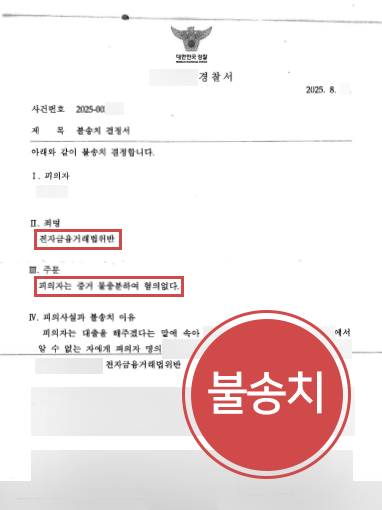
With respect to the financial transaction violation charge, after reviewing all of the materials submitted by the criminal defense attorney, the organization of the statements, and the client’s manner of response, the police determined that “the client had no intent to take part in a crime.”
As a result, a decision of ‘no suspicion of crime (non-referral)’ was rendered on the charge of violating the Electronic Financial Transactions Act.
The client, who had been placed at risk of criminal punishment due to a momentary mistake, escaped that situation and was able to recover everyday life and trust in every respect, including work, family, and financial transactions.
The Risk of the Act of Transferring Account Information
Article 6-3 of the Electronic Financial Transactions Act requires very strict care in the use and management of account information.
If anyone provides, transfers, keeps, or distributes to another person an access medium such as one’s own account number, password, or verification number, for the purpose of its use in a crime or while knowing that it will be used in a crime, a crime is established.
Penalty
Electronic Financial Transactions Act, Article 49(4) | Penalty |
A person who, in violation of Article 6-3, receives or provides account-related information, or keeps, transfers, or distributes it | Imprisonment for up to 5 years or a fine of up to 30 million won |
In other words, there is a significant risk in that the act itself of transferring account information to another person can become a means of crime.
In particular, if it is used by a voice phishing or fraud organization, a person may become a subject of investigation even without intending it.
If You Are Facing a Police Investigation
Daeryun Law Firm provides professional strategies based on experience accumulated through handling many similar cases, including voice phishing, involvement in loan fraud, and charges of providing an access medium.
After accurately identifying the facts, the firm prevents the client’s disadvantageous statements through organizing the direction of the statements and accompanying the client to the police investigation.
In addition, the firm provides multifaceted assistance with the case through collaboration with experts in specialized fields, such as digital forensics experts and evidence investigation experts.
If you are facing a police investigation in a similar situation, please feel free at any time to entrust your case through a 🔗legal consultation reservation.
Frequently Asked Questions Related to the Case
A. The key is ‘whether one provided it while recognizing that it would be used in a crime (intent).’Q. Does merely having informed someone of account information amount to a violation of the Electronic Financial Transactions Act?
If you were deceived or could not at all have foreseen the possibility of a crime, you can avoid punishment by proving the absence of intent.
A. It is important to prepare your statements through a consultation with a criminal defense attorney before the investigation.Q. In a case of violating the Electronic Financial Transactions Act, how should I respond before the police investigation?
If you accurately organize the facts and prepare materials that prove you provided the account without intent (text and call records, financial transaction details, and the like), you can minimize the disadvantage even in the police investigation.

This content is based on actual case studies of Daeryun Law LLC with some adaptations, and the copyright belongs to our firm.
Unauthorized reproduction, duplication, or distribution and other copyright infringements may result in legal action under applicable laws.