
CONTENTS
- 1. The Client Who Came to a Busan Fraud Attorney

- - How the Client Came to a Busan Fraud Attorney
- - The Client's Charge Explained by a Busan Fraud Attorney
- 2. The Busan Fraud Attorney's Assistance
- - Busan Fraud Attorney, Argument That the Client Was Also a Victim of the Fraud Offense
- - Busan Fraud Attorney, Argument That the Client Gained No Actual Benefit
- - Busan Fraud Attorney, Argument That the Client Actively Cooperated With the Investigation
- 3. Result of the Busan Fraud Attorney's Assistance: Non-Prosecution
- - The Busan Fraud Attorney's Case Notebook

1. The Client Who Came to a Busan Fraud Attorney
The client who came to a Busan fraud attorney was facing a charge of violating the Electronic Financial Transactions Act, and requested a Busan attorney's help in defending against punishment.

 How the Client Came to a Busan Fraud Attorney
Through the consultation, the Busan attorney was able to examine the circumstances of the client's case in detail.
One day, the client received a text message about a loan and submitted an online consultation request.
Following the agent's instructions, the client sent photographs of the front of a bankbook and of an identification card.
After this, the agent reportedly made unreasonable requests, such as demanding copies of other bankbooks.
Growing suspicious, the client pressed the agent, asking whether this was a scam, whereupon the agent reassured the client by even showing the agent's own driver's license.
In the end, the client was taken in and even sent a check card in the client's own name by courier service.
However, not long afterward, the client learned that the client's account had been used as an account for voice phishing proceeds.
As a result, the client was charged with violating the Electronic Financial Transactions Act and requested a fraud-related consultation from a Busan attorney.
The Client's Charge Explained by a Busan Fraud Attorney
The Electronic Financial Transactions Act prohibits the act of transferring or acquiring an access medium.
Accordingly, by transferring the access medium of a financial institution, that is, the client's own check card, to another person, the client committed the offense of violating the Electronic Financial Transactions Act.
In addition to a check card, the access media defined under the Electronic Financial Transactions Act include bankbooks, OTPs, public certificates, bankbook passwords, and the like.
If such access media were lent for monetary consideration or in the knowledge that they would be used in a crime, the person may be punished for 🔗violation of the Electronic Financial Transactions Act.
A person who transfers or lends an access medium, as the client did, may be punished by imprisonment for not more than 5 years or a fine not exceeding 30 million won.
④ A person who falls under any of the following shall be punished by imprisonment for not more than 5 years or a fine not exceeding 30 million won.
1. A person who, in violation of Article 6 (3) 1, transfers or acquires an access medium
2. The Busan Fraud Attorney's Assistance
The Busan fraud attorney, while acknowledging the client's charge, established a response strategy so as to defend against punishment as much as possible.
Based on this strategy, the attorney then made the following arguments.
Busan Fraud Attorney, Argument That the Client Was Also a Victim of the Fraud Offense
In financially destitute circumstances, the client received a text message offering a low-interest loan, was deceived and taken in, and came to commit the offense in this case.
On this basis, the attorney argued that the client was also a victim who suffered harm of about 2 million won, and that the client transferred the access medium as part of that process.
Busan Fraud Attorney, Argument That the Client Gained No Actual Benefit
The client currently bears numerous debts.
However, the attorney argued that the client had merely been deceived and taken in by a fraud organization, and had gained no actual benefit whatsoever from this offense.
Busan Fraud Attorney, Argument That the Client Actively Cooperated With the Investigation
The client committed this offense without clearly recognizing whether the client's conduct amounted to a crime.
The attorney argued that, although the client only belatedly learned of this upon receiving contact from the police, the client thereafter showed remorse for the conduct and actively cooperated with the investigation.
3. Result of the Busan Fraud Attorney's Assistance: Non-Prosecution
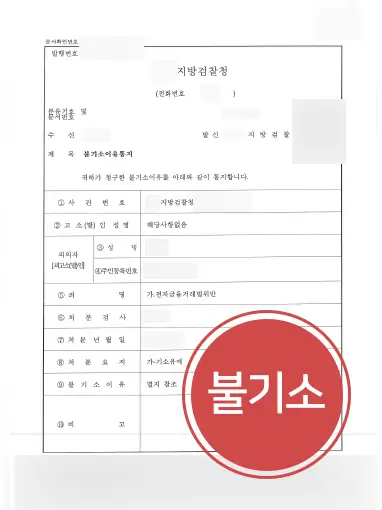
Accepting the arguments the Busan fraud attorney made to the best of the attorney's ability, the prosecution issued a non-prosecution (suspension of indictment) disposition.
The Busan Fraud Attorney's Case Notebook
The case above was one in which a client, who did not know that the client's conduct was a criminal act in violation of the law, became involved in a fraud offense and, facing the risk of punishment, requested a consultation from a Busan attorney.
The client's matter was a situation in which not only the Electronic Financial Transactions Act but also a charge of aiding and abetting fraud could potentially have been applied.
However, with the help of the Busan attorney, the client received a non-prosecution disposition and was able to conclude the case without incident.
At Daeryun Law Firm, for clients who have unfairly become offenders, attorneys with extensive experience in fraud-related criminal cases provide assistance to the best of their ability, from accompanying clients during police questioning to defending them at trial.
If you have become involved in a fraud offense and are facing the risk of punishment as described above, please book a 🔗legal consultation at any time.
This content is based on actual case studies of Daeryun Law LLC with some adaptations, and the copyright belongs to our firm.
Unauthorized reproduction, duplication, or distribution and other copyright infringements may result in legal action under applicable laws.