
CONTENTS
- 1. The Client Who Sought a Gangneung Attorney

- 2. The Strategy for the Client Who Sought a Gangneung Attorney
- - Gangneung Attorney's Strategy 1. Admitting the Charges and Actively Cooperating With the Investigation
- - Gangneung Attorney's Strategy 2. Asserting Financial Hardship
- 3. The Client Who Sought a Gangneung Attorney Successfully Avoids an Actual Custodial Sentence

1. The Client Who Sought a Gangneung Attorney
This is the account of a client.
The client had handed over a bank account, password, and public certificate for a loan to an unidentified person met through social media, and was indicted on charges of violating the Electronic Financial Transactions Act.
The client wished above all to avoid an actual custodial sentence.
Seeking a swift conclusion to the case, the client looked for a law office where multiple attorneys respond as one team, and chose the Daeryun Law Firm Gangneung office.
 Charges of Violating the Electronic Financial Transactions Act, Explained by a Gangneung Attorney
Under the Electronic Financial Transactions Act, no person may borrow or lend an access medium while receiving, demanding, or promising compensation for the use and management of an access medium for electronic financial transactions.
🔗A violation of the Electronic Financial Transactions Act refers to committing a crime by transferring, acquiring, lending, keeping, delivering, or distributing an access medium such as a debit card.
The Electronic Financial Transactions Act strictly prohibits the following acts.
-Transferring or acquiring an access medium
-Borrowing an access medium while receiving, demanding, or promising compensation, or keeping, delivering, or distributing it
-Borrowing or lending an access medium for the purpose of using it in a crime or knowing that it will be so used, or keeping, delivering, or distributing it
-Using an access medium as the object of a pledge
-Arranging, brokering, or advertising the above acts, or soliciting them while receiving, demanding, or promising compensation
A violation of the Electronic Financial Transactions Act may be punished by imprisonment for up to five years or a fine of up to 30 million won.
However, mitigated punishment may be available if the offender turns himself in, blows the whistle, or makes a complete and voluntary disclosure of the full circumstances of the offense, or if the risk of a subsequent crime did not materialize because of a voluntary transaction suspension, a loss report, or similar measures.
Precedents on Violations of the Electronic Financial Transactions Act, Explained by a Gangneung Attorney
∙A Case Found Not to Be an Act of Transfer
This is a case in which the defendant sent his own bank passbook and cash card to a lender in order to obtain a loan.
The Supreme Court held that the defendant had merely entrusted the passbook and cash card for temporary use after being deceived by the lender, and that this could not be regarded as a transfer. Accordingly, it acquitted him of the charge of violating the Electronic Financial Transactions Act.
∙A Case Stating That an Act of Keeping Also Constitutes a Violation of the Electronic Financial Transactions Act
The defendant was keeping an access medium in another person's name and was indicted on charges of violating the Electronic Financial Transactions Act.
The issue was the meaning of "keeping an access medium" prohibited under Article 6 (3) 2 of the Electronic Financial Transactions Act.
The Supreme Court held that "the 'keeping' of an access medium under Article 6 (3) 2 of the Electronic Financial Transactions Act refers to possessing or holding an access medium in another person's name so that a financial account in another person's name can be unlawfully traded or used."
Accordingly, it held that the defendant's act of keeping an access medium in another person's name constituted a violation of the Electronic Financial Transactions Act.


2. The Strategy for the Client Who Sought a Gangneung Attorney
For the client who came seeking a Gangneung attorney, the Gangneung branch office took the following measures.
Gangneung Attorney's Strategy 1. Admitting the Charges and Actively Cooperating With the Investigation
The client admitted all of the above charges and showed remorse.
As a defense strategy against punishment, the Gangneung attorney devised an approach of admitting all of the charges and actively participating in the investigation.
Accordingly, the client actively participated in the investigation by the authorities and assisted with the progress of the case.
The Gangneung attorney emphasized this attitude on the client's part and requested leniency.
Gangneung Attorney's Strategy 2. Asserting Financial Hardship
The client handed over the access medium for electronic financial transactions to the unidentified person because he believed that person's claim that it was a procedure for obtaining a loan.
The client had recently lost his job and was experiencing financial hardship.
The Gangneung attorney asserted that the client had believed the process was one for obtaining a loan, and requested leniency.
3. The Client Who Sought a Gangneung Attorney Successfully Avoids an Actual Custodial Sentence

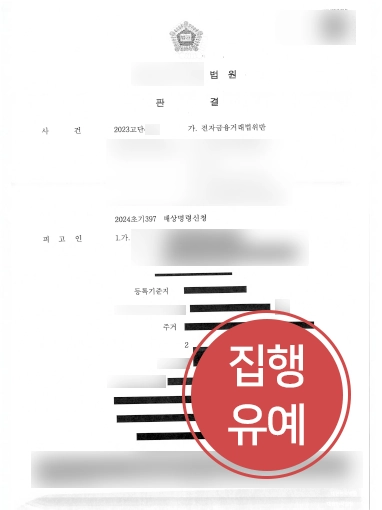
The client received a suspended sentence and successfully avoided an actual custodial sentence.
According to the Supreme Court, as of 2023, over the most recent six years, 1,081 people were indicted for violating the Electronic Financial Transactions Act, of whom 349 were indicted with detention and 732 were indicted without detention.
In addition, 24,019 offenders received punishment of a fine or heavier, of whom 3,255 received imprisonment, 8,178 received imprisonment combined with suspended sentences, and 12,586 received fines.
As this crime has increased, the courts have been imposing more severe punishment.
For this reason, if you face charges of violating the Electronic Financial Transactions Act, consulting an attorney quickly from the early stage of the case can be helpful.
Through Daeryun 🔗Gangneung Attorney Consultation Booking, you may have your situation reviewed.
This content is based on actual case studies of Daeryun Law LLC with some adaptations, and the copyright belongs to our firm.
Unauthorized reproduction, duplication, or distribution and other copyright infringements may result in legal action under applicable laws.