
CONTENTS
- 1. Details of the Customs Act Violation Case

- - Assistance Provided by the Attorney Specializing in Customs
- 2. Result of the Customs Act Violation Case
- 3. Explanation of the Concept of a Customs Act Violation
- - Explanation of the Concept of the Narcotics Control Act
- 4. How to Respond to a Violation of the Customs Act and a Violation of the Narcotics Control Act

1. Details of the Customs Act Violation Case

The client, who came to Daeryun stating that he was being charged with a violation of the Customs Act, is a pharmacist who had suffered from depression and sleep disorders for many years and had regularly been prescribed and taken psychotropic drugs.
On the day of the incident, because visiting a hospital was burdensome, the client ordered psychotropic drugs of the same composition from an overseas website, and some of these were detected during a customs inspection.
Customs immediately visited the client's pharmacy and seized all of the psychotropic drugs, and the client was charged with a violation of the Customs Act and a violation of the Narcotics Control Act (psychotropic drugs).
As a pharmacist, the client faced a situation in which his pharmacist's license could be revoked if he received a sentence of imprisonment without labor or heavier for the violation of the Narcotics Control Act, so it was a case in which defending against an actual custodial sentence and securing leniency in the form of a fine were absolutely necessary.
 Assistance Provided by the Attorney Specializing in Customs
Daeryun Law Firm provided the following assistance through a one-stop response system in which an attorney specializing in customs, a customs specialist who holds a licensed customs broker qualification, and an attorney specializing in medical matters who holds a pharmacist's license participate together.
We organized the client's admission of wrongdoing, confession, and cooperation with the investigative agency into objective materials and supported their faithful reflection in the investigation records.
2. Demonstrating the complete preclusion of any possibility of distributing the psychotropic drugs
We professionally analyzed and submitted the point that the drugs in question were immediately seized by customs and that there was no possibility whatsoever of their actually being distributed or being distributed in the future.
3. Demonstrating the irreparable harm of losing the pharmacist's license
We argued as a matter of law that the risk of revocation of the pharmacist's license, which would arise if a sentence of imprisonment without labor or heavier were imposed, should be actively reflected as a sentencing factor.
4. Securing factors warranting leniency, such as a letter of apology and a record of donations
In order to objectify the client's will to repent, we prepared a letter of apology, evidence of donations, and other materials, and persuasively presented that there was no likelihood of reoffending.
5. Submission of a written opinion by the customs specialist
By analyzing specialized matters such as the import procedure, the licensing requirements, and the necessity of a prescription, we emphasized that the client's conduct involved a low degree of intent and posed only minor social danger.
2. Result of the Customs Act Violation Case
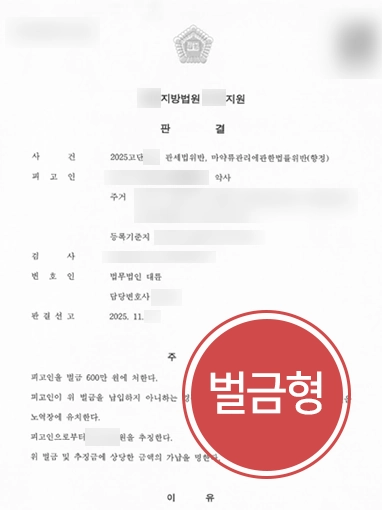
Through a thorough review of the law and the submission of materials warranting leniency, the client received a minor fine even though it was a case in which the possibility of an actual custodial sentence clearly existed.
In a case in which a violation of the Customs Act and a violation of the Narcotics Control Act were applied at the same time, the leniency in the form of a fine was an outcome that was possible because of Daeryun's professional assistance and the collaboration among specialists in each field.
As a result, the client was able to maintain his pharmacist's license and to achieve a full social and professional recovery.


3. Explanation of the Concept of a Customs Act Violation
A violation of the Customs Act refers to the act of importing goods without meeting the reporting, permission, or approval requirements that the law mandates, or of submitting false information regarding the contents of a declaration (such as the name of the item, quantity, and price) in order to evade customs duties.
With the recent increase in overseas direct purchases, even ordinary people are easily exposed to the risk of a violation.
Cases in which ordinary people are likely to commit a violation include the following.
- Purchasing medicines that require a prescription from overseas without a hospital prescription and bringing them in
- Importing medical devices, health supplements, and the like in large quantities without permission
- Falsely declaring the name or composition of an item to reduce or evade customs duties
- Importing items requiring a professional license without authorization
- Bringing in restricted items by mail or express delivery
Under the Customs Act, imprisonment for not more than 3 years or a fine not exceeding 30 million won may be imposed, so even ordinary people face the risk of an actual custodial sentence.
Article 241 of the Customs Act (Declaration of Export, Import, or Return) (1) A person who intends to export, import, or return goods shall declare to the head of the customs office the name of the item, specifications, quantity, and price of the relevant goods, as well as other matters prescribed by Presidential Decree.
Explanation of the Concept of the Narcotics Control Act
The Narcotics Control Act strictly prohibits an ordinary person who is not a narcotics handler from purchasing, possessing, using, or importing psychotropic drugs.
Even for medical purposes, a lawful prescription and dispensing procedure must be followed, and any conduct outside of this becomes subject to criminal punishment.
The main cases in which ordinary people commit a violation are as follows.
- Purchasing or receiving delivery of psychotropic drugs from overseas without a hospital prescription
- Taking psychotropic drugs received from an acquaintance
- Bringing in psychotropic drugs purchased while traveling without declaring them
- Personally keeping prescription-only drugs for psychological purposes, mood enhancement, or the like
Under the Narcotics Control Act, imprisonment for not more than 5 years or a fine not exceeding 50 million won may be imposed, so it has a very strict punishment structure.
1. The act of possessing, owning, using, transporting, managing, importing, exporting, manufacturing, dispensing, administering, handing over, trading, inducing, recommending, or arranging the trade of, or providing narcotics or psychotropic drugs
Article 5 of the Act on the Management of Narcotics, etc. (Restriction on the Handling of Narcotics, etc.) (1) A narcotics handler shall not engage in any of the acts prescribed in each subparagraph of Article 4(1) for any purpose other than that handler's business.
Article 61 of the Act on the Management of Narcotics, etc. (Penalty Provisions) (1) A person who falls under any of the following subparagraphs shall be punished by imprisonment for not more than 5 years or a fine not exceeding 50 million won.
7. A person who handles psychotropic drugs, cannabis, or temporary narcotics, or who issues a prescription therefor, in violation of Article 5(1) or (2), Article 9(1), or Article 35(1)
4. How to Respond to a Violation of the Customs Act and a Violation of the Narcotics Control Act

Category | Key Issues | Required Measures |
Violation of the Customs Act | Whether the reporting and permission requirements were violated, intent, and the risk of distribution | · Initial statement strategy · Review of permission and approval requirements · Analysis of the seized items |
Violation of the Narcotics Control Act | Intent in possessing and importing psychotropic drugs, whether the purpose was medical, and the likelihood of reoffending | · Submission of treatment records and materials of remorse · Securing factors warranting leniency |
Common Response | The risk of an actual custodial sentence and the possibility of license revocation | · Organizing the facts · Proving the preclusion of any possibility of distribution · Preparing grounds for leniency |
Daeryun operates a genuine one-stop response system in which a customs specialist who holds a licensed customs broker qualification, an attorney specializing in medical matters who holds a pharmacist's or physician's license, and an attorney specializing in criminal cases work together.
The more complex a case is, with a violation of the Customs Act and a violation of the Narcotics Control Act applied at the same time, the more essential it is to have specialized analysis in each field and a carefully designed sentencing strategy.
If you need help, please proceed with a 🔗Legal Consultation Booking right now to prepare a response.
This content is based on actual case studies of Daeryun Law LLC with some adaptations, and the copyright belongs to our firm.
Unauthorized reproduction, duplication, or distribution and other copyright infringements may result in legal action under applicable laws.