
CONTENTS
- 1. The Client Who Came to Be Charged with a Pharmaceutical Affairs Act Violation

- - Overview of the Case
- 2. Prohibition of the Sale of Medicine by Non-Pharmacists Under the Pharmaceutical Affairs Act
- - Core Issues
- 3. Scope of Assistance to Defend Against the Pharmaceutical Affairs Act Violation Charges
- - Proving the Pharmacist's On-Site Presence and Supervision
- - Presenting the Legal Doctrine on a Non-Pharmacist's Mere Delivery Act
- - Asserting 'Implied Instruction' Based on Precedent
- - Submitting Community Petitions and Materials Establishing Trust
- 4. Result of the Pharmaceutical Affairs Act Violation Case, No Charge
- - The Importance of Responding to a Pharmaceutical Affairs Act Violation

1. The Client Who Came to Be Charged with a Pharmaceutical Affairs Act Violation
This is a case in which a client couple under suspicion of a Pharmaceutical Affairs Act violation were able to conclude the case with a disposition of no suspicion of crime, thanks to the systematic assistance of a medical attorney.
 Overview of the Case
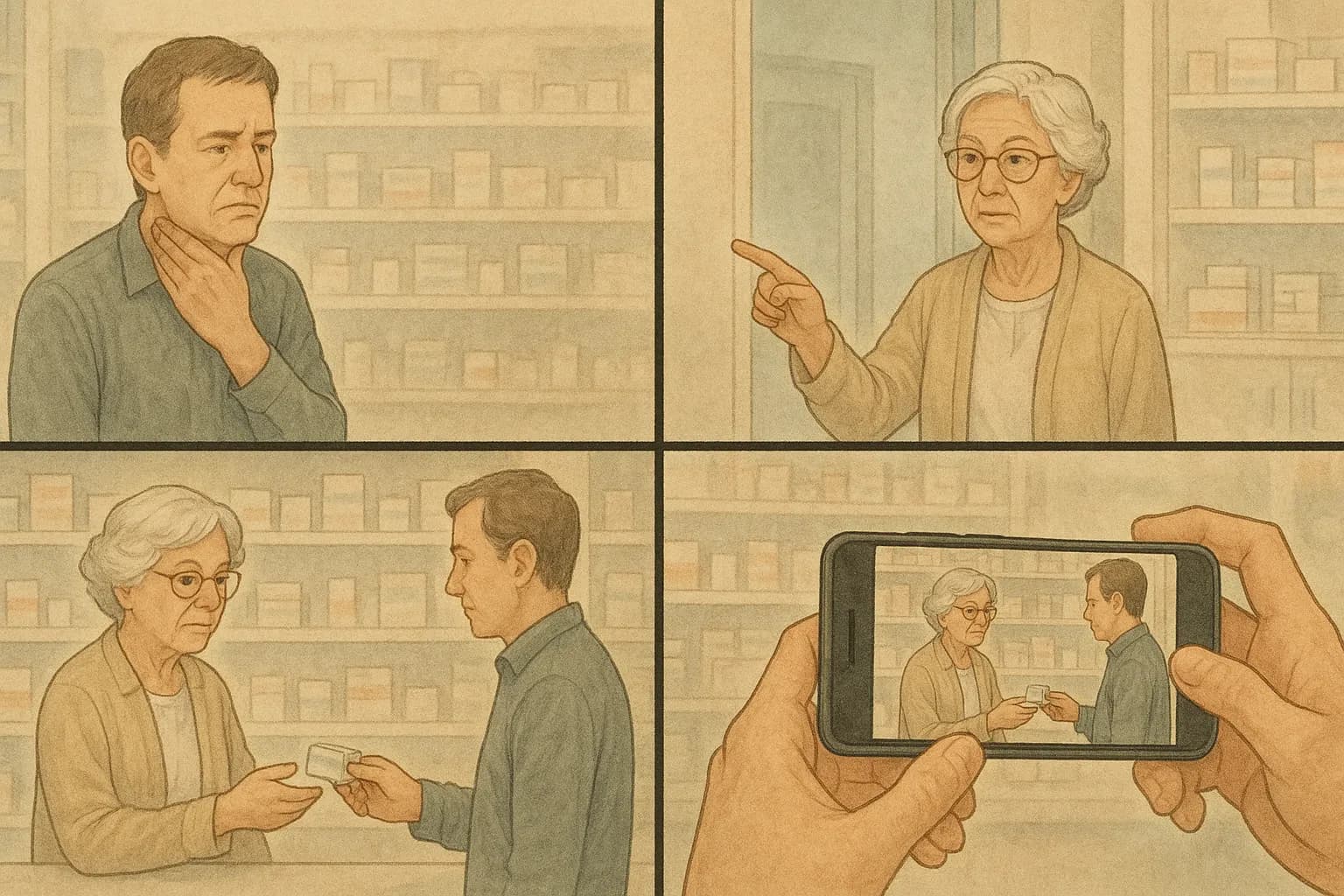
The case began when a customer visited the pharmacy complaining of neck pain.
At the time, the husband, who was the pharmacist, selected the medicine in the dispensary, then signaled with his eyes for his wife, the pharmacy clerk at the counter, to hand the medicine over.
The wife delivered it to the customer and completed the payment. This scene was filmed by a third party, and a report was filed stating that “a non-pharmacist directly sold the medicine.”
The video did not capture the specific scene of the pharmacist’s instruction, so from the outside it could appear as if the employee had sold the medicine on her own while the pharmacist was away.
As a result, the investigative authorities could interpret the conduct as a “sale by a non-pharmacist,” and the client couple faced the risk of criminal punishment and an administrative disposition for violation of the Pharmaceutical Affairs Act.


2. Prohibition of the Sale of Medicine by Non-Pharmacists Under the Pharmaceutical Affairs Act
Article 44(1) of the Pharmaceutical Affairs Act provides that "no person other than a pharmacy founder or a pharmacist may sell pharmaceuticals or acquire them for the purpose of sale."
Pharmaceutical Affairs Act Article 44 (Sale of Pharmaceuticals)
A violation may, under Article 93(1)7 of the Pharmaceutical Affairs Act, be subject to imprisonment for not more than five years or a fine not exceeding 50 million won.
Core Issues
The key issue in this case was whether it was an “independent sale by a non-pharmacist” or “an assisting act carried out under the pharmacist's supervision and instruction.”
Accordingly, from the outset the medical specialist attorney set the essence of the case as “whether there was instruction and supervision by the pharmacist” and focused on systematically collecting evidence to prove this.
3. Scope of Assistance to Defend Against the Pharmaceutical Affairs Act Violation Charges

In connection with the Pharmaceutical Affairs Act violation case, the submitted video alone did not clearly show the pharmacist's involvement, so there was a significant possibility that it could be judged as a ‘sale by the employee acting alone.’
Accordingly, the medical attorney focused on preparing specific evidence and legal arguments to rebut this.
Proving the Pharmacist's On-Site Presence and Supervision
To prove that, at the time of the incident, the pharmacist was in a position to attend to patients from the dispensary and supervise the entire process, the medical attorney submitted visual materials, including the pharmacy's internal layout, the distance between the dispensary and the counter, and a location from which the line of sight could be secured.
In addition, by confirming the fact and statements that the pharmacist was performing dispensing work while wearing a gown and name tag, the attorney dispelled the misunderstanding of an ‘absence of the pharmacist’.
In addition, by submitting records showing that the pharmacist conducted transactions with a pharmaceutical company before and after the time of the incident, the attorney objectively proved that the pharmacist did not leave the pharmacy during that time.
Presenting the Legal Doctrine on a Non-Pharmacist's Mere Delivery Act
The medical attorney submitted an opinion stating that, in a situation where there was a specific instruction from the pharmacist and the pharmacist made the final decision to sell immediately thereafter, the act of a non-pharmacist simply handing over the medication and processing the payment does not constitute an ‘independent sale’ under the Pharmaceutical Affairs Act.
In particular, by submitting the pharmacy’s operating rules and internal manual as evidence, the attorney explained that the authority to select medication and decide whether to sell rests entirely with the pharmacist and that the employee is in a structure where she cannot make independent judgments.
Asserting 'Implied Instruction' Based on Precedent
Supreme Court, decided October 9, 1998, 98Do1967, summary of the decision
By citing the above Supreme Court precedent, the attorney emphasized the point that a sale carried out under the implied or presumed direction of a pharmacist may legally be regarded as a sale by the pharmacist.
The attorney also highlighted the point that the medicine in question fell within the category of general (over-the-counter) medicines that cannot cause serious harm to public health, thereby reducing its weight in the assessment of unlawfulness.
Submitting Community Petitions and Materials Establishing Trust
To highlight the point that the pharmacy had been operated for decades on the basis of trust with local residents, the firm submitted residents’ petitions and a joint signature, along with statements from many people that “the pharmacist was always present at the pharmacy.”
This served as important material for fully excluding the possibility of the pharmacist’s absence and non-involvement.
4. Result of the Pharmaceutical Affairs Act Violation Case, No Charge

In the Pharmaceutical Affairs Act violation case, through the medical law attorney’s strategic presentation of evidence and persuasion on the legal principles, the investigative agency acknowledged that the relevant act was not an ‘independent sale by a non-pharmacist’ but merely simple delivery and payment assistance carried out under the pharmacist’s instruction and supervision.
The situation, which had been unclear from the video alone, reached the conclusion that it did not meet the elements of a ‘violation of the Pharmaceutical Affairs Act’ as the pharmacist’s presence on the premises, the process of instruction, and the structure of the pharmacy’s operation were proven from multiple angles.
In the end, the client couple were able to avoid both criminal punishment and administrative disposition and to obtain a disposition of no suspicion of crime, and were also able to escape the burden of a prolonged investigation and the risk of damage to their social reputation.
The Importance of Responding to a Pharmaceutical Affairs Act Violation
A violation of the Pharmaceutical Affairs Act is a serious matter that directly concerns the qualification to sell pharmaceuticals and public health, and even a small error or misunderstanding can lead to criminal punishment and an administrative disposition.
In particular, a situation that appears on its face to be a violation, such as a 'sale by a non-pharmacist,' carries a significant risk of an unfavorable determination if the evidence is insufficient, even where the pharmacist's instruction and supervision were in fact present.
Accordingly, an accurate organization of the facts, interpretation of the legal principles, and the securing of physical evidence to support them at an early stage are crucial.
At Daeryun LLC, a specialized attorney is promptly assigned from immediately after the incident occurs, and establishes and carries out a defense strategy suited to the client's situation.
Through this, we support the client in dispelling unnecessary misunderstandings and protecting their honor and business foundation as a pharmacist.
If you need professional assistance in connection with your case, please feel free to entrust your case at any time through a 🔗legal consultation appointment.


Watch related video content
for this case study.

Seminar highlights on pharmaceutical rebate regulation
This content is based on actual case studies of Daeryun Law LLC with some adaptations, and the copyright belongs to our firm.
Unauthorized reproduction, duplication, or distribution and other copyright infringements may result in legal action under applicable laws.