
CONTENTS
- 1. Construction Dispute | The Client Who Requested a Response to the Construction Payment Claim Lawsuit

- - What Is a Construction Payment Lawsuit?
- - How a Defendant Should Respond in a Construction Dispute
- 2. Construction Dispute | The Response Strategy for Rebutting the Construction Payment Claim Lawsuit
- 3. Construction Dispute | Result of the Construction Payment Claim Lawsuit, Dismissal of the Plaintiff's Claim

1. Construction Dispute | The Client Who Requested a Response to the Construction Payment Claim Lawsuit
In this construction dispute case, the client purchased real estate for the purpose of operating a lodging business and then concluded a contract with the plaintiff regarding new construction work.
Thereafter, the plaintiff filed a construction dispute lawsuit claiming approximately 250 million won and delay damages, on the ground of construction payment and mandate remuneration, asserting that “the construction was completed and the use approval was obtained, yet the defendant did not pay the construction payment in full.”
However, the client appealed the unfairness, asserting that the plaintiff's argument was not based on the contents of the contract or on any objective agreement, and that the monetary transactions likewise could not be regarded as construction payment, and requested a response to the construction dispute.
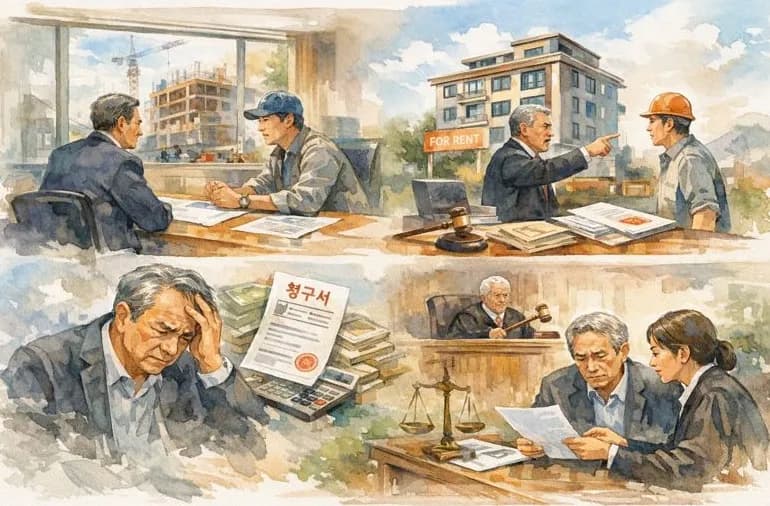
 What Is a Construction Payment Lawsuit?
A construction payment lawsuit is a representative type of construction dispute, and it is a civil lawsuit in which a party who performed the construction claims payment of the amount from the ordering party.
In particular, in a construction dispute, the key issues addressed are the actual parties to the contract and the contract contents, whether an agreement on additional or modified construction exists, the relationship between the amounts already paid and the settlement, and the presence or absence of objective evidence supporting these.


How a Defendant Should Respond in a Construction Dispute
When you become the defendant in a construction payment lawsuit within a construction dispute, you should closely review the following matters.
- The contents of contract documents, such as the contract, estimates, and settlement statements
- Whether additional construction payment or a side agreement is objectively proven
- If there are remittance records, whether they constitute construction payment or another legal relationship
- Whether the funds said to have been spent on construction costs were actually used at the relevant site
2. Construction Dispute | The Response Strategy for Rebutting the Construction Payment Claim Lawsuit
In this construction dispute case, we established a response strategy for each issue, noting that the plaintiff's claims were divided into a claim for remuneration under a separate mandate contract and a claim for construction payment.
1. Whether a separate mandate contract was formed
The plaintiff argued that, based on the relationship of acquaintance, messenger conversations, and monetary transactions, a mandate contract for remuneration of 100 million won had been formed.
However, the construction specialist attorney denied the formation of a separate mandate contract, on the grounds that no mandate contract existed and that the monetary transactions likewise could not be specified as mandate remuneration.
2. Whether an agreement or modification contract on construction payment was recognized
The plaintiff company argued that, because the contract did not clearly set out the details regarding the progress of construction or the payment of progress payments, additional construction payment not in the contract had been separately agreed.
However, the construction specialist attorney rebutted that the additional agreement claimed by the plaintiff was not proven, on the ground that there existed no contract, written agreement, or settlement materials at all that could recognize additional construction payment or a modification contract.
3. The legal nature of the remittance records
The plaintiff, citing the transaction records of remittances to the client as evidence, was requesting the return of those funds, asserting that the plaintiff had spent construction payment on the client's behalf.
The corporate specialist attorney argued that, while it was true that there had been several remittance records between the client and the plaintiff, it could not be concluded that those funds had been used as construction payment.
In addition, the attorney emphasized that most of the money remitted by the plaintiff was a return of money that the client had previously lent to the plaintiff, thereby lowering the credibility of the plaintiff's argument.
Representatively, basic materials such as the contract for work, amendment contracts, estimates, progress and settlement records, and bank transfer records, as well as on-site photographs, work logs, and messenger conversation records that can confirm the scope of work or whether additional construction occurred also become important grounds for judgment.
In addition, where the other party claims an additional agreement or an oral arrangement, securing documents and fund-flow materials that can objectively rebut this has a significant impact on the outcome of the dispute.
In a construction dispute, the later the organization of the facts is, the more difficult proof can become, so professional review is needed from the early stages of litigation.
3. Construction Dispute | Result of the Construction Payment Claim Lawsuit, Dismissal of the Plaintiff's Claim
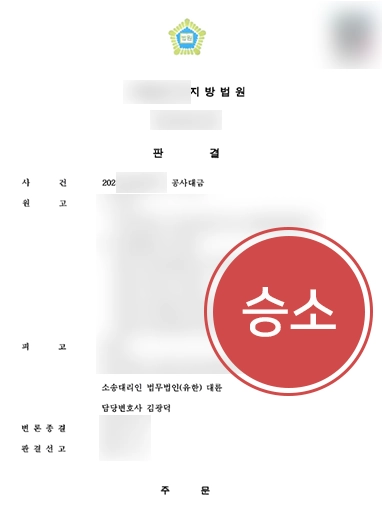
In this construction dispute, the court, finding it difficult to recognize either the formation of the separate mandate contract claimed by the plaintiff or the existence of an additional agreement on construction payment, dismissed the plaintiffs' claims in their entirety.
The court also ordered that the litigation costs be borne by the plaintiffs.
As a result, the client was able to escape the monetary burden of approximately 250 million won and the risk of delay damages.

Daeryun's Corporate Legal Affairs Group, composed of attorneys who have handled numerous corporate transaction disputes such as construction payment disputes, subdivided by field, systematically reviews even complex issues.
By establishing a strategy suited to the nature of the case and the scale of the company, the group focuses on preventing the spread of the dispute and on minimizing future additional disputes and transactional risks.
If you are in a situation requiring a legal response over a construction payment matter, 🔗scheduling a legal consultation to review a more stable resolution is something we hope you will consider.
This content is based on actual case studies of Daeryun Law LLC with some adaptations, and the copyright belongs to our firm.
Unauthorized reproduction, duplication, or distribution and other copyright infringements may result in legal action under applicable laws.