
CONTENTS
- 1. The Client's Situation

- 2. About the Survivor's Pension
- 3. The Attorney's Assistance
- - How the Client Came to Live Apart
- - The Relevant Provisions Reviewed by the Attorney
- 4. The Judgment the Attorney Obtained

1. The Client's Situation
This is the account of the client who sought assistance.
The client explained that her husband had passed away one year earlier. She applied for a survivor's pension but received a disposition denying it.
The reason for the denial was that the client had not lived together with her husband.
The client explained that she had no choice but to live apart because her husband had contracted HIV/AIDS, a statutory infectious disease.
However, her husband had continuously sent her living expenses through their children, and she had stayed by his side at the hospital before he passed away.
The client felt the situation was unjust, explaining that although she had lived apart from her husband, they had legally remained in a marital relationship for more than 20 years.
The client's husband had been enrolled in the National Pension for more than 20 years, and the monthly benefit amount was approximately one million won.
The client sought the attorney's help in filing an administrative suit so that she could receive the survivor's pension.
2. About the Survivor's Pension
The client applied for a survivor's pension but received a disposition denying it, and so she sought assistance.
A survivor's pension refers to a pension paid to surviving family members who relied on that pension for their livelihood when a National Pension subscriber or similar person passes away.
To receive a survivor's pension, the deceased National Pension subscriber must meet one of the following requirements.
2. An enrollment period of 10 years or more
3. A period of paying pension premiums amounting to at least one-third of the enrollment period
4. A period of at least three years of paying pension premiums during the five years before the date of death up to the date of death
A survivor's pension is received by the surviving family members who relied on the deceased subscriber for their livelihood, in the order of spouse, children, parents, grandchildren, and grandparents.
Receiving an approval disposition after applying for a survivor's pension does not mean that one hundred percent of the amount will be paid. Depending on the deceased's pension enrollment period, the recipient receives approximately 40 to 60 percent.
Because the client had relied on her husband's pension for her livelihood, she decided to file an 🔗administrative suit in order to obtain a judgment revoking the disposition in this case.
3. The Attorney's Assistance
The attorney provided the following assistance so that the client could receive the survivor's pension.
 How the Client Came to Live Apart
The client requested a review of her survivor's pension application but received a disposition denying it on the ground that a livelihood-support relationship was not recognized.
However, the client had maintained a legal marital relationship with her husband for more than 20 years and had continued a livelihood-support relationship.
After returning from an overseas business trip, the client's husband suddenly showed signs of serious health problems, and an examination resulted in diagnoses of diabetes, ALS, and AIDS.
Because the client was aware of the risk of transmitting AIDS, an infectious disease, she had no choice but to decide to live apart.
Even so, the client continued to bring side dishes and regularly checked on his health, and her husband, grateful for this, continued to send living expenses.
On this basis, the attorney argued that although the client lived apart due to her husband's health condition, the livelihood-support relationship had continued.
The Relevant Provisions Reviewed by the Attorney
As the attorney determined, the National Pension Act defines the surviving family members eligible to receive a survivor's pension as the spouse who had relied on the National Pension for their livelihood.
If a support relationship cannot be recognized due to reasons such as leaving home or going missing, the person is excluded from the surviving family members eligible to receive a survivor's pension.
On this basis, the attorney argued that the client had in fact maintained a support relationship, and that the disposition in this case was therefore improper.
4. The Judgment the Attorney Obtained

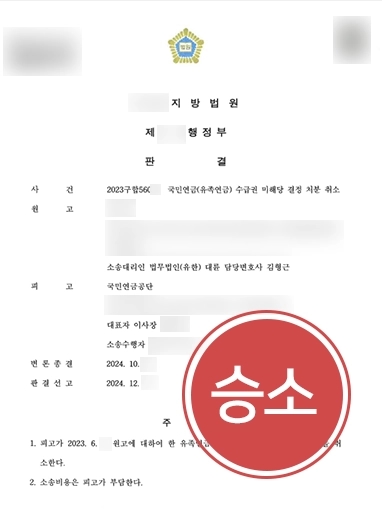
As a result of the attorney's assistance, the court issued a judgment revoking the disposition determining that the client was ineligible for survivor's pension benefits.
The client had been distressed not only at being unable to live with her husband until his death due to his illness, but also at receiving, after his death, a disposition denying even his pension, leaving her feeling without hope for the future.
However, the attorney developed a strategy and filed an administrative suit, and the client became able to receive the survivor's pension.
Because filing suit against a government agency involves considerable difficulty, it is recommended to seek the assistance of an attorney.
If, as in this case, you need to file an administrative suit against the National Pension Service over matters such as the National Pension or a survivor's pension, you may seek a 🔗attorney referral at any time.
This content is based on actual case studies of Daeryun Law LLC with some adaptations, and the copyright belongs to our firm.
Unauthorized reproduction, duplication, or distribution and other copyright infringements may result in legal action under applicable laws.