
CONTENTS
- 1. The Client Who Turned to the Gunsan Law Firm

- - How the Client Came to the Gunsan Law Firm
- 2. Stay of Execution Provisions Explained by the Gunsan Law Firm
- 3. Assistance from the Gunsan Law Firm
- - Gunsan Law Firm Argument ① Harm Difficult to Recover From
- - Gunsan Law Firm Argument ② Effect on Public Welfare
- - Gunsan Law Firm Argument ③ The Business Operator's Obligations
- 4. The Court's Decision on the Gunsan Law Firm's Arguments
- - If You Need the Assistance of the Gunsan Law Firm

1. The Client Who Turned to the Gunsan Law Firm

The client received a corrective order under somewhat unfair circumstances and turned to the Gunsan office to raise an objection together with the firm and to request professional assistance.
 How the Client Came to the Gunsan Law Firm
The client is associated with Company S, which was established for purposes such as the collection and processing of recyclable materials.
To entrust the disposal of approximately 650 tons of waste, the client entered into an agreement with Company A.
As it turned out, Company A was an unlicensed waste disposal operator.
After entering into the entrustment contract with Company S, Company A dumped waste without authorization at the site subject to the disposition in this case.
In response, the administrative agency issued a corrective order for a violation of the Wastes Control Act, on the ground that the client had entrusted the work without verifying whether the entrustee had the capacity to dispose of the waste in accordance with the waste disposal standards or the recycling principles and compliance requirements.
Because the party that dumped the waste at the site was Company A, the client sought to obtain a 🔗stay of execution against this disposition.
The client turned to the Gunsan Law Firm to resolve the matter with the assistance of a firm experienced in a range of 🔗administrative litigation.
2. Stay of Execution Provisions Explained by the Gunsan Law Firm
The stay of execution described in Article 23 of the Administrative Litigation Act is a system under which the effect of a disposition or its execution is suspended when there is an urgent need to prevent harm to the claimant.
The purpose of a stay of execution is to prevent harm that is difficult to recover from and that may arise from a disposition or its execution.
A decision to stay execution takes effect not only as to the applicant and the administrative agency but also as to third parties and the relevant administrative agencies.
Requirements for a Stay of Execution
① There must be a benefit in the stay of execution.
② The suit on the merits must be lawfully pending.
③ There must be a concern that harm difficult to recover from will arise.
④ There must be an urgent need.
⑤ There must be no concern that the stay of execution would have a serious effect on public welfare.
⑥ It must not be clear that the claim on the merits is without grounds.
🔗Curious about the overview and procedure of administrative litigation?
3. Assistance from the Gunsan Law Firm
The Gunsan Law Firm analyzed the statutes and precedents relevant to the case and developed a response tailored to each issue.
To obtain a decision from the court to stay execution, the firm argued the following.
Gunsan Law Firm Argument ① Harm Difficult to Recover From
Under the relevant statutes, failure to comply with the corrective order is punishable by imprisonment for up to three years or a fine of up to 30 million won.
The firm emphasized that, if the client could not comply with the disposition in this case, criminal punishment would follow, and that if the client were punished, harm impossible to recover from would clearly arise for the client.
Gunsan Law Firm Argument ② Effect on Public Welfare
The disposition in this case calls for the lawful disposal of the waste, but the party that dumped the waste at the site is Company A.
A corrective order can therefore be issued against Company A, and if Company A fails to comply, vicarious administrative execution is available.
Because the current law would apply to vicarious administrative execution, the firm emphasized that there was no concern that the stay of execution would have a serious effect on public welfare.
Gunsan Law Firm Argument ③ The Business Operator's Obligations
Each item of Article 17(1) of the Wastes Control Act sets out the obligations that a business operator discharging workplace waste must observe.
The party who becomes the subject of a corrective order also means the business operator who failed to observe the compliance requirements set out in each item.
The firm therefore emphasized that the business operator who discharged the workplace waste in the disposition in this case was Company A, and that the client was a mere third party who was not even the representative director.
4. The Court's Decision on the Gunsan Law Firm's Arguments
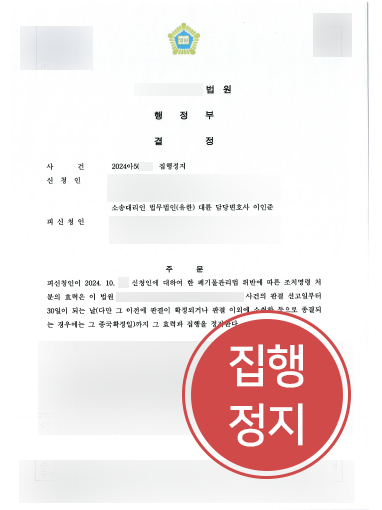
Accepting the Gunsan Law Firm's arguments, the court issued a decision to stay execution of the corrective order.
The client expressed deep gratitude to the Gunsan Law Firm.
If You Need the Assistance of the Gunsan Law Firm
Daeryun Law Firm has handled a range of 🔗administrative litigation cases, and its 🔗administrative attorneys, who have developed deep know-how, offer solutions tailored to each client.
Through analysis of its own administrative litigation data and the latest trends in precedent, the firm works to resolve legal disputes across many areas quickly.
The firm provides comprehensive legal services, including not only representation in administrative appeals and administrative litigation but also statutory interpretation and advisory work.
If you need the assistance of an attorney in a situation similar to the case above, you are welcome to turn to the Gunsan Law Firm for a consultation at any time.
This content is based on actual case studies of Daeryun Law LLC with some adaptations, and the copyright belongs to our firm.
Unauthorized reproduction, duplication, or distribution and other copyright infringements may result in legal action under applicable laws.