
CONTENTS
- 1. The Client Who Came to the Gwangju Real Estate Attorney

- - The Story of the Client Who Requested a Consultation From the Gwangju Real Estate Attorney
- 2. What Is a Lease Deposit Return Lawsuit? Explained by a Gwangju Real Estate Attorney
- - Lease Deposit Return Lawsuit
- - Termination of the Contract Due to Breach of the Special Terms
- - Conditions for Termination of the Contract
- 3. Assistance Provided by the Gwangju Real Estate Attorney
- - Gwangju Real Estate Attorney: Lawful Termination of the Contract Under the Special Lease Terms
- - Gwangju Real Estate Attorney: That the Lessor's Conduct May Be Regarded as a Tort
- 4. Result of the Gwangju Real Estate Attorney's Assistance: The Claim for Full Return of the Deposit Was Granted
- - If You Intend to Pursue a Deposit Return Lawsuit

1. The Client Who Came to the Gwangju Real Estate Attorney
The client, who sought out a Gwangju real estate attorney, was a tenant who had requested the return of the jeonse deposit from the landlord. When the landlord did not return the deposit, the client requested assistance in order to proceed with litigation.
 The Story of the Client Who Requested a Consultation From the Gwangju Real Estate Attorney
This is the case as understood by the Gwangju real estate attorney.
The client signed a two-year jeonse lease on an officetel and moved in with the client's family.
The client then attempted to obtain jeonse loan guarantee insurance, but the bank advised that the insurance could not be obtained because the lessor had a prior record of reimbursement claim debt.
Relying on a clause set as a special condition at the time of the contract, which provided that the contract could be terminated if the jeonse loan and the jeonse deposit return guarantee insurance were not available, the client requested the return of the down payment, but the lessor refused to return it, claiming to have no money.
After several attempts to reach the lessor by phone were refused, the client, who faced the risk of not recovering hundreds of millions of won, anxious and fearful, sought out an attorney with extensive experience handling real estate cases to request assistance in recovering the deposit.
2. What Is a Lease Deposit Return Lawsuit? Explained by a Gwangju Real Estate Attorney
The following addresses matters related to a lease deposit return lawsuit, examined through the client’s case.
Lease Deposit Return Lawsuit

A claim for return of a lease deposit refers to a lawsuit that a lessee (tenant) can file against a lessor (landlord) when the lease has ended and the tenant should have the deposit returned, but the landlord does not return it.
In the client's case, a standard contract was generally drawn up when entering into the jeonse lease, but there were matters requiring additional agreement between the lessor and the lessee, so the lawsuit proceeded based on a violation of the contractual terms set out in a special agreement.
If a part set out in a special agreement with the lessor is violated, notice of termination of the contract can be given on the ground of the breach of the special agreement, and this may be done by certified mail or by text message or KakaoTalk.
In a jeonse deposit return lawsuit, the key is to prove that the contract between the lessor and the lessee has terminated.
In a jeonse deposit return lawsuit arising from a breach of a special agreement, it is critical to prove that the special agreement existed in the lease contract.
While some cases are resolved through certified mail alone, proceeding with the legal assistance and review of an attorney, rather than handling it on one's own, can be more effective.
If certified mail has been sent but the return is not carried out within the period, a 🔗jeonse deposit return lawsuit should be pursued.
If an attorney is retained, after the complaint is drafted, service is carried out through the court.
After service, the lessor's side submits an answer, and after reviewing the answer and gathering additional evidence, a brief is sent, after which the court sets a date for oral argument and proceeds.
Termination of the Contract Due to Breach of the Special Terms
Various legal disputes can arise when a real estate contract is terminated.
Termination refers to extinguishing the effect of a contract through the declaration of intent of one of the parties.
Difference between rescission and termination of a contract
| Termination of a contract | Ending the contractual relationship going forward |
| Rescission of a contract | Treating the contract itself as if it had never existed from the beginning |
When terminating a contract alone, various problems such as interim payment issues or claims for damages can arise, so it is important to proceed with the assistance of a specialized attorney
Conditions for Termination of the Contract
The following are grounds for termination, and at least one of these conditions must be met for the process to proceed.
1. Breach of contract by the lessor
2. Problems with the living environment
3. Personal circumstances
4. Refusal of move-in registration and fixed date confirmation
5. The lessor's request for surrender of possession
The client in this case fell within the category of a problem with the contract, and was therefore able to proceed with a lawsuit for the return of the deposit.
The evidence required for a lawsuit to return the deposit is as follows.
| Lease agreement and record of the deposit payment Proof of completion of restoration to the original condition Certified mail demanding return of the deposit Other supporting evidence (text messages, emails, etc.) |
3. Assistance Provided by the Gwangju Real Estate Attorney

The Gwangju real estate attorney closely reviewed the case through a consultation with the client and established a response strategy suited to the matter, providing assistance as follows.
Gwangju Real Estate Attorney: Lawful Termination of the Contract Under the Special Lease Terms
The following is what the client had recorded as a special provision at the time of the contract.
While searching for a new residence before concluding the lease agreement, the client stated that the client would enter into the contract only for a property eligible for guarantee insurance, so that the deposit could be safely returned through the insurance even if 1. the lessor failed to return the jeonse deposit, or 2. a jeonse fraud occurred.
The client clearly requested, before the lease agreement, a property eligible for jeonse deposit return guarantee insurance from the licensed real estate agent, and the lessor entered into the contract by answering that it was possible, but upon later verification, enrollment in the jeonse deposit return guarantee insurance turned out to be impossible.
Accordingly, the client raised an objection with the lessor, stating that enrollment was impossible, but the lessor took no action and even declined the client's calls, and on these grounds the client argued that this amounted to termination of the contract and requested the immediate return of the deposit.
Gwangju Real Estate Attorney: That the Lessor's Conduct May Be Regarded as a Tort
The Gwangju real estate attorney argued that the landlord may have known the guarantee insurance could not be obtained because the landlord had been unable to return the lease deposit to the prior tenant who had occupied the officetel before the client moved in, yet still falsely stated that the guarantee insurance was available in order to use the deposit received from the client to pay the prior tenant.
The attorney also argued that because the client proceeded with the contract believing the property was eligible for guarantee insurance, the landlord's deceptive conduct constituted a violation of the special terms of the lease agreement, and the client's claim for return of the deposit was valid, citing as evidence receipts for the brokerage fee, moving costs, cleaning costs, and other expenses incurred to move into the current property.


4. Result of the Gwangju Real Estate Attorney's Assistance: The Claim for Full Return of the Deposit Was Granted
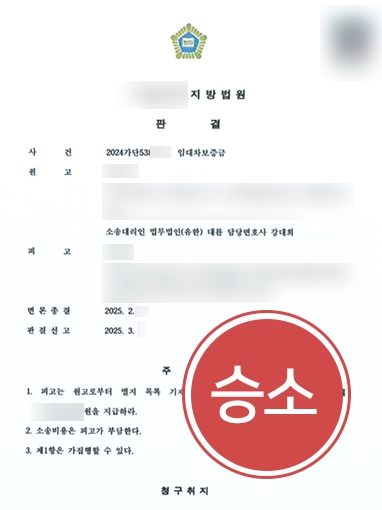
The court, accepting the argument of the Gwangju real estate attorney, granted the full deposit amount claimed by the client and rendered a judgment ordering the lessor to pay the client 314,000,000 won and to bear the litigation costs as well.
If You Intend to Pursue a Deposit Return Lawsuit

As in the client's case, if a deposit is not being returned despite a reasonable request, pursuing legal procedures may be the most reliable way to recover it.
The case above was one in which a claim for return of deposit lawsuit was pursued to recover the deposit from the lessor, and the full amount was recovered.
When a lessor does not return a deposit, the lengthy and complex legal procedures often cause the lessee considerable stress.
For this reason, we assist lessees who have not had their deposits returned in pursuing litigation through more favorable means so that they may have the full claimed amount granted.
At Daeryun LLC, real estate specialist attorneys with extensive experience in real estate cases provide strategies tailored to a range of cases, from 🔗monthly rent deposit return lawsuits to jeonse deposit return lawsuits, through legal review and case law analysis.
If you are preparing a claim for return of deposit lawsuit, please feel free to entrust your case to a Gwangju real estate attorney at any time
This content is based on actual case studies of Daeryun Law LLC with some adaptations, and the copyright belongs to our firm.
Unauthorized reproduction, duplication, or distribution and other copyright infringements may result in legal action under applicable laws.