
CONTENTS
- 1. The Client Who Sought a Defamation Attorney

- - The Client Who Sought Assistance to Defend Against Defamation Penalties
- 2. Penalties for Defamation Explained by a Defamation Attorney
- - What Are the Elements of the Crime of Defamation?
- 3. Areas of Assistance Provided by the Defamation Attorney
- - Defamation Penalty Defense Strategy ① No Statement of False Facts
- - Defamation Penalty Defense Strategy ② Difficulty in Establishing Publicity
- - Defamation Penalty Defense Strategy ③ Expression Within the Scope of Ordinary Conduct
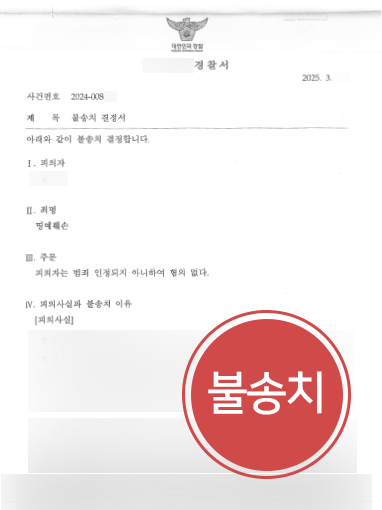
- 4. Result of the Defamation Attorney's Assistance: “Non-Referral”
- - If You Face Penalties for Defamation

1. The Client Who Sought a Defamation Attorney

The client, who came to a defamation attorney, requested legal assistance in a situation where the client had been charged with defamation by a former partner, and through the attorney's help obtained a non-referral decision from the police.
 The Client Who Sought Assistance to Defend Against Defamation Penalties
The following is the story of a client who came to a defamation attorney.
The client, who had been in a workplace romance, broke up with the other party after witnessing the other party communicating with another person of the opposite sex.
The client later said, at a drinking gathering with other colleagues, that the relationship had ended because the trust between them had broken down.
Upon learning of this, the other party filed a criminal complaint against the client for defamation, claiming that the client had spread false facts about the other party, such as infidelity.
However, this was not true, and the client felt wronged.
He therefore came to a defamation attorney and requested help in order to receive legal assistance and defend against punishment.
2. Penalties for Defamation Explained by a Defamation Attorney
The client, who came to a defamation attorney, was in a situation in which he had been the subject of a police complaint on charges of having committed 🔗defamation/dissemination of false information.
Defamation is a crime that is established when a person publicly states a fact and thereby damages another person's reputation.
What is important is that the crime is established not only when a false fact is stated, but defamation may also be recognized when a true fact is stated, so caution is required.
If defamation is recognized, the level of punishment is as follows.
Type | Level of punishment |
Defamation by statement of fact | Imprisonment for up to 2 years or a fine of up to 5 million won |
Defamation by statement of false fact | Imprisonment for up to 5 years, suspension of qualifications for up to 10 years, or a fine of up to 10 million won |
What Are the Elements of the Crime of Defamation?
One of the principal elements for establishing the crime of defamation is “publicity,” but this is not established only when directed at an unspecified large number of people.
What is publicity?
Accordingly, even if a fact is disseminated to a single individual, the requirement of publicity is satisfied if there is a possibility of it being spread to an unspecified or large number of people.
Conversely, however, publicity may not be established with respect to people who belong to a specially limited scope rather than an unspecified large number, such as close friends, relatives, or business partners.
Therefore, in order to clearly determine the establishment of the crime of defamation, it is advisable to seek advice from an attorney to closely grasp the case and conduct an appropriate legal review.


3. Areas of Assistance Provided by the Defamation Attorney

The defamation attorney conducted a detailed interview with the client and then gathered evidence, including statements from people around the client, to build the defense.
Defamation Penalty Defense Strategy ① No Statement of False Facts
The client had merely said, at a drinking gathering with colleagues, that he and a former partner broke up because they lost trust.
He did not say at all that the other party had committed infidelity or adultery.
The attorney collected statements from people around them that the police had not secured, submitted them as evidence, and emphasized that there was no statement of false facts at all.
Defamation Penalty Defense Strategy ② Difficulty in Establishing Publicity
The client discussed matters related to the incident only at a private gathering for drinks with close, longtime work colleagues.
There was a Supreme Court precedent holding that, where the likelihood of dissemination to an unspecified number of people is low when the relationships of the participants in such a conversation are considered as a whole, the element of ‘publicity’ is not recognized.
Based on this precedent and these legal principles, the attorney argued that it was difficult to apply the charge of defamation to the client.
Defamation Penalty Defense Strategy ③ Expression Within the Scope of Ordinary Conduct
In addition, the client merely said that he was upset that the relationship had ended in a breakup after trust with the other party was broken, and did not make any expressions insulting the other party or damaging the other party's reputation.
Therefore, it was also difficult to find that the social evaluation of the other party had been damaged by the client's remarks.
The attorney secured additional statements from people around them that could prove this, submitted them as evidence, and argued that the client's charges were not established.
4. Result of the Defamation Attorney's Assistance: “Non-Referral”

The police, who accepted the defamation attorney's arguments, rendered a non-referral decision, stating that the client's crime was not recognized.
If You Face Penalties for Defamation
This was a case in which a client who had been sued for defamation by a former romantic partner safely obtained a non-referral decision with the help of an attorney.
Likewise, when implicated in the crime of defamation, it is important to closely determine the elements of the crime based on specialized knowledge of the legal principles and to prepare an appropriate response.
At Daeryun Law Firm, attorneys with extensive professional experience in criminal cases, including the crime of defamation, provide evidence collection, defense strategies, and investigation response suited to the client's situation.
If you find yourself in a similar situation, please feel free to seek help at any time through a 🔗legal consultation appointment.
This content is based on actual case studies of Daeryun Law LLC with some adaptations, and the copyright belongs to our firm.
Unauthorized reproduction, duplication, or distribution and other copyright infringements may result in legal action under applicable laws.