
CONTENTS
- 1. The Client Who Requested a Response to Punishment for Defamation

- - What Is Defamation?
- 2. Assistance for Defending Against Punishment for Defamation
- - Responding to the Defamation Charge: Conducting a Preliminary Simulation of the Police Investigation
- - Responding to the Defamation Charge: Arguing That It Was a Justifiable Act
- 3. Result of Responding to Punishment for Defamation: Successful Non-Referral Decision
- - Defamation: Why a Specialized Lawyer Is Needed

1. The Client Who Requested a Response to Punishment for Defamation

This is the account of a client who requested a response to punishment for defamation.
The client expressed dissatisfaction with the products of Company A in an internet open chat room.
The representative of Company A who had been dealing with the client became aware of this and filed a complaint against the client for defamation.
Taken aback by the sudden complaint, the client decided to seek the help of an attorney to respond to the punishment for defamation.
The client sought out an attorney experienced in defamation matters and visited Daeryun Law Firm.
 What Is Defamation?
🔗Defamation refers to the act of damaging the reputation of a person or organization by stating specific facts or false facts about that person or organization.
-A person who damages the reputation of another by publicly stating facts shall be punished by imprisonment or imprisonment without labor for not more than two years or by a fine not exceeding 5 million won.
-A person who damages the reputation of another by publicly stating false facts shall be punished by imprisonment for not more than five years, suspension of qualifications for not more than ten years, or a fine not exceeding 10 million won.
Network Act (Information and Communications Network Act) Article 70
A person who, with the purpose of defaming another, damages the reputation of another by publicly disclosing facts through an information and communications network shall be punished by imprisonment for not more than three years or a fine not exceeding 30 million won.
A person who, with the purpose of defaming another, damages the reputation of another by publicly disclosing false facts through an information and communications network shall be punished by imprisonment for not more than seven years, suspension of qualifications for not more than ten years, or a fine not exceeding 50 million won.
Reputation can be broadly divided into objective reputation and subjective reputation.
Objective reputation is a concept that includes both ‘internal reputation’ and ‘external reputation,’ while subjective reputation refers to the ‘feeling of reputation’ that an individual experiences.
▶External reputation refers to the evaluation that society makes regarding an individual's human and social value. Accordingly, an act that damages external reputation can be viewed as conduct that is the object of the crime of defamation.
▶Mitigating factors: where the degree of stating false facts is minor, where the likelihood of dissemination is low, sincere remorse, no record of criminal punishment, substantial recovery of the harm (including a deposit in court), and the like
▶Aggravating factors: where serious harm was caused to the victim, where the offender is a habitual offender, where harm was caused during a settlement attempt, a prior conviction for the same type of offense, and the like


2. Assistance for Defending Against Punishment for Defamation

The attorney provided assistance to defend against punishment for defamation.
The defamation attorney examined the client's case closely and responded to the police investigation.
Responding to the Defamation Charge: Conducting a Preliminary Simulation of the Police Investigation
In a defamation case, the suspect's statement has a significant effect on the direction of the investigation.
In particular, if the suspect cannot clearly explain the context of the expression or the intent behind its creation, there is a high possibility that the suspect may be misunderstood as having had the intent to damage another person's reputation.
The attorney in charge conducted a sufficient preliminary interview with the client prior to the police appearance, and then carried out a simulation assuming the actual investigation situation.
Through this, the attorney enabled the client to experience the atmosphere of a police investigation in advance and to ease the psychological burden, and minimized the possibility that the client might become flustered during questioning and use an unfavorable expression.
Responding to the Defamation Charge: Arguing That It Was a Justifiable Act
The defamation specialist attorney argued that the client's conduct was a legitimate act that did not violate social norms.
The client suffered serious mental harm because of Company A's service.
The post in question was also uploaded for a public interest purpose, so that no further victims like himself would arise.
The defamation specialist attorney argued that the act of stating facts for a public interest purpose precludes illegality.
▶Applicable precedent: A case in which the alleged fact concerns the public interest means that the alleged fact, viewed objectively, must be one concerning the public interest and must be alleged as such. The public interest also includes matters concerning the interest and concern of a particular social group or all of its members.
3. Result of Responding to Punishment for Defamation: Successful Non-Referral Decision
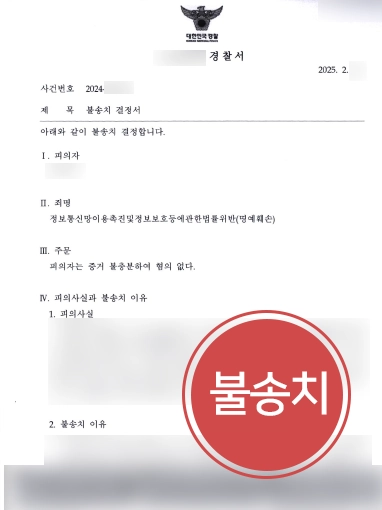
As a result of the response to punishment for defamation, the police rendered a decision of non-referral with respect to the client.
The police determined that the client's conduct was judged to be the mere expression of an opinion and that there was no evidence to regard it as having otherwise disparaged the victim.
The client said, "It was something I wrote for the public interest, and I never thought I would face a defamation complaint. I was worried about receiving a serious punishment, but thanks to the attorney I was able to conclude the case at the police investigation stage."
Defamation: Why a Specialized Lawyer Is Needed
If you have been reported for defamation, whether you face criminal punishment may vary greatly depending on whether the content of the expression is true or false, whether there was a public-interest purpose, and whether intent is recognized.
Therefore, legal judgment and strategy are very important from the early stages of the investigation.
To prevent unnecessary misunderstandings or unfavorable statements from leading to criminal punishment, it is best to obtain the assistance of an attorney specializing in criminal matters from the early stages of the investigation.
Daeryun Law Firm provides the following legal services to respond to punishment for defamation.
▶Initial legal consultation and establishment of a response strategy
▶Establishment of a statement strategy for responding to police questioning and mock investigation simulations
▶Submission of a written legal opinion asserting grounds excluding illegality and the like
▶Responding to trial with a sentence-mitigation strategy, including submission of sentencing materials
If you have been involved in a defamation matter, please visit the nearest Daeryun Law Firm office.

This content is based on actual case studies of Daeryun Law LLC with some adaptations, and the copyright belongs to our firm.
Unauthorized reproduction, duplication, or distribution and other copyright infringements may result in legal action under applicable laws.