
CONTENTS
- 1. The Story Behind Receiving the Defamation Complaint Filing

- 2. How to Respond When You Receive a Defamation Complaint Filing
- - Elements of Defamation
- - Punishment Level for Defamation
- 3. The Specialist Attorney Responding to the Defamation Complaint Filing
- - Inducing Admission of the Defamation Charge
- - Completion of Compliance Education
- - Weak Publicity and Likelihood of Dissemination
- 4. Outcome of the Response to the Defamation Complaint Filing

1. The Story Behind Receiving the Defamation Complaint Filing
This is the account of a client who, stating that he had received a defamation complaint, sought assistance in defending against the complaint.
The client was working in the development team of a company. From a certain point, he reportedly began to notice a peculiar undercurrent between one team member, the victim in this case, and the team leader.
At a private gathering where he was drinking with close colleagues, he brought up the subject of the victim.
Jokingly, the client said that the victim and the team leader appeared to be in a romantic relationship, claiming that he had seen the two of them engaging in physical contact, touching each other's waists, in a meeting room.
His colleagues reportedly reacted with surprise but also with apparent interest, and the client says he became excited that they took an interest in his story.
Having had a good deal to drink and feeling exhilarated by the colleagues who were responding to his account, the client lied that the victim and the team leader had traveled abroad together even though each had a spouse.
After the gathering ended, the client began to regret the lies on his way home, but a few weeks later he was the subject of a defamation complaint.
The complaint alleged that the client had publicly stated false facts about the victim and thereby damaged the victim's reputation.
After receiving the defamation complaint, the client came to this firm to seek advice on how to respond.
2. How to Respond When You Receive a Defamation Complaint Filing
If you have received a defamation complaint, you should immediately seek the assistance of a specialized attorney, obtain advice on whether to admit or deny the defamation charge, and then establish a response strategy accordingly.
In the case of defamation, because severe punishment is imposed given that it damages another person's honor and causes harm, particular caution is required.
 Elements of Defamation
🔗Defamation is established when the following elements are met.
① Public nature
The defamatory content must be communicated in a state where an unspecified or large number of people can perceive it.
② Statement of fact or false fact
A statement of a specific fact or false fact capable of lowering the social evaluation of a specific person
Whether true or false, the content must be such that it lowers the other person's reputation for the offense to be established
③ An act that damages a person's reputation
The content must be such that it can lower social evaluation, and there must be a possibility that the person will suffer damage to social credit, dignity, reputation, and the like
④ Intent
When communicating the defamatory content, the person must intend to damage another's reputation or at least recognize the possibility of doing so
Supreme Court Judgment 2018Do4200, rendered on June 15, 2018, held as follows regarding the elements for the establishment of defamation.
The public nature that constitutes an element of defamation refers to a state in which an unspecified or large number of people can perceive it.
Even if a fact was disseminated to a single person individually, the requirement of public nature is met if there is a possibility that it will be spread from that person to an unspecified or large number of people; conversely, if there is no possibility of dissemination, the spreading of a fact to one specific person lacks public nature.
On the other hand, where the public nature of defamation is recognized on the ground of the possibility of dissemination as stated above, dolus eventualis is required at least as a subjective element of the constituent elements of the crime, so there must be recognition of the possibility of dissemination as well as an internal intention to accept that risk.
Whether the actor accepted the possibility of dissemination must be inferred from the actor's standpoint as to his or her state of mind, while considering how an ordinary person would assess that possibility of dissemination based on specific circumstances such as the form and situation of the act as it appeared externally.
Punishment Level for Defamation
If a criminal complaint for defamation leads to the establishment of defamation, the following level of punishment is imposed depending on whether the stated fact is true or false.
Where a fact is stated: imprisonment or imprisonment without labor of up to 2 years or a fine of up to 5 million won
Where a false fact is stated: imprisonment of up to 5 years, suspension of qualifications for up to 10 years, or a fine of up to 10 million won


3. The Specialist Attorney Responding to the Defamation Complaint Filing
The specialist attorney responded as follows to the defamation complaint the client received.
Inducing Admission of the Defamation Charge
The specialist attorney persuaded the client to admit all the charges and to show a remorseful attitude.
Following the specialist attorney's advice, the client wrote a handwritten letter of apology based on the guidelines provided by the specialist attorney.
The specialist attorney emphasized that the client fully admitted and was remorseful about the fact that he had conveyed false statements about the victim to his coworkers, and requested leniency.
Completion of Compliance Education
The specialized attorney coordinated with a psychological counseling center to help the client complete law-abidance education.
The specialized attorney submitted the certificate of completion of the law-abidance reinforcement education and the counselor's written opinion, emphasizing that the client was making efforts to prevent reoffending.
The counselor's written opinion submitted by the specialized attorney contained the following.
Based on the client's active completion of the reoffending-prevention education, the client's will to practice behavioral improvement, and the client's resolve to actively pursue treatment and management, it is assessed that the likelihood the client will be capable of responding appropriately should a similar situation arise is high.
The specialized attorney emphasized that, although the client committed the wrongdoing out of a careless thought, the client was resolving each day, with regret and reflection, not to reoffend, and requested that a lenient disposition be imposed.
Weak Publicity and Likelihood of Dissemination
The attorney emphasized that the publicity and the potential for dissemination in the client's case were not significant.
The client acknowledged having caused harm by making a statement that could damage the victim's reputation, but had merely told a fabricated story to coworkers at the company and had not spoken about the victim to anyone else at all.
Citing this point, the attorney requested leniency on the ground that the degree of harm the client caused to the victim was minor.
4. Outcome of the Response to the Defamation Complaint Filing

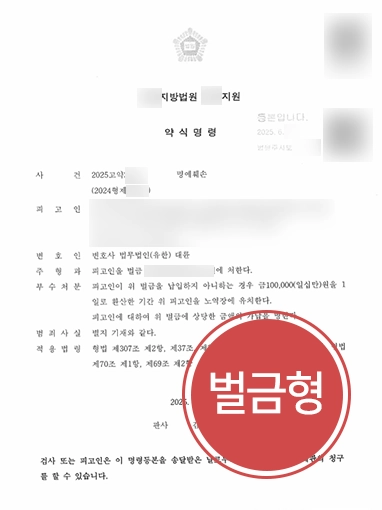
As a result of the attorney's response to the defamation complaint received by the client, the prosecution filed a summary indictment seeking a minor fine, and the court accepted this and issued a summary order.
Through the attorney's response, the client was able to conclude the case with a minor fine despite having received a defamation complaint based on the assertion of false facts.
In a situation similar to that of the client in this case, an actual custodial sentence may be imposed without an active response from the attorney.
If you have received a defamation complaint, please proceed without delay with a 🔗legal consultation reservation and seek assistance in defending against an actual custodial sentence.
This firm will present a response strategy tailored to the client through collaboration among criminal law attorneys, the psychological counseling center, and the evidence investigation center.
This content is based on actual case studies of Daeryun Law LLC with some adaptations, and the copyright belongs to our firm.
Unauthorized reproduction, duplication, or distribution and other copyright infringements may result in legal action under applicable laws.