
CONTENTS
- 1. A Client Who Came to Us Seeking a Reduction of a Drunk Driving Fine

- - How the Client Came to Face a Drunk Driving Fine Crisis
- - The Key Issues of the Case Identified by the Attorney Handling Drunk Driving Cases
- 2. The Attorney's Assistance Toward Reducing the Drunk Driving Fine
- - The Attorney's Strategy ① | Prompting an Amendment of the Indictment
- - The Attorney's Strategy ② | Mitigation of the Sentence Through Reduction of the Range
- - The Attorney's Strategy ③ | Emphasizing Mitigating Circumstances
- 3. Reduction of the Drunk Driving Fine Achieved, a 50% Reduction
- - If You Need a Reduction of Your Fine
- - Drunk Driving FAQ

1. A Client Who Came to Us Seeking a Reduction of a Drunk Driving Fine
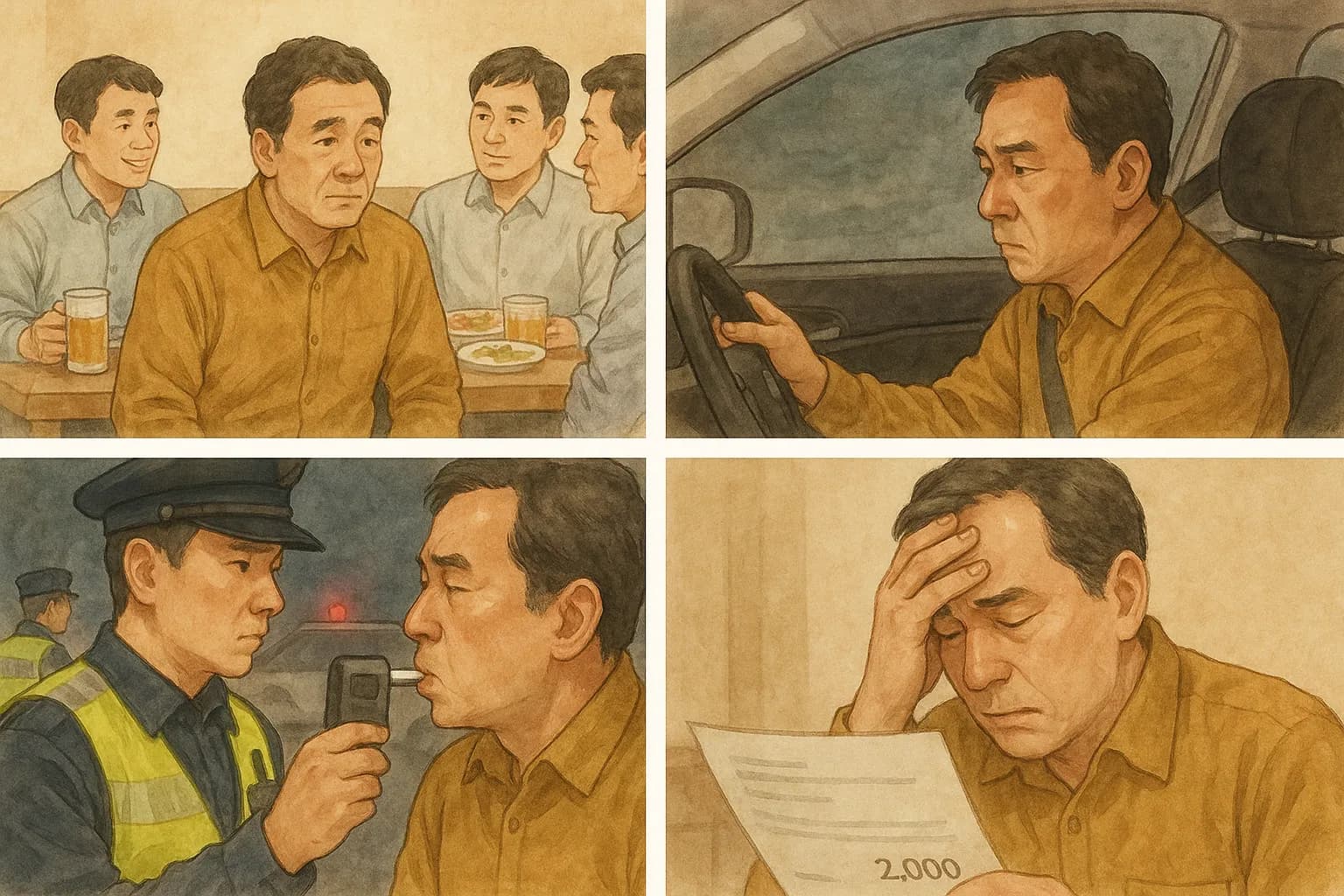
The client, who requested a consultation seeking a reduction of the drunk driving (DUI) fine, was caught by the police while driving his own vehicle after a late-night gathering involving alcohol.
He subsequently received notice from the court that a fine of KRW 20 million was to be imposed by summary order, and he was in a state of considerable shock and anxiety over the unexpectedly large fine.
Expressing deep regret and anxiety, the client said, “I never imagined that a momentary decision would lead to such a heavy financial burden,” and earnestly sought out an attorney handling drunk driving cases in order to explore the possibility of a reasonable reduction of the drunk driving fine.
 How the Client Came to Face a Drunk Driving Fine Crisis
The client had two prior drunk driving convictions, but he had since lived diligently for nearly 20 years without reoffending.
On the day of the incident, after a gathering with acquaintances involving alcohol, he requested a designated driver, but the assignment of a driver was delayed, so he unavoidably drove a short distance himself.
However, a minor collision occurred while he was driving, and a breath test was conducted when the police arrived.
During this process, the breath test result showed a reading exceeding 0.2%, and a subsequent blood test produced an even higher reading.
Taking the higher blood test result as its basis, the prosecution proceeded with a summary indictment, and the court accordingly issued a summary order imposing a fine of KRW 20 million, the highest level.
Greatly shocked by the unexpectedly high fine, the client requested the assistance of an attorney handling drunk driving cases.
The Key Issues of the Case Identified by the Attorney Handling Drunk Driving Cases
To seek a reduction of the drunk driving fine, the attorney handling drunk driving cases first identified the key issues of the case.
The most important issue in this case was the applicable range of the blood alcohol concentration.
On its face, the reading exceeded 0.2% and appeared to fall within the most severe punishment range, but there was a sufficient possibility that the actual blood alcohol concentration at the time driving ended was lower than this.
The Road Traffic Act prescribes the levels of punishment by blood alcohol concentration as follows.
Article 148-2 (3) of the Road Traffic Act
Blood Alcohol Concentration | Level of Punishment |
0.03% or more but less than 0.08% | Imprisonment for not more than 1 year or a fine not exceeding KRW 5 million |
0.08% or more but less than 0.2% | Imprisonment for not less than 1 year and not more than 2 years, or a fine of not less than KRW 5 million and not more than KRW 10 million |
0.2% or more | Imprisonment for not less than 2 years and not more than 5 years, or a fine of not less than KRW 10 million and not more than KRW 20 million |


2. The Attorney's Assistance Toward Reducing the Drunk Driving Fine
To seek a reduction of the drunk driving fine, the attorney handling drunk driving cases responded to the case by employing a comprehensive range of strategies.
The core of the approach was not simply to appeal to emotion, but rather to logically demonstrate, on legal and scientific grounds, the reasonableness of reducing the sentence.
The Attorney's Strategy ① | Prompting an Amendment of the Indictment
The central strategy in this case was to scientifically contest the reliability of the blood alcohol concentration measurement.
The attorney handling drunk driving cases filed a formal request for an examination with the National Forensic Service and secured various scientific data as follows.
∙ The cause of the difference in readings between the breath test and the blood test
∙ The rate of change in blood alcohol concentration over time
In addition, by submitting a request for factual inquiry to the company that manufactured the measuring device, the attorney confirmed that the official margin of error of the device was ±5%, and established that there was no difference in accuracy depending on the blood alcohol concentration range.
On the basis of this scientific evidence, the attorney emphasized that the initial breath test result, conducted closest to the time driving ended, more accurately reflected the blood alcohol concentration at the actual time of driving.
In the end, the prosecution withdrew the blood test reading that it had originally taken as the basis for the indictment and applied to amend the indictment based on the lower initial reading, and the court accepted this, which became a turning point at which the very standard for judging the facts charged was changed.
The Attorney's Strategy ② | Mitigation of the Sentence Through Reduction of the Range
The second important strategy in this case was to induce the application of a more lenient statutory punishment range, on the ground that the blood alcohol concentration reading may have differed from the level at the actual time of driving.
Presentation of the Legal Argument
The Supreme Court has already held that, where time has elapsed between the time driving ended and the time of measurement, the reading cannot be taken as the blood alcohol concentration at the time of driving without further consideration.
In particular, where the time of measurement is within 90 minutes after drinking, it is a matter of scientific and legal experience that the blood alcohol concentration is likely still rising, that is, in the “rising phase”.
Because a reading taken during the rising phase is necessarily higher than at the actual time of driving, the range can be reassessed on this basis with reference to the closest initial measurement result.
Application to the Client's Case
In this case as well, an interval of about 20 to 60 minutes existed between the time the client finished drinking, the time driving ended, and each respective time of measurement, and a meaningful difference was also confirmed between the initial measurement result and the final measurement result.
This is a typical case of the “rising phase,” in which the blood alcohol concentration increased over time, and it supports the view that the reading at the actual time of driving was likely lower than the final measurement.
In addition, reflecting the position of the Supreme Court that a scientific analysis must take into account individual factors such as the defendant's amount of alcohol consumed, drinking pace, constitution, and degree of physical activity, rather than applying a simple calculation or an average value, the attorney attempted a scientific reinterpretation of the readings based on objective expert examination data and legal reasoning.
The Thrust of the Argument
Through these efforts to establish the facts, both the prosecution and the court came to accept the possibility of applying a lower blood alcohol concentration range.
As a result, a sentencing range one level lower than the most severe punishment range was applied.
The Attorney's Strategy ③ | Emphasizing Mitigating Circumstances
Beyond simply disputing the readings, the attorney handling drunk driving cases also actively highlighted the client's sincere remorse and his efforts to prevent reoffending.
After the incident, the client returned his vehicle to his company and firmly committed to using designated driver services, and he voluntarily prepared a pledge to abstain from drunk driving and a pledge to comply with the law.
The attorney also emphasized, on multiple fronts, that the likelihood of reoffending was low, citing family counseling, a base of social support, and letters of appeal from workplace colleagues.
Furthermore, the attorney argued that, given that the prior drunk driving convictions were matters from nearly 20 years in the past, it was unreasonable to treat them as grounds for aggravated punishment for reoffending.
3. Reduction of the Drunk Driving Fine Achieved, a 50% Reduction
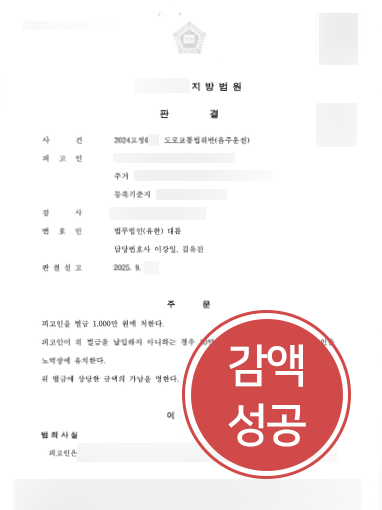
After a meticulous response aimed at reducing the drunk driving fine, the court recognized that the client's blood alcohol concentration was below 0.2% and issued a judgment reducing the fine from the KRW 20 million sought by the prosecution in its summary indictment to KRW 10 million.
This was a meaningful outcome in which, despite a case made unfavorable by the high blood alcohol concentration and the prior convictions, the sentence was reduced by half through scientific analysis and a strategic response.
After the trial, the client expressed both relief and remorse, saying, “I cannot undo my mistake, but I am deeply grateful that the circumstances of the case were fully considered and the sentence was adjusted. I will hold myself firmly accountable so that this never happens again.”
If You Need a Reduction of Your Fine
A drunk driving case can extend beyond simple criminal punishment to license suspension, settlement with the victim, and civil liability for damages.
Daeryun Law Firm understands the psychological burden on its clients and provides the following strategic responses.
▷ Assisting in securing evidence such as on-site CCTV, dashcam footage, and witness statements
▷ Managing the case in a favorable direction from the outset through initial measures and the preservation of evidence immediately after the incident
▷ A comprehensive response through careful legal review and scientific analysis
▷ Prompt response through the assignment of a consulting attorney and a dedicated case attorney
If you are facing a similar situation, 🔗Schedule a Legal Consultation to entrust your case to us.
Drunk Driving FAQ
A. Generally, that is not the case. Under Article 457-2 of the Criminal Procedure Act, where a defendant requests a formal trial in objection to a summary order, the court may not impose a more severe type of punishment than the punishment pronounced in the summary order. In other words, if a fine was imposed in the summary order, as a matter of principle the court may not impose a more severe type of punishment in the formal trial, such as imprisonment with labor or imprisonment without labor. However, increasing the amount of the fine is permitted. Q. If I request a formal trial after a summary order in order to seek a reduction of the drunk driving fine, could the sentence become heavier?
A. The period immediately after the incident occurs is the most important. Because the content of the initial statements and whether evidence is preserved have a significant effect on the eventual trial result, it is advantageous to obtain the assistance of an attorney as soon as possible.Q. To seek a reduction of the drunk driving fine, is it advisable to retain an attorney handling drunk driving cases?
This content is based on actual case studies of Daeryun Law LLC with some adaptations, and the copyright belongs to our firm.
Unauthorized reproduction, duplication, or distribution and other copyright infringements may result in legal action under applicable laws.