
CONTENTS
- 1. Background of the Drunk Driving Property-Damage Accident

- - Background to Becoming a Suspect for Drunk Driving
- 2. Issues in the Drunk Driving Property-Damage Accident
- - Level of Punishment for Drunk Driving
- 3. Assistance Provided in the Drunk Driving Property-Damage Accident Case
- - Strategy 1 for Denying Drunk Driving | Objective Reconstruction of the On-Scene Circumstances
- - Strategy 2 for Denying Drunk Driving | Presenting the Legal Basis
- - Strategy 3 for Denying Drunk Driving | Emphasizing Repair of the Harm and a Diligent Attitude
- 4. Drunk Driving Property-Damage Accident Case Result, Non-Referral (Police) Decision
- - If You Are Facing a Drunk Driving Allegation You Believe to Be Unjust
- - Drunk Driving Property-Damage Accident FAQ

1. Background of the Drunk Driving Property-Damage Accident
The client, who was suspected of having caused a drunk driving property-damage accident, requested legal assistance from our firm in order to assert innocence.
 Background to Becoming a Suspect for Drunk Driving
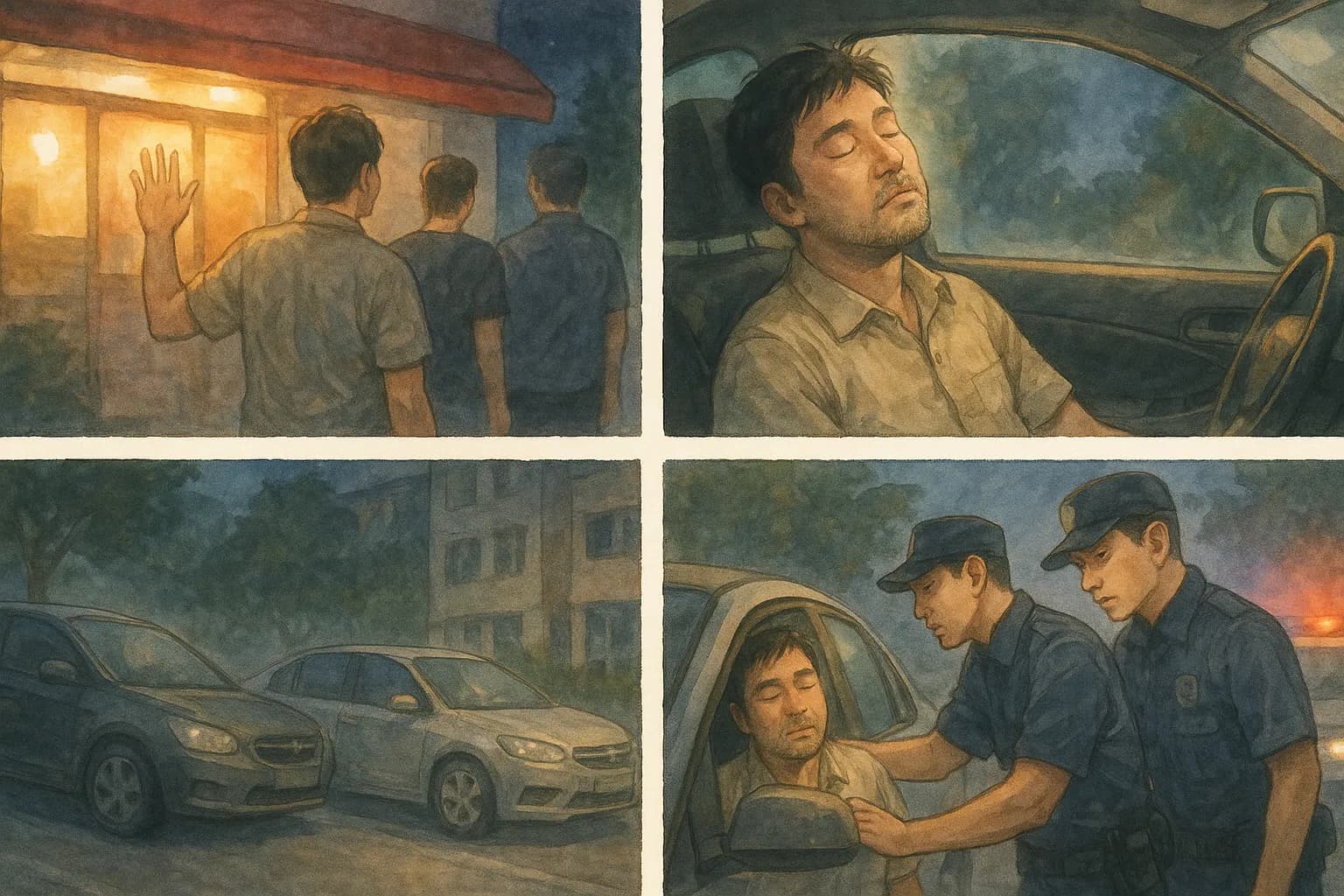
After finishing a gathering with acquaintances, the client parked the vehicle near the restaurant the client operates and, before heading home, intended to rest briefly in the vehicle to sober up.
Although the engine was running, the client had merely run the air conditioning to avoid the hot weather and had fallen asleep.
However, while the client was in a deep sleep, an accident occurred in which the vehicle suddenly moved forward and struck several vehicles parked opposite in succession.
At the time, the vehicle was parked on a slight incline, and it was presumed that the gear operation or pedal contact had occurred unconsciously.
In addition, the client remained asleep even immediately after the accident and did not become aware of the situation until the police arrived at the scene and woke the client.
The police breath test subsequently showed a blood alcohol concentration considerably exceeding the threshold for criminal punishment; however, the client came to our firm to clear this grievance, asserting that the client had not “driven” the vehicle.


2. Issues in the Drunk Driving Property-Damage Accident
The core of the drunk driving property-damage accident case was whether there was an ‘intent to drive’.
If the movement of the vehicle arose simply from a physical factor or from an unconscious bodily reaction during sleep, this does not constitute ‘driving’ under the Road Traffic Act.
In addition, the question arose of whether a person can be deemed to have engaged in ‘drunk driving’ merely on the ground of being intoxicated, in a situation where the vehicle moved accidentally.
In other words, although in formal terms the client's blood alcohol concentration reading exceeded the threshold for criminal punishment, in substance the key issue was that no act of driving itself existed.
Level of Punishment for Drunk Driving
If the client were found to have ‘driven’ while intoxicated, the client could have faced the following punishment.
Road Traffic Act Article 148-2 Paragraph 3
Blood Alcohol Concentration | Level of Punishment |
0.03% or more and less than 0.08% | Imprisonment with labor for up to 1 year or a fine of up to 5,000,000 won |
0.08% or more and less than 0.2% | Imprisonment with labor for 1 year or more and up to 2 years, or a fine of 5,000,000 won or more and up to 10,000,000 won |
0.2% or more | Imprisonment with labor for 2 years or more and up to 5 years, or a fine of 10,000,000 won or more and up to 20,000,000 won |
3. Assistance Provided in the Drunk Driving Property-Damage Accident Case
So that the client, who was suspected of having caused a drunk driving property-damage accident, could deny the allegation and defend against punishment, the attorney of our firm argued as follows.
Strategy 1 for Denying Drunk Driving | Objective Reconstruction of the On-Scene Circumstances
The core issue in this case was whether the suspect had an ‘intent to drive.’
There was a strong possibility that the vehicle's movement at the time of the incident was simply the result of a physical factor or of unconscious conduct during sleep.
The attorney therefore concentrated on securing the dashcam footage to objectively establish the client's unconscious movements.
By analyzing the footage frame by frame, the attorney reconstructed in concrete detail the circumstances showing that the suspect did not ‘consciously control the vehicle’.
Results of the Dashcam Analysis
∙ Circumstances were confirmed in which the suspect, while half asleep, shifted about and touched the gear with the right hand and pressed a pedal with the foot
∙ A scene was captured in which the accelerator and the brake lit up at the same time
This footage served as decisive evidence supporting the conclusion that the suspect had not operated the vehicle volitionally.
On this basis, the investigative authority acknowledged that “the vehicle moved independently of the suspect's will,” and as a result, the objective reconstruction of the on-scene circumstances became a key clue establishing the ‘absence of intent’ in the drunk driving.
Strategy 2 for Denying Drunk Driving | Presenting the Legal Basis
Relying on Article 2, Item 26 of the Road Traffic Act and Supreme Court precedent (Decision 2004Do1109), the attorney emphasized that the concept of driving includes a purposive element of an intentional act of control.
In other words, a vehicle's mere movement cannot be deemed ‘driving,’ and only where conscious and intentional operation exists is it assessed as driving in the legal sense.
Supreme Court Decision 2004Do1109, rendered April 23, 2004
On the basis of this legal principle, the attorney repeatedly argued the following points.
② The vehicle moving while the suspect was half asleep was merely the result of unconscious conduct
In addition, the suspect's consistent statement that “the engine was started in order to run the air conditioning” supported that the purpose of starting the engine was a physiological need rather than driving, and this served as a basis for emphasizing that the requirement of an ‘act of driving’ under the Road Traffic Act was not met.
This legal argument and analysis of the circumstances served as the key reasoning that persuaded the investigative authority to reach the conclusion of an ‘absence of intent to drive.’
Strategy 3 for Denying Drunk Driving | Emphasizing Repair of the Harm and a Diligent Attitude
Separately from criminal liability, the attorney pursued a parallel strategy of thoroughly establishing the measures taken to repair the harm caused by the accident and the suspect's intent to show remorse.
The client immediately compensated in full, through automobile insurance, for the property damage arising from the property-damage accident, and reached an amicable settlement with the victim's side.
In addition, the client submitted objective materials (such as a certificate of completion and a medical certificate) showing that the client had practiced abstinence from alcohol after the accident and had completed recurrence-prevention education and psychological counseling.
Such a diligent response led the investigative authority to recognize that it was difficult to assess the suspect on the same footing as an ordinary drunk driving suspect, and ultimately led to a recognition that ‘there was no intent to drive, and the likelihood of social blame was also low.’
4. Drunk Driving Property-Damage Accident Case Result, Non-Referral (Police) Decision
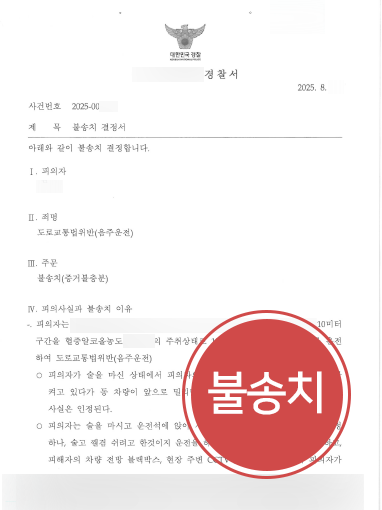
With respect to the client's charge of having caused a drunk driving property-damage accident, as a result of presenting a logical denial and submitting sufficient materials, the investigative agency recognized that the client ‘had no intent to drive,’ and ultimately a non-referral (police) decision was rendered on the charge of violation of the Road Traffic Act (drunk driving).
As a result, the client was able to conclude the case without criminal punishment
If You Are Facing a Drunk Driving Allegation You Believe to Be Unjust
Daeryun Law Firm comprehensively manages the entire course of drunk driving property-damage accident cases, in which criminal punishment, license suspension and revocation, and insurance handling are intertwined.
Every detail, down to the smallest clue such as the blood alcohol concentration level, dashcam footage, and the vehicle's stopped condition, is analyzed in order to establish a response strategy tailored to the client.
In addition, key evidence such as the condition of the scene immediately after the incident, vehicle dashcam footage, and witness statements is promptly secured, and a framework for defending the client against the allegation is built from the early stages of the police investigation.
If you are facing a drunk driving allegation that you believe to be unjust, as described above, you may request assistance with your case through 🔗Legal Consultation Booking.
Drunk Driving Property-Damage Accident FAQ
A. The Supreme Court does not regard a case in which the vehicle moved without any conscious operation as driving. However, securing evidence to establish this is very important, and the allegation may be denied through sufficient proof.Q. I fell asleep in my car and an accident occurred. Does this count as a drunk driving property-damage accident?
A. Where recovery of the victim's loss has been achieved, the court takes this into account as a favorable sentencing factor. Accordingly, prompt insurance handling and a sincere intention to compensate the victim are very important.Q. Does handling the matter through insurance after a drunk driving property-damage accident reduce the criminal punishment?

This content is based on actual case studies of Daeryun Law LLC with some adaptations, and the copyright belongs to our firm.
Unauthorized reproduction, duplication, or distribution and other copyright infringements may result in legal action under applicable laws.