
CONTENTS
- 1. The Client Who Committed the Crime of Intrusion upon Habitation

- - The Circumstances of the Case as Grasped by the Criminal Attorney
- 2. Defense Strategy for Multiple Charges, Including Intrusion upon Habitation
- - Defense Strategy Against Criminal Punishment ① | Emphasizing the Impulsive and Unplanned Structure of the Offense
- - Defense Strategy Against Criminal Punishment ② | Explaining the Circumstances of the Portion Concerning Violation of the Act on Punishment of Crime of Stalking
- - Defense Strategy Against Criminal Punishment ③ | Reaching a Settlement Through Criminal Conciliation
- - Defense Strategy Against Criminal Punishment ④ | Comprehensive Explanation of Mitigating Circumstances
- 3. Outcome of Intrusion upon Habitation and Related Charges: Suspension of Indictment on All Charges
- - Sentencing Levels for Intrusion upon Habitation and Related Charges
- - If You Are Considering a Legal Consultation with a Criminal Defense Attorney
- - Frequently Asked Questions about the Case

1. The Client Who Committed the Crime of Intrusion upon Habitation
This is the account of the client who requested a consultation regarding charges including the crime of intrusion upon habitation.
 The Circumstances of the Case as Grasped by the Criminal Attorney

The client, a university student, experienced ongoing emotional clashes as his relationship with his girlfriend deteriorated, and after an argument, he committed an impulsive act in the course of visiting the home where they had cohabited in order to retrieve his belongings.
When his girlfriend would not open the door, he acted excessively in an agitated state in an attempt to resolve the situation, and in this process he came to be investigated on multiple charges, including intrusion upon habitation, infliction of bodily injury, special intimidation, and violation of the Act on Punishment of Crime of Stalking.
After the incident, the client deeply regretted his actions, and, having cut off all contact with the victim and facing imminent enlistment for active military service, he came to the law firm Daeryun and requested the assistance of a criminal attorney in the hope that the case would be concluded promptly.


2. Defense Strategy for Multiple Charges, Including Intrusion upon Habitation

For the client involved in the crime of intrusion upon habitation and other charges, the criminal attorney carefully analyzed matters such as the circumstances of the case, the emotional situation, the impulsiveness, and the course of the relationship with the victim, and constructed a defense strategy along the following lines.
Defense Strategy Against Criminal Punishment ① | Emphasizing the Impulsive and Unplanned Structure of the Offense
The criminal attorney focused on explaining that the client's act was not a planned and prepared offense but an impulsive act carried out spontaneously in a situation where the emotional clash had become severe.
This was because the core circumstance of the case was that, with arguments with the cohabiting partner having accumulated, the client visited the home to retrieve his belongings, and when the victim would not open the door, his judgment momentarily became clouded and he committed an excessive act.
In addition, the attorney submitted as a basis the point that there had been no tools or plan prepared in advance, and no circumstances of repeated approach, thereby emphasizing that the client's act was not an ‘intentional intrusion’ but an incident that occurred in a temporary and impulsive situation.
Defense Strategy Against Criminal Punishment ② | Explaining the Circumstances of the Portion Concerning Violation of the Act on Punishment of Crime of Stalking
The client received notice of an emergency measure decision, effective for about one month after the intrusion upon habitation incident, ordering him not to approach within 100m received it.
However, there were several violations of the measure thereafter, and on its face, there was room to misconstrue this as an approach intended to continue stalking.
Accordingly, the criminal attorney, in order to make clear that the violations were not for an intentional and continuous purpose of stalking, carefully organized the actual circumstances as follows and explained them to the investigative agency.
▷ The fact that the victim's side continuously made contact on the pretext of settlement and dialogue
▷ The circumstance that the client, being inexperienced at ending the relationship, was unable to refuse this
In other words, the initiative for the violation of the access-prohibition measure did not lie with the client, and the attorney emphasized that this was an incident that occurred in an unstable situation in which the relationship between the two parties had not been completely resolved.
Through this, the attorney highlighted the point that the client's conduct involved no intent to stalk and was an exceptional situation arising from relationship conflict rather than criminal intent, and requested mitigation of the level of punishment.
Defense Strategy Against Criminal Punishment ③ | Reaching a Settlement Through Criminal Conciliation
Even in a situation where a direct meeting with the victim was difficult, the client sincerely wished to apologize and reach a settlement.
Accordingly, the criminal attorney reflected these circumstances and actively made use of the criminal conciliation procedure, and the client, through the assistance of counsel, conveyed his apology to the victim indirectly and participated sincerely in the conciliation.
As a result, an amicable settlement was reached in the criminal conciliation, and the victim, understanding the client's remorse and circumstances, even submitted a statement of no desire for punishment.
The criminal attorney clearly stated this fact in the opinion and explained the following grounds for leniency to the investigative agency.
∙ The victim clearly expressed the intention of no desire for punishment
∙ The client's deep remorse and determination to prevent reoffending were confirmed
∙ Explanation that the settlement contributes to the prompt conclusion of the case and to social recovery
Defense Strategy Against Criminal Punishment ④ | Comprehensive Explanation of Mitigating Circumstances
The criminal attorney comprehensively explained the points that the client was a first-time offender and a university student with a stable social foundation, and that he was about to enlist for active military service.
Because the investigative agency regards a suspect's criminal record, living environment, and potential for improvement as key factors in determining whether to impose punishment, these factors served as important materials demonstrating that the risk of reoffending was low.
Accordingly, the criminal attorney organized the materials below and submitted them together with the opinion, thereby emphasizing that the client was not a socially dangerous individual, and that he had a clear will to put his life in order and start anew on the occasion of his military service.
Submitted Materials
∙ Academic and life-foundation materials∙ Materials confirming that he was a first-time offender
3. Outcome of Intrusion upon Habitation and Related Charges: Suspension of Indictment on All Charges

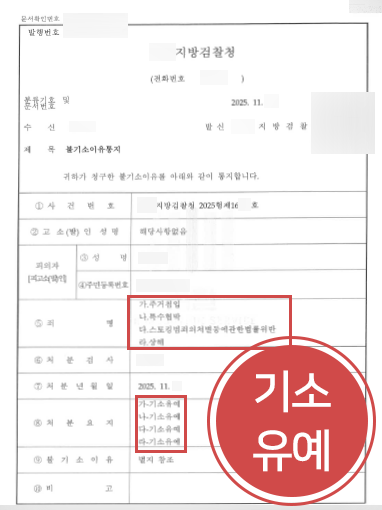
As a result of the criminal defense attorney's active presentation of the facts regarding intrusion upon habitation and all other charges, a disposition of suspension of indictment was issued on all of the client's charges.
This outcome reflected a combination of factors, including the amicable settlement reached through criminal mediation led by the criminal defense attorney and the active presentation of mitigating circumstances.
A suspension of indictment refers to a disposition in which the prosecutor, while acknowledging the suspect's alleged conduct, decides not to indict after considering factors such as the suspect's age, the motive for the offense, and whether a settlement was reached.
This was a significant outcome that allowed the client to avoid criminal punishment.
Through this intrusion upon habitation case, the client was able to fully resolve the relationship, reaffirming a resolve to make a fresh start through the upcoming military enlistment and concluding the matter.
Sentencing Levels for Intrusion upon Habitation and Related Charges
The client faced four charges: intrusion upon habitation, infliction of bodily injury, special (aggravated) intimidation, and violation of the Act on Punishment of Crime of Stalking (violation of an emergency measure).
: A person who intrudes upon another's residence, a managed structure, a vessel or aircraft, or an occupied room
∙ Infliction of Bodily Injury
: A person who inflicts bodily injury on another
∙ Special (Aggravated) Intimidation
: A person who intimidates another by displaying the force of a group or multitude or by carrying a dangerous object
∙ Violation of the Act on Punishment of Crime of Stalking (violation of an emergency measure)
: A person who fails to comply with an emergency measure
Each of these offenses carries a relatively high statutory penalty, and the actual sentencing level may vary considerably depending on whether the defendant is a first-time offender, whether a settlement is reached, and whether materials showing remorse and mitigating circumstances are submitted.
Sentencing Levels
Applicable Charge | Sentencing Level |
Infliction of Bodily Injury (Article 257 of the Criminal Act) | Imprisonment for up to 7 years, suspension of qualifications for up to 10 years, or a fine of up to 10 million won |
Intrusion upon Habitation (Article 319 of the Criminal Act) | Imprisonment for up to 3 years or a fine of up to 5 million won |
Special (Aggravated) Intimidation (Article 284 of the Criminal Act) | Imprisonment for up to 7 years or a fine of up to 10 million won |
Violation of an Emergency Measure (Article 20 of the Act on Punishment of Crime of Stalking) | Imprisonment for up to 1 year or a fine of up to 10 million won |
If You Are Considering a Legal Consultation with a Criminal Defense Attorney
As in the case above, when several charges apply at the same time and the investigation proceeds with the charges treated together, the investigative authorities may assess factors such as the risk of reoffending, the degree of violence, and the continuity of the relationship more strictly.
Daeryun LLC protects clients from the police investigation stage onward, by structuring a logical direction for statements, organizing favorable facts, and preventing unnecessary disclosure so that clients are not subjected to unfavorable interpretations.
In addition, the firm coordinates the manner of conveying an apology, whether to meet in person, and the strategy for participating in mediation, working to create conditions for leniency that both the client and the victim can accept.
If you find yourself in a similar situation and are considering a legal consultation with a criminal defense attorney, you may 🔗reserve a legal consultation and entrust your case.
Frequently Asked Questions about the Case
A. It depends on the circumstances, but where charges such as assault, intimidation, or violation of a provisional measure also apply, there is a possibility of arrest in flagrante delicto or emergency arrest. Q. If someone is reported for intrusion upon habitation, are they arrested on the spot?
A. The key is whether the relationship is ongoing and whether there was consent to residence, and if the parties are separating or in conflict, intrusion upon habitation may be established the moment the victim expresses an intention not to allow entry, even at a home where the parties had cohabited.Q. Can intrusion upon habitation be established even between partners or cohabitants?
This content is based on actual case studies of Daeryun Law LLC with some adaptations, and the copyright belongs to our firm.
Unauthorized reproduction, duplication, or distribution and other copyright infringements may result in legal action under applicable laws.