
CONTENTS
- 1. The Client Who Came to a Corporate Attorney

- - How the Client Became Involved in the Obstruction of Official Duties by Deceit Case
- 2. The Corporate Attorney's Response Strategy
- - The Corporate Attorney's Argument ① | Review of Whether the Statutory Elements Were Met
- - The Corporate Attorney's Argument ② | Denial of Intent and Scope of Responsibility
- - The Corporate Attorney's Argument ③ | Absence of Any Obstruction of Official Duties
- 3. The Outcome of the Corporate Attorney's Response: Non-Prosecution
- - Standards of Punishment for Obstruction of Official Duties by Deceit
- - When the Response of a Corporate Attorney Is Needed

1. The Client Who Came to a Corporate Attorney
The client, who needed the help of a corporate attorney, had become the subject of an investigation after questions were raised about the propriety of documents submitted during a licensing and permit procedure.
Because of the sudden criminal complaint, the client was experiencing both anxiety about the possibility of future punishment and the burden of professional responsibility at the same time.
 How the Client Became Involved in the Obstruction of Official Duties by Deceit Case
The client's company, at the stage of completing a construction project that had been underway for a long period, applied for permission to use the building before its formal completion, and in this process various internal review materials and supervision-related documents were submitted together.
The trouble began when it was pointed out that, in some of those documents, the descriptions relating to the state of construction progress did not match the actual situation at the site.
In particular, controversy arose over whether the progress rate indicated in the opinion letter and the method of affixing the seal were proper, and on that basis suspicions emerged that the application had been made on the basis of materials that differed from the facts.
The supervisory authority then took issue with the possibility that these circumstances had influenced the public official's licensing decision and proceeded with a criminal complaint, and the client was included among the subjects of the investigation on the ground that the client had been in charge of the work of organizing the relevant documents.

2. The Corporate Attorney's Response Strategy
The corporate attorney designed a strategy aimed at reframing the issues around the elements required to establish the offense and at proactively organizing the key points that the investigative authority would assess.
The Corporate Attorney's Argument ① | Review of Whether the Statutory Elements Were Met
The corporate attorney set, as the most central issue, whether the conduct in question satisfied the elements of the crime of obstruction of official duties by deceit under the Criminal Act, and proceeded with a review of the legal principles.
The attorney noted that, according to Supreme Court precedent, the mere fact that there is a problem with a document is not enough, and that what matters is whether the public official actually fell into error and made a mistaken disposition.
Supreme Court Decision 2010Do7034, September 8, 2011
Accordingly, the corporate attorney emphasized that the manner in which the seal impression was used on the supervisor's opinion letter at issue could not readily be assessed as "deceit" in itself, and stressed that the client had no motive or need to use the seal impression without authorization and that the conduct had been carried out with the consultation or consent of the persons concerned.
The Corporate Attorney's Argument ② | Denial of Intent and Scope of Responsibility
The corporate attorney developed the argument that it was difficult to hold the client responsible, emphasizing that the document had not been prepared on the judgment of a single individual but had been submitted after passing through the approval of multiple superiors.
The attorney also actively argued that intent itself was difficult to recognize, emphasizing that there was no direct evidence to suggest an intention to obtain the license fraudulently through false entries.
The Corporate Attorney's Argument ③ | Absence of Any Obstruction of Official Duties
The corporate attorney also focused on the characteristics of the system for permitting use before formal completion.
Because that system permits use on a limited basis even where certain requirements have not been fully satisfied, the attorney emphasized that the mere existence of some unfinished construction could not lead to the conclusion that the public official's judgment had been distorted.
Going further, the attorney specifically established that the responsible public official had already been aware of the situation at the site and that it was difficult to regard the submitted opinion letter as having had a decisive influence on the actual judgment, thereby emphasizing that no obstruction of official duties had occurred.


3. The Outcome of the Corporate Attorney's Response: Non-Prosecution
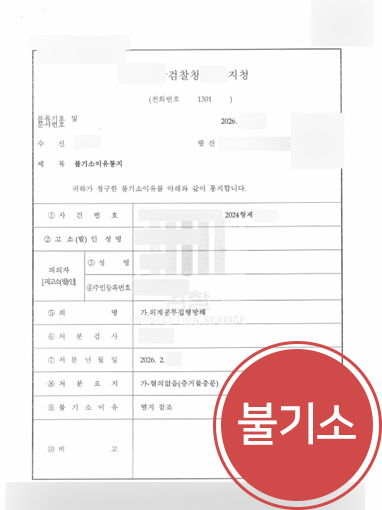
As a result of the corporate attorney's response, the prosecution issued a non-prosecution decision on the following grounds.
· It was difficult to regard the elements of the crime of obstruction of official duties by deceit as having been met
· It was difficult to regard the conduct as having substantially misled the public official's judgment or affected the outcome
The client, who began the matter amid extreme anxiety that it might lead to criminal punishment, expressed gratitude, saying that through the corporate attorney's prompt response the client was cleared of the charge and felt a great sense of relief.
Standards of Punishment for Obstruction of Official Duties by Deceit
The crime of obstruction of official duties by deceit is established only where the offender induces a public official's mistake or misunderstanding and a wrongful disposition is in fact made, and the Supreme Court has so held in its precedent.
Supreme Court Decision 2018Do18582, April 29, 2021
Under Article 137 of the Criminal Act, the crime of obstruction of official duties by deceit may be punished by imprisonment for up to five years or a fine of up to 10 million won.
When the Response of a Corporate Attorney Is Needed
The client in the above case was under considerable mental strain after becoming involved in the obstruction of official duties by deceit matter, but through the systematic assistance of a corporate attorney was able to establish a response strategy from the early stage of the case and ultimately obtain a non-prosecution decision.
The corporate attorneys of Daeryun Law Firm comprehensively review the legal issues that may arise in corporate activities and design a strategy suited to the situation the client faces.
They also prepare strategic arguments suited to the client's situation in the course of resolving the dispute and, afterward, review internal procedures and business practices so that similar problems do not recur, providing the necessary legal advice.
If, like the client, you have become involved in an obstruction of official duties by deceit matter, we ask that you request the assistance of a 🔗corporate attorney at an early stage.
This content is based on actual case studies of Daeryun Law LLC with some adaptations, and the copyright belongs to our firm.
Unauthorized reproduction, duplication, or distribution and other copyright infringements may result in legal action under applicable laws.