
CONTENTS
- 1. Drunk Driving by a Public Official | Case Details

- 2. Drunk Driving by a Public Official | Explanation of the Concept
- - Requirements for the Establishment of Drunk Driving
- 3. Drunk Driving by a Public Official | Disciplinary Criteria for Public Officials
- - Level of Punishment for Drunk Driving
- 4. Drunk Driving by a Public Official | Key Points of Legal Response
- - Assistance of the Attorney Specializing in Drunk Driving Cases
- 5. Drunk Driving by a Public Official | Case Result

1. Drunk Driving by a Public Official | Case Details
Let us look at the account of a client who sought our firm's assistance, stating that he was at risk of criminal punishment and disciplinary action for drunk driving as a public official.
The client is an education public official working at a middle school in a provincial area, who had worked diligently and earned the trust of the school and the local community.
On the day of the incident, the client drank a small amount of alcohol at an evening company gathering, slept in the school's night-duty room, and then drove his vehicle to return home in the early morning.
The client judged that he had rested sufficiently, but during a police check conducted on the way home, a blood alcohol concentration of 0.045% was measured, and he was caught for drunk driving.
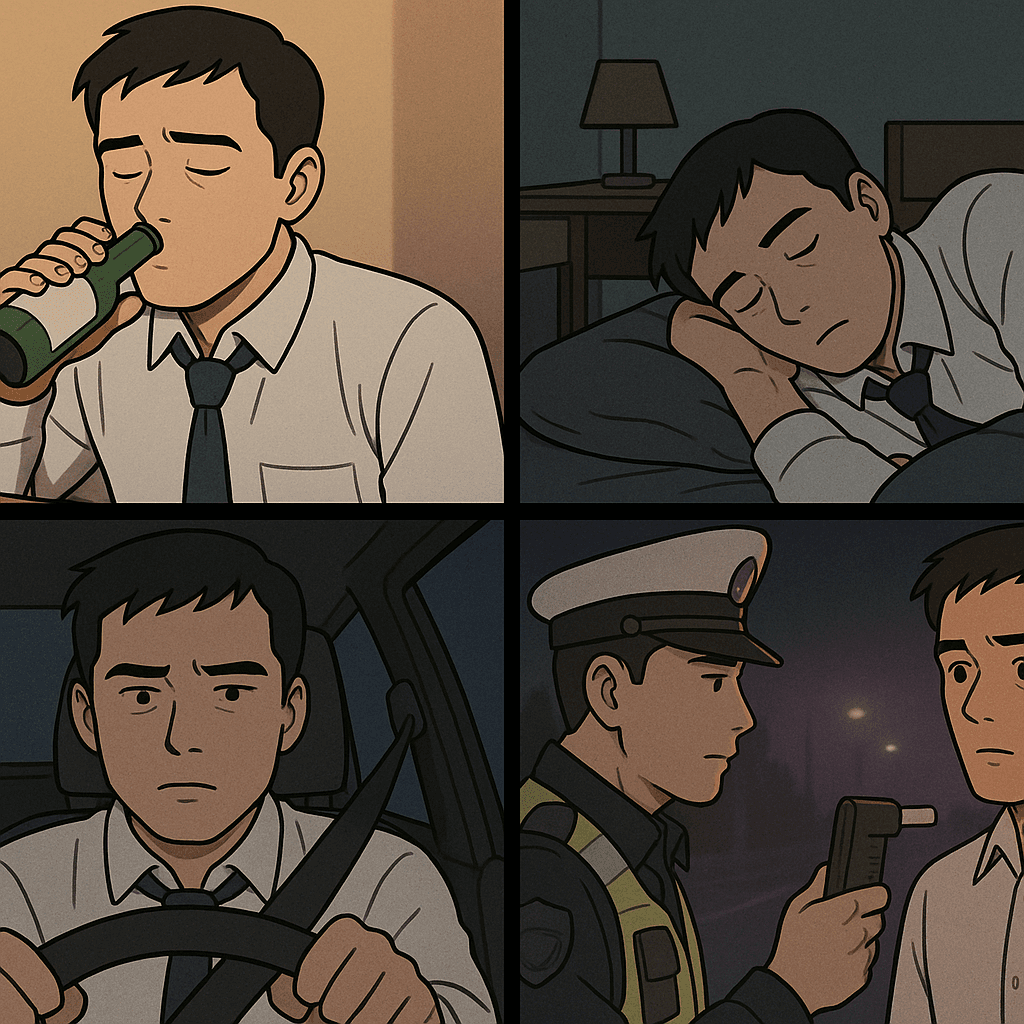
Although the client was a first-time offender with no prior offenses of the same kind, given the nature of his occupation as an education public official, there was a situation in which disciplinary action such as automatic dismissal could be imposed if a sentence of imprisonment without labor or heavier were pronounced.
Accordingly, the client decided to receive legal assistance from an attorney specializing in drunk driving cases from the early stage of the case.
2. Drunk Driving by a Public Official | Explanation of the Concept
Drunk driving by a public official refers to the criminal act of a public official driving a vehicle while intoxicated.
If a public official is caught driving while intoxicated, in addition to criminal punishment, various disciplinary actions such as suspension, salary reduction, demotion, dismissal, or removal may be imposed under the State Public Officials Act and various disciplinary decrees.
In particular, the blood alcohol concentration level, whether the conduct was repeated, and whether an accident accompanied it serve as the key criteria for determining the level of disciplinary action.
 Requirements for the Establishment of Drunk Driving
Article 44 of the Road Traffic Act defines driving with a blood alcohol concentration of 0.03% or higher as drunk driving.
For drunk driving to be established, the driver must be in an intoxicated state, an act of driving must have actually taken place, and the blood alcohol concentration must be 0.03% or higher must be satisfied, and a separate penalty provision applies even if a breathalyzer test is refused.
3. Drunk Driving by a Public Official | Disciplinary Criteria for Public Officials
Drunk driving by a public official results in disciplinary action according to the following table.
| Category | Level of Disciplinary Action |
| First drunk driving offense | Below 0.08% : suspension to salary reduction 0.08–0.2% : demotion to suspension 0.2% or higher : dismissal to suspension Refusal of testing : dismissal to suspension |
| Second drunk driving offense | removal to demotion |
| Three or more drunk driving offenses | removal to dismissal |
| Driving while the license is suspended or revoked | demotion to suspension |
| Drunk driving while the license is suspended or revoked | removal to demotion |
| Traffic accident due to drinking | Bodily injury or property damage : dismissal to suspension Death : removal to dismissal Fleeing after an accident (property) : dismissal to suspension Fleeing after an accident (personal) : removal to dismissal |
| Public officials in charge of driving duties | License revocation : removal to dismissal License suspension : dismissal to suspension Otherwise : blood alcohol concentration criteria apply |
Level of Punishment for Drunk Driving
Under the Road Traffic Act, the 🔗punishment for drunk driving by blood alcohol concentration is as follows.
The levels below are based on first-time offenders, and in the case of repeat offenders, a higher level of punishment is imposed.
| Blood Alcohol Concentration | Sentence for Drunk Driving |
| 0.03% or higher and below 0.08% | Imprisonment for up to 1 year or a fine of up to 5 million won |
| 0.08% or higher and below 0.2% | Imprisonment for 1 to 2 years or a fine of 5 million to 10 million won |
| 0.2% or higher | Imprisonment for 2 to 5 years or a fine of 10 million to 20 million won |
| When a breathalyzer test is refused | Imprisonment for 1 to 5 years or a fine of 5 million to 20 million won |
The client's level was 0.045%, falling within the lowest range, but given his status as a public official, even a fine could lead to a critical disadvantage.


4. Drunk Driving by a Public Official | Key Points of Legal Response
In a situation like the client's, using the following response points may create a possibility of obtaining leniency.
· Proving first-time offense and low blood alcohol concentration: Emphasizing that the 0.045% level is low and that there is no prior record
· Explaining the circumstances of residual-alcohol driving: Objectively proving that the driving occurred after sufficient rest rather than immediately after drinking
· Efforts to prevent reoffending: Completing drunk driving prevention education and submitting a plan for voluntary alcohol counseling and treatment
· Highlighting the social and economic harm: Stating in detail, as an education public official, the risk of suspension or salary reduction in the event of a fine or heavier penalty and the effect on the family's livelihood
· Emphasizing the absence of an accident: Submitting materials showing that there was no personal or property damage at all
Assistance of the Attorney Specializing in Drunk Driving Cases
Our firm's attorney specializing in drunk driving cases heard the circumstances of the case from the client and quickly collected the necessary evidence.
· Preparing materials to prove first-time offense and low level: Organizing and submitting the absence of any past criminal record, driving history, amount of alcohol consumed, and rest time
· Explaining residual-alcohol driving: Securing an expert opinion on the time of the company gathering, the times of sleeping and waking, and the rate of alcohol metabolism
· Emphasizing family and workplace circumstances: Describing in detail in the written argument that he supports three children and that, as an education public official, the social impact of suspension or dismissal would be significant, and submitting a written apology and a family petition
· Plan to prevent reoffending: Submitting to the court the client's certificate of completion of drunk driving prevention education and a confirmation of counseling treatment
The attorney specializing in drunk driving cases attended every stage of the preparation of the statement records to prevent unfavorable statements, and requested leniency by submitting, without omission, materials that the court could consider in sentencing.
5. Drunk Driving by a Public Official | Case Result

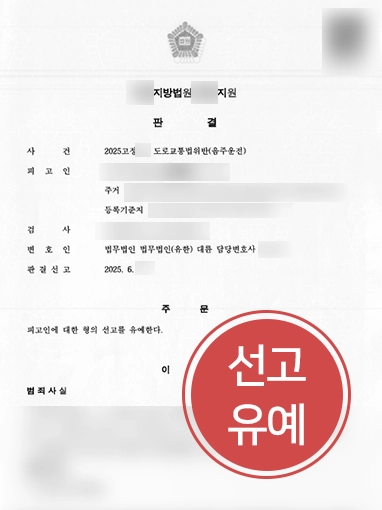
The court, having heard the argument of the attorney specializing in drunk driving cases, rendered a judgment of suspension of sentencing for the client.
Suspension of sentencing is a system that acknowledges the offense while suspending the pronouncement of the sentence, allowing one to be relieved of the execution of the sentence if no crime is committed for a certain period.
When a public official is caught for drunk driving, serious disciplinary action follows alongside criminal punishment.
Even if the blood alcohol concentration level is low, a fine or heavier penalty can lead to salary reduction or suspension, causing significant occupational and social damage, so it is essential to receive the assistance of an attorney specializing in drunk driving cases at the early stage.
We emphasize that accurate identification of the facts, securing objective materials, and preparing measures to prevent reoffending are key strategies that can lead to a suspension of sentencing or mitigation.
If you need assistance in a situation similar to that of the client in this case, please consider arranging a 🔗legal consultation appointment with Daeryun LLC.
This content is based on actual case studies of Daeryun Law LLC with some adaptations, and the copyright belongs to our firm.
Unauthorized reproduction, duplication, or distribution and other copyright infringements may result in legal action under applicable laws.