
CONTENTS
- 1. The Client's Situation

- - The Client Who Received a Business Suspension Order
- 2. Examining the Statutes Related to Administrative Appeals
- - Statutes on Administrative Appeals and Administrative Litigation
- - Differences Between Administrative Appeals and Administrative Litigation
- 3. Assistance Provided in the Administrative Appeal Filing
- - Assistance ① No Grounds for the Disposition Exist
- - Assistance ② Deviation From and Abuse of Discretionary Power
- - Assistance ③ Violation of the Principle of Proportionality
- 4. Result of the Administrative Appeal Assistance: Revocation of the Disposition
- - If You Need Assistance With an Administrative Appeal Filing

1. The Client's Situation

The client, who came to file an administrative appeal, consulted with an attorney, seeking to resolve the matter by filing an administrative appeal together with a law firm that has experience handling many administrative cases.
 The Client Who Received a Business Suspension Order
The account of the client to request help is as follows.
The client was the representative director of Company A and was performing detailed safety inspection services for buildings.
Then one day, the client received a business suspension order of 1.5 months from the administrative agency.
The reason was that a person who was not an officer or employee of Company A had performed detailed safety diagnosis and seismic performance evaluation services.
The client later learned that an error had occurred in the course of entering the status of participating engineers into the integrated facility information system of the Korea Authority of Land and Infrastructure Safety.
Although the client had not had any engineer who was not a member of staff perform the work, he received a business suspension order, so he resolved to file a 🔗administrative appeal.
He visited Daeryun to request help from an attorney with a deep understanding of administrative cases.
2. Examining the Statutes Related to Administrative Appeals
Both an administrative appeal and administrative litigation refer to dispute-resolution procedures that ensure the legality of administration and provide relief for the rights and interests of the public.
Let us examine the statutes related to administrative appeals and the differences between an administrative appeal and administrative litigation.
※ Dispute-resolution procedure: a procedure filed to obtain relief for one's rights or interests by contesting an administrative disposition
Statutes on Administrative Appeals and Administrative Litigation
An administrative appeal refers to a system that allows a member of the public whose rights or interests have been infringed by an unlawful or unjust disposition of an administrative agency to obtain relief quickly and simply through legal means.
① A disposition or omission by an administrative agency may be contested through an administrative appeal under this Act, except where another statute contains special provisions.
Administrative litigation refers to a lawsuit filed to revoke or modify a disposition where the rights of a member of the public have been infringed by an unlawful disposition of an administrative agency.
A revocation lawsuit may be filed by a person who has a legal interest in seeking revocation of a disposition. The same applies to a person who, even after the effect of a disposition has ceased due to the lapse of a period, the execution of the disposition, or other causes, has a legal interest restored by the revocation of that disposition.
Differences Between Administrative Appeals and Administrative Litigation
Although administrative appeals and administrative litigation are both administrative relief systems and may appear similar, they have the following differences.
| Administrative Appeal | Administrative Litigation |
Applicable Statute | Administrative Appeals Act | Administrative Litigation Act |
Adjudicating Body | Administrative agency | Court |
Subject of Review | Unlawful acts, unjust acts, omissions | Unlawful acts, omissions |
Filing Period | Within 90 days from the day the disposition was known Within 180 days from the day the disposition was made | Within 90 days from the day the disposition was known Within 1 year from the day the disposition was made |
Hearing Procedure | Oral hearing, written hearing, principle of non-disclosure | Oral hearing, principle of open proceedings |
Means of Securing Compliance | Power of direct disposition | Indirect compulsion |
An administrative appeal resolves matters through a relatively quick and simple procedure, whereas administrative litigation is a procedure filed with a court to obtain a legal judgment, and it is more formal and may take more time.


3. Assistance Provided in the Administrative Appeal Filing
The administrative attorney systematically carried out procedures such as analyzing the relevant statutes, preparing the petition for administrative appeal, and assembling supporting evidence, established a strategy, and made the following arguments.
Assistance ① No Grounds for the Disposition Exist
The client made an error in the course of entering the service results into the integrated facility information system of the Korea Authority of Land and Infrastructure Safety, inputting the data incorrectly.
However, this was merely a simple act of negligence, and the client had not had any person who was not an officer or employee of the company perform work such as safety inspections.
Accordingly, the attorney emphasized that no grounds for the disposition existed in this case.
Assistance ② Deviation From and Abuse of Discretionary Power
The data in this case amounted to nothing more than a clerical error caused by the client's negligence.
As a result, the client gained no improper benefit, and the mistake did not give rise to any serious defect in the safety inspection or any risk of harming public safety.
Accordingly, the attorney emphasized that this disposition was a decision that deviated from and abused discretionary power and was far too harsh on the client.
Assistance ③ Violation of the Principle of Proportionality
For the client's violation, sufficient improvement could be achieved through measures lighter than a business suspension order, such as a corrective order.
While the degree of harm to the public interest was nonexistent or minor, the disadvantage the client would suffer was excessively heavy.
The attorney emphasized that this was an unjust decision that violated the principle of proportionality.
4. Result of the Administrative Appeal Assistance: Revocation of the Disposition
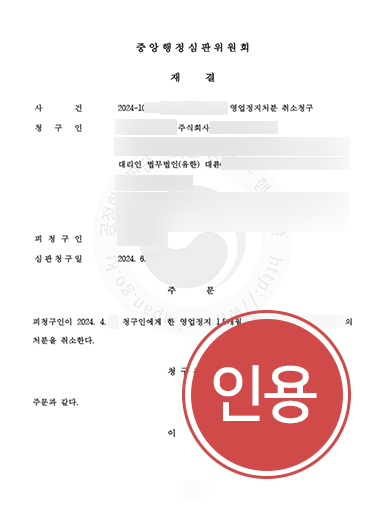
The Central Administrative Appeals Commission accepted the administrative attorney's arguments and issued a decision revoking the disposition of 1.5 months of business suspension.
🔗Relief From Business Suspension, having succeeded in this, the client expressed deep thanks to the administrative attorney.
If You Need Assistance With an Administrative Appeal Filing
Filing an administrative appeal is a procedure for requesting legal relief against a disposition of an administrative agency, and it goes through a special procedure that differs from civil litigation.
To understand the complex statutes related to a case and respond systematically, it is recommended to seek specific advice from an attorney.
At Daeryun, attorneys who have handled many administrative appeals and administrative litigation matters provide tailored solutions and protect the rights and interests of clients.
If you wish to proceed with an administrative appeal and 🔗administrative litigation together with an attorney, we recommend finding a solution through a 🔗legal consultation booking.
This content is based on actual case studies of Daeryun Law LLC with some adaptations, and the copyright belongs to our firm.
Unauthorized reproduction, duplication, or distribution and other copyright infringements may result in legal action under applicable laws.